Follower or natural leader? Your personality type may open more doors than your resume

Sharon See

CAN a personality test offer clues on how an employee may behave or fit into a particular workplace? Four Seasons Hotel Singapore believes so.
It uses the Predictive Index Behavioural Assessment “that measures a prospective candidate’s natural behavioural drives and needs”, the hotel’s regional director of people and culture Jonathan Joo tells The Business Times (BT).
“In a nutshell, we use the results to predict how individuals will behave in given situations, so we can make the great hires with confidence and build a winning team,” he says.
The behavioural assessment tool is used primarily for management roles at the initial interview stage. First, prospective candidates choose adjectives that describe how they are expected to behave at work; then, they choose adjectives to describe themselves.
Each adjective is associated with one of four key factors that determine workplace behaviour: dominance, extraversion, patience, and formality. This is used to draw up a reference profile that “gives a snapshot of the way he or she would naturally think and work”.
Joo’s team then analyses the reference profile against the role requirements and team dynamics.
“For example, if we are hiring for a guest-facing role such as guest relations manager, a reference profile that would indicate a great fit for the role would be having high extraversion, which is the drive for social interaction with other people,” he says.
“If we are hiring for an accountant, a reference profile reflecting high precision would similarly indicate a good fit with requirements of the role.”
But Joo emphasises that the assessment is “just one of many data points” used to make an “informed hiring decision”, adding that the hotel is “committed to advancing diversity and fostering a culture of inclusion and belonging worldwide”.
Meanwhile, other companies have tried to push the concept further.
Looking beyond grades
In 2018, Singapore hedge fund Dymon Asia took a chance on using psychometric tests to screen for candidates, as part of a pilot by social movement Tangent.
This was motivated by the idea that grades do not necessarily mean talent. It was a far cry from the assumption that hedge funds typically hire only graduates in areas such as finance or economics.
The hypothesis behind Tangent is that psychometric tests are deployed “at the wrong time”, often at the interview stage, says Martin Tan, chief executive of philanthropic organisation The Majurity Trust, which initiated Tangent.
“By then, you lose a large pool of people that otherwise would be very suitable because we use resumes as the way to filter people, and inherent within resumes are biases,” Tan tells BT. “So whether you have a degree, non-degree, automatically, nobody really looks further than that.”
Through the pilot, Dymon attracted about 800 applicants and ultimately made eight offers to an arguably unexpected pool: the oldest candidate was 48, two or three did not have college degrees, and one had a PhD in chemistry. Half had no experience in finance.
Just what was the company looking for?
Tan describes how a company benchmark was created by putting, for example, both high-performing and bottom-performing employees through the same test, to identify their commonalities.
One desirable trait of high-performing employees was “bouncibility” – how one bounces back from setbacks, Tan says, adding that those with this trait are “not too bothered about setbacks”. Another was having a low score in “social desirability”.
“What we found is that those who perform well in investments or data analytics tend to score lower in social desirability, meaning that their goal in life is not to be the same as everybody or to be well-liked.”
They “have their own minds”, says Tan, adding that having a “contrarian view” can be invaluable in the field of data.

After a one-year apprenticeship, seven of the candidates took up various roles in the company. Today, five years on, three are still at Dymon, while some have moved elsewhere in the finance industry.
Tan says other companies tried to poach these employees, perhaps in a sign of how the pilot “worked really well”.
Tangent’s approach of looking beyond grades coincides with a key policy shift in the Forward Singapore movement: that employers should “commit to looking beyond qualifications” and “recognise and reward diverse skills and competencies”.
This topic was already hotly discussed when the Tangent pilot began and nudged a further “rethink” of hiring, says Tan.
But the pilot, which aimed to be disruptive, was itself disrupted by the Covid-19 pandemic in 2020. At that point, companies’ priorities switched from hiring to preserving jobs, says Tan.
Cost was another key factor that led to Tangent being scaled back. For Dymon Asia, the pilot cost about S$30,000.
“Psychometric assessments are not cheap, so for companies to deploy at the application stage isn’t the easiest, and I recognise that,” he says, explaining why some companies were hesitant to pay to test candidates that they may not even hire.
“(The cost) is on a per-licence basis, so I couldn’t get the business model to work,” Tan concedes. “The business model can only work if it’s on a per-company unlimited licence, but very few assessment companies are prepared to do that.”
But he argues that companies could see savings in the long run if psychometric tests help ensure job fit and improve retention.
By the time the Tangent initiative ended, it had worked with 14 different industries, customising the psychometric assessment for each one. For larger companies, one difficulty was having to align the pilot with global human resources (HR) practices.
The personality profiling industry is reportedly worth US$2 billion, with such tests said to be used by 80 per cent of Fortune 500 companies.
But test providers themselves often note that their tests should not be a key component of hiring decisions.
Ethics and effectiveness
Most psychometric test designers do not want companies to make decisions based solely on a person’s profile, even if the aim is to hire more of the same type of high performers, says James Mclauchlan, director at Jambar Team Building.
Recruiting a particular personality type could be a form of discrimination, and could create an echo chamber that reduces the organisation’s diversity, adds Dazzling Chong, a certified Myers-Briggs Type Indicator (MBTI) trainer and purpose coach.

Practically speaking, there are also limitations in interpreting a candidate’s profile.
A personality assessment may reveal how someone is inclined to behave, but may not reveal the degree to which they can be flexible and perform “non-preferred personality functions”, says Justin Peter, a consultant on personal and organisational development at Personality Matters.
Mclauchlan, who does profiling at Jambar, says: “If you have a high EQ (emotional quotient) in that file or a low EQ, does it mean you show all of the best virtues of those traits, or do you show the worst virtues of those traits?
“If you’re a direct person, does that mean that you’re good at helping a team take action, or does that mean that you are basically just telling everybody what to do all of the time?”
Still, Chong says that does not stop HR managers from “reverse engineering” some interview questions to uncover certain personality aspects, to avoid employing “someone who really doesn’t fit with the fabric of the organisational culture”.
Alex Yew, managing director for people advisory in Asia-Pacific at chief executive officer advisory firm Teneo, points out that personality tests can help as hiring managers ultimately “want the candidate to be successful in the job”. Certain jobs do call for certain traits: roles in customer service, for example, may require more patience.
“If a candidate doesn’t match that, they’re not going to be long-lived in that career, so you want to make sure that there is a match, and it’s not that you want to discriminate,” he says. “It’s just that some people are just not built for certain jobs… and it actually helps the person get the right job.”

Majurity’s Tan believes personality tools could even become useful to companies on the brink of a retrenchment exercise.
Say that a company needs to lay off 10 per cent of its workforce, but has vacancies for other positions. Psychometric tests could inform the company of possible fits for soon-to-be retrenched employees in other departments that need people.
“Do you know how much money we’d save? We’ll save on hiring, we save institutional memory, we build loyalty, we save severance costs. It’s actually very profitable if HR departments think that way,” he says.
Using a common language
Psychologists and other experts often deem personality profiling to be pseudoscience at best, but coaches such as Mclauchlan believe that these tools offer a “user-friendly” experience.
At the very least, personality profiling tools are useful in helping people understand themselves – and perhaps others who may be especially different.
The tools provide a common framework of understanding, allowing people to talk about their similarities and differences in a shared language, while providing insight into others’ behaviours.

Chong, the MBTI trainer, recalls coaching an international marketing team of people from across the world. For the half-day workshop, the company flew in employees from China, Japan, Germany, India, the US and various parts of Europe.
“The good takeaway for them was seeing they had more in common than different,” she says, even if their cultural differences were a “pain point”.
Where personality profiling shines, industry watchers agree, is in building effective teams and facilitating communication between friends and coworkers.
“The idea behind most of the models is that when I’m interacting with somebody of a different trait to me, then I can flex into their style a little bit… I’m going to make a little bit more of an effort to match their energy,” says Jambar’s Mclauchlan.
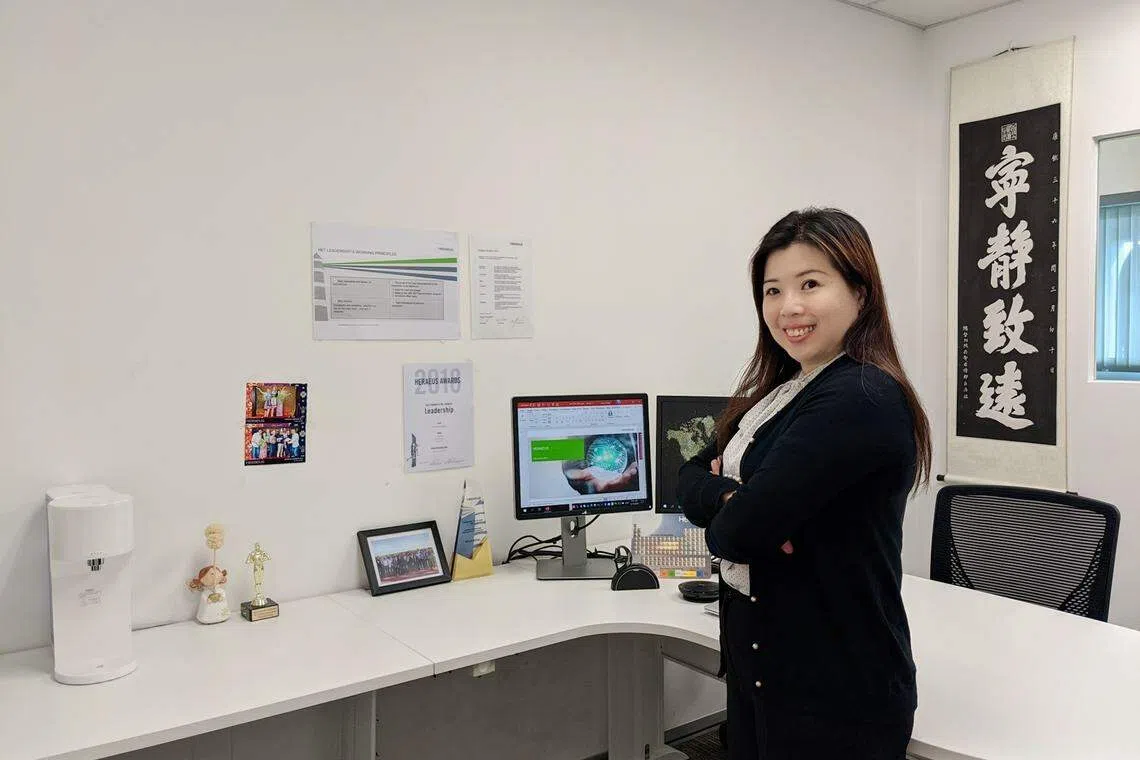
Chan Li-San, global head of the semiconductor materials business line at German semiconductor firm Heraeus Electronics, has first-hand experience of this. She recounts her experience with a subordinate who seemed to use her as a “sounding board” – perhaps a little too much.
“She (would) always come to me and ask me stuff and tell me about her proposal, and I said, ‘Why don’t you just put it down in a PowerPoint, and I’ll read it’,” says Chan, who admits to being “irritated” at first.
After attending an MBTI workshop with Chong, she realised her subordinate was an ENFP, an extrovert with extraverted intuition. Such types are said to enjoy exploring different ideas or activities. Chan herself is an INTJ, an introverted intuitive thinker.
“Dazzling explained that most extroverts like to talk to people with an INTJ profile because INTJs tend to be more strategic in thinking, so they believe that we can give them good advice,” Chan recalls with a laugh.
“I took it as: I should not take that she’s such a nuisance, but (that) she actually sees me as an expert,” she says, adding that communication between them improved after that.
“When she shared her ideas with me, I also asked her questions, and then she thought over them as well, and actually she herself has all the answers already,” she adds. “It’s just for me to be her sounding board.”
But one of her staff said he felt “exposed” after others learnt what his type was at the workshop.
“He thought, ‘Oh, now people know how I’m thinking or what I’m thinking’, and I said that’s not true,” she says. “We are not mind readers.”
His concerns were understandable, she says, as he may have been worried that others would try to “manipulate” him based on what they knew about his type.
But that is also the crux, she points out: “Because you want to communicate better, you want to convince each other better, right? At the same time, he can pick up the skills to convince me better.”
It’s fair game, she concludes with a chuckle.
Dr Peter, the consultant from Personality Matters, says his clients have found the MBTI to be “very insightful”. At the same time, he encourages them “not to pigeonhole themselves and others into their reported personality types”.
“Such attitudes may also result in individuals using their personality as an excuse to avoid responsibilities that are not part of their personality description,” he says. “On the other hand, character development and professional growth can be achieved when you flex or pivot from your preferred personality functions to non-preferred ones.”
For example, “natural” introverts can learn to exercise extraversion when the situation calls for it, such as when giving a presentation to a group of people.
For Chan, who manages nine subordinates at Heraeus, understanding her team’s MBTI spurs effective communication and reduces friction.
She quips that she is “emotionless” – as INTJs often describe themselves – and takes comfort in knowing that team members typed as “feelers” can remind her to take care of people’s emotions.