Fuelled by Asia: Carola Richter, BASF
Prior to taking up her third HK posting as BASF regional president, Carola Richter, a physicist by training, fulfilled her dream of performing in an orchestra.
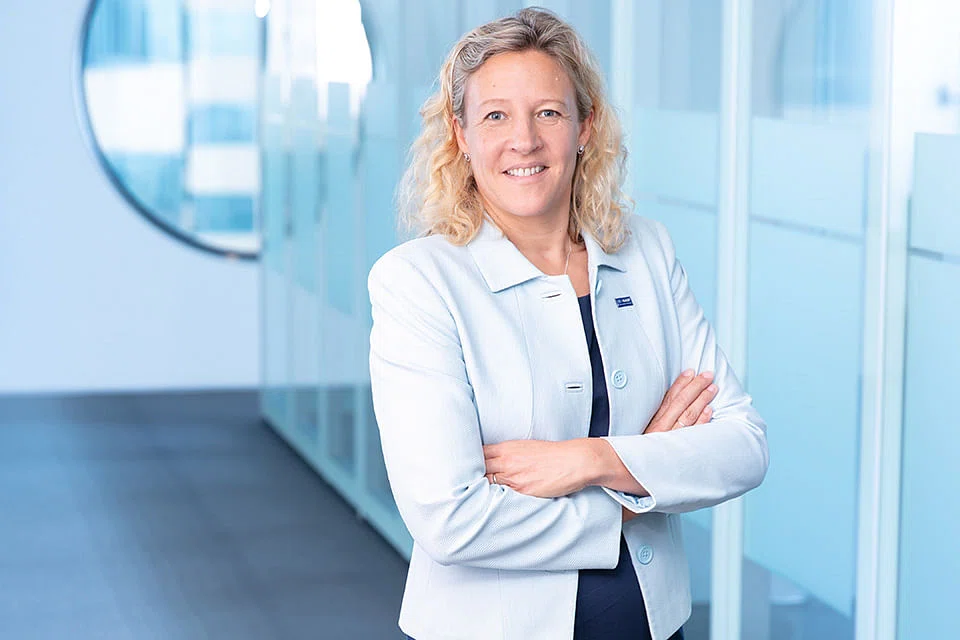
CAROLA Richter may not have been born or educated in Asia, but the BASF executive has been based in the region so often in her career that she sees it as her "second home".
In her close to 2 decades' stint at the German chemical giant, she has taken on roles out of Hong Kong thrice, including her current appointment in mid-2019, as president for BASF in South and East Asia, Asean, as well as Australia and New Zealand.
"I always wonder why I return to Ludwigshafen, because I love it so much, being in Asia-Pacific," she says with a laugh, in a web interview with The Business Timesfrom her office in Hong Kong. Ludwigshafen, a city on the Rhine in south-western Germany, is home to BASF and other companies.
Dr Richter's love for being in Asia stems from the dynamism and opportunities to be found here, she says.
"I'd love to stay in Asia-Pacific as long as possible," she says. "There's so much happening, it's so dynamic. I like the spirit; for me, it's just a perfect place."
Her current role has her in charge of BASF's managing directors in countries in Asia-Pacific outside of greater China. This includes many regions with diverse cultures, but she observes that, working with colleagues around the region, a common trait is the "can-do attitude" and a positive spirit, moving quickly towards targets.
"I very much enjoy the openness to try out new things, which I'm sometimes missing in Europe a little bit," she says, noting that there is a lot more experience in Europe in various areas. People in Asia, however, are more willing to try out different opportunities that are seen as novel.
Dr Richter, who holds a PhD in physics and mathematics, started her BASF career as a management consultant at its headquarters in Germany in 2003 before moving to Hong Kong from 2005 to 2008 as a senior manager for coatings and performance chemicals.
Her second stint in the city came between 2011 and 2015, as senior vice-president for global marketing, technology and supply chain, dispersions and pigments.
"Over time I had the opportunity to be in very different positions, also covering really local countries," she says. "So I think that was one of the reasons why I got the opportunity now, in this president role, to come back to Asia again."
For a regional business leader, the pandemic has presented some challenges, making it more difficult to visit the countries under her purview to meet local talent.
"For me it always makes a big difference when you can meet them in person rather than just do a telephone interview," she says. "Actually, I should be travelling in Asia-Pacific and not back home to our headquarters - so that is something I'm missing the most."
Asia-Pacific is by far the fastest-growing region for BASF, Dr Richter notes, and also an important market for the industry.
"It's very obvious that for the chemical industry, the Asia-Pacific region will play - and already is playing - the dominant role in the world," she says.
China may be the first Asian market that comes to mind for most, but Asean and India too are growing very strongly, she points out.
And BASF, which is the world's largest chemical company by sales, has new investments coming up in Asia, she discloses. The fresh inflows would benefit the region, she says, as sustainability aspects can be integrated directly into new plants.
Sustainability boost
The focus on sustainability comes amid renewed emphasis on its importance in business conversations worldwide.
"For BASF, it was always a topic on our mind, and really close to the core of what we do," Dr Richter says.
She observes that past conversations on sustainability had been more focused on issues such as pollution in waterways or the air, but these days, there is more commitment and harder targets.
One example that has often been cited is the carbon footprint of companies, she notes. BASF has committed to be carbon-neutral by 2050, with a 25 per cent reduction by 2030.
There is also increased awareness in Asia-Pacific. "In the earlier years, especially in Asia-Pacific, it was a topic that was maybe covered at the end of the conversations with customers," Dr Richter says.
"Today, you find that every company is approaching us on one or the other sustainability issues, and that most conversations start with that, which I find a very dynamic trend in Asia-Pacific."
BASF is focused on being an industry thought and action leader to drive sustainable solutions. "We see it as something positive. For us, we see it as a driver for growth," says Dr Richter.
The 156-year-old chemical giant operates across a large segment of industries ranging from agriculture, to coatings and materials.
This also provides opportunities for the group to further improve or expand its large range of products that can help support companies on their sustainability journeys.
For instance, a more durable product could result in less raw materials being used, says Dr Richter, citing as an example a BASF product used in shoe soles.
Fans of adidas would be familiar with its popular Boost line of shoes, which boasts a sole that has high energy return while retaining durability. "It's hard to imagine adidas without Boost", the sportswear company's pitch goes, on its revolutionary midsole "made from thousands of expanded particles that work together to deliver an uptick of energy return in every stride". The foam was developed by BASF's performance materials business unit under the brand name Infinergy.
Apart from innovation in new products, BASF also has its sights on the circular economy, given the need for alternatives in the chemical industry to replace raw materials such as fossil fuels. Waste - such as plastic waste or biomass - can feed into the value chain, Dr Richter notes.
One BASF initiative is in the area of chemical recycling of plastics - what it calls ChemCycling. The project takes plastic waste and transforms it into pyrolysis oil, which can be used for downstream production.
Dr Richter says: "This chemical recycling has a lot of advantages. You can really target the more difficult waste, and you can offer your customers a product which they cannot differentiate really - in terms of performance, in terms of specifications - from the products they already know from the past (that are) based on fossil fuels."
And in this relatively newer field of chemical recycling, it is likely that companies would have collaborations on such projects, she says.
BASF works with regional partners on ChemCycling, including Quantafuel in Europe, and Mitsui Chemicals in Japan.
As technologies mature, costs can decline over time, Dr Richter says, notingthat the cost of pyrolysis oil is also getting more competitive.
"It is important that we have a framework, supported by the governments, that will enable this transition to new technologies, at least in an interim period," she says, adding that this can help make transitions happen until prices get more competitive compared to, for instance, fossil fuels.
Double bass
As a physicist by training and a senior executive in a chemical company, one might naturally expect Dr Richter to be fairly left-brained. She is - but the board room and corporate arena aren't her only performance theatres.
Outside of science and business, she also happens to be a skilled musician. She plays the double bass in an orchestra - something she picked up during a sabbatical prior to her current role.
"I had one dream - I always wanted to learn a new instrument," she says. As a child, she played the violin, but never had time to practise her favourite instrument, the double bass.
During the 6-month sabbatical, she took the time to practise for hours each day, focused on reaching her goal of playing in an orchestra.
Eventually, she got to perform a Beethoven classical symphony on stage with an orchestra. "It was a very, very difficult piece I had to practise; I was very nervous, but I managed. I played with 5, 6 other double bass players."
Moving to Hong Kong, she has also kept up with her musical pursuits.
"I think that the older you get, the more you realise that in order to really stay strong in your job (and) enjoy what you do, it's important that you also have another part in life that you do," she says.
"You do something else where you are not in your role like the regional president, but I'm just simply a member of an orchestra somewhere, which I think is just a great additional thing you do in life. It helps me out."
Career progression
Apart from striking a balance with external activities, Dr Richter believes that a firm grounding in science can be helpful to building a career.
"I always recommend to people: if you study science, you have a lot of opportunities after you graduate," she says, adding that an education in science gives individuals the ability to ask questions to understand the root causes and apply logic to things.
For those keen to rise to top positions in multinational companies such as BASF, she also believes that they should be open to opportunities as they come along.
"Don't have one fixed career path in your mind, but be open for the positions, be open for the opportunities," she says.
"Nobody really can plan everything step by step for the long-term future. But just take the chances as they come, and there will be a lot of opportunities."
And she speaks from personal experience.
Whenever she has been asked if she's ready to take on new positions, Dr Richter says: "I always said 'Yes, let me, let me try it out, let me do my best'."
Taking on new roles may be a challenge for some, particularly if they have families, she acknowledges.
"That is also a topic I'm also often discussing with talents," she says. "So what we are trying to do is, first of all, it should always be a family move, you should ideally not come alone. We try to take care of the partner."
For herself, she says that she has been lucky, as her husband is a teacher and has been able to find work when she is deployed abroad.
People should find roles they are truly passionate about so as to be able to perform their best, she adds. Her career began with a stint at McKinsey & Company, before her move to BASF.
"What I like very much about BASF career development is that you are being put in many very different roles, and this also happened to myself," she says. "All these positions helped me to develop because I saw so many elements of the business and so many parts of the business."
This keeps things interesting as well for employees, Dr Richter says, adding that something "unique" about the company is that employees tend to stay very long.
"If you look at our headquarters in Germany it's not only that people stay long. A lot of people tell you that their father or mother has worked for BASF, or even grandparents - so it's even several generations working at the same company."
Says Dr Richter:"It's never boring. You always have a new opportunity, a new role to grow in."
*The Raffles Conversation will be on break from November.
CAROLA RICHTER
President, South and East Asia, Asean, Australia and New Zealand BASF
1973: Born in Germany
2000: PhD in Physics and Mathematics, University of Heidelberg
CAREER
2000-2003 Strategy Consultant, McKinsey & Co
2003: Joined BASF AG as management consultant in Ludwigshafen, Germany
2005: Senior Manager Asia Pacific, Coatings, Performance Chemicals, BASF East Asia Regional Headquarters Ltd, Hong Kong
2008: Director, Business Management Acrylics & Superabsorbents Europe, BASF SE, Ludwigshafen, Germany
2009: Vice President, Global Business Management Hygiene, BASF SE, Ludwigshafen, Germany
2011: Senior Vice President, Global Marketing, Technology & Supply Chain, Dispersions & Pigments, BASF East Asia Regional HQ Ltd, Hong Kong
2015: Senior Vice President, Economic Evaluations, BASF SE, Ludwigshafen, Germany
2019: President, South & East Asia, ASEAN & ANZ, BASF East Asia Regional Headquarters Ltd, Hong Kong