Heavy vehicles’ green journey stuck in neutral gear, but the push must continue

SINGAPORE’S move towards electric passenger cars and light goods vehicles (LGVs) has shifted into a higher gear, but the transition for heavy goods vehicles (HGVs) seems stuck in neutral.
This is despite the benefits highlighted by industry players: lowered emissions and air pollution – helping corporates tick the big green sustainability box – at a similar lifetime cost to diesel vehicles.
Adoption has been hampered by higher initial costs and a lack of incentives; an immature market; and logistical barriers. Going electric may also be untenable for long-haul use.
However, with more electric HGVs (eHGVs) arriving in Singapore this year, this is a chance to get serious about cleaning up the big movers – and big polluters – of road transport.
Light took flight but heavy is grounded
While Singapore’s adoption of electric goods vehicles has increased, this is skewed greatly towards LGVs. These are commercial vehicles with a maximum laden weight (MLW) of up to 3,500 kg, including vans and smaller lorries.
HGVs have a MLW of 3,501 kg to 16,000 kg, and include larger multi-axle lorries, tipper trucks and garbage trucks. Those above 16,000 kg are very heavy goods vehicles (VHGVs) such as large prime movers and cranes.
In the first six months of 2023, 1,188 out of 4,359 goods vehicles registered in Singapore – or 27.3 per cent – were fully electric, according to Land Transport Authority (LTA) figures.
But LGVs are overrepresented. Of these electric goods vehicles, 87.1 per cent were LGVs – higher than the share of LGVs in the overall commercial vehicle population, which stood at two-thirds as at end-2022.
HGVs formed just 7.8 per cent of the fully-electric goods vehicles registered in the first half of 2023 – despite forming more than a fifth of the total commercial vehicle population.
Only five fully-electric VHGVs were registered in H1 2023, though VHGVs form 11.2 per cent of the commercial vehicle population.
Vehicle loan figures tell a similar story. UOB has seen increased demand for EV loans to businesses, but eLGV loans make up the majority of these, says Bonar Silalahi, head of UOB’s sector solutions group.
Big trucks, big emissions
Yet there is much to be gained by getting heavy vehicles to go electric.
Most heavy vehicles use diesel engines because such engines can generate enough torque to shift big loads. These remain the most pollutive type of internal combustion engine in common use, even though they have been getting cleaner.
The National Environment Agency (NEA) mandates that goods vehicles meet the latest Euro VI emissions standards, and has encouraged the adoption of cleaner goods vehicles through incentives.
Yet nearly two-thirds of goods vehicles on the road are five years or older, and thus may not adhere to the latest standards that took effect in 2018.
And even the newest diesel engines still contribute to pollution. According to a 2019 International Council on Clean Transportation study, diesel is responsible for as much as 66 per cent of transport pollution deaths.
Closer to home, a 2021 study by Singapore University of Technology and Design (SUTD) researchers showed that diesel vehicles make up 18.8 per cent of the road vehicle population here, but generate 62.9 per cent of greenhouse gas (GHG) emissions.
One of the study’s authors, associate professor Lynette Cheah, told The Business Times (BT) that a switch from diesel to electric trucks will reduce air pollution, noise pollution and, potentially, global warming.
Granted, EVs powered by Singapore’s natural-gas-fired electricity grid will still create emissions. But even taking into account the emissions from power generation, the study found that eHGVs emit up to 11 per cent less GHGs over their life cycle compared to diesel vehicles.
If Singapore’s power generation shifts towards renewable energy, the emissions savings can be as much as 60 per cent, the study found.
By adopting eHGVs, businesses will benefit from a lower total cost of ownership and a reduced environmental footprint, says Prof Cheah. The latter is important as vehicle fleet pollution counts under Scope 1 or direct emissions, and going electric also improves ESG (environmental, social and governance) optics, she added.
Driving an eHGV is also less unpleasant, thanks to a lower level of noise, vibration and pollution, she says.
Still a heavy cost to bear
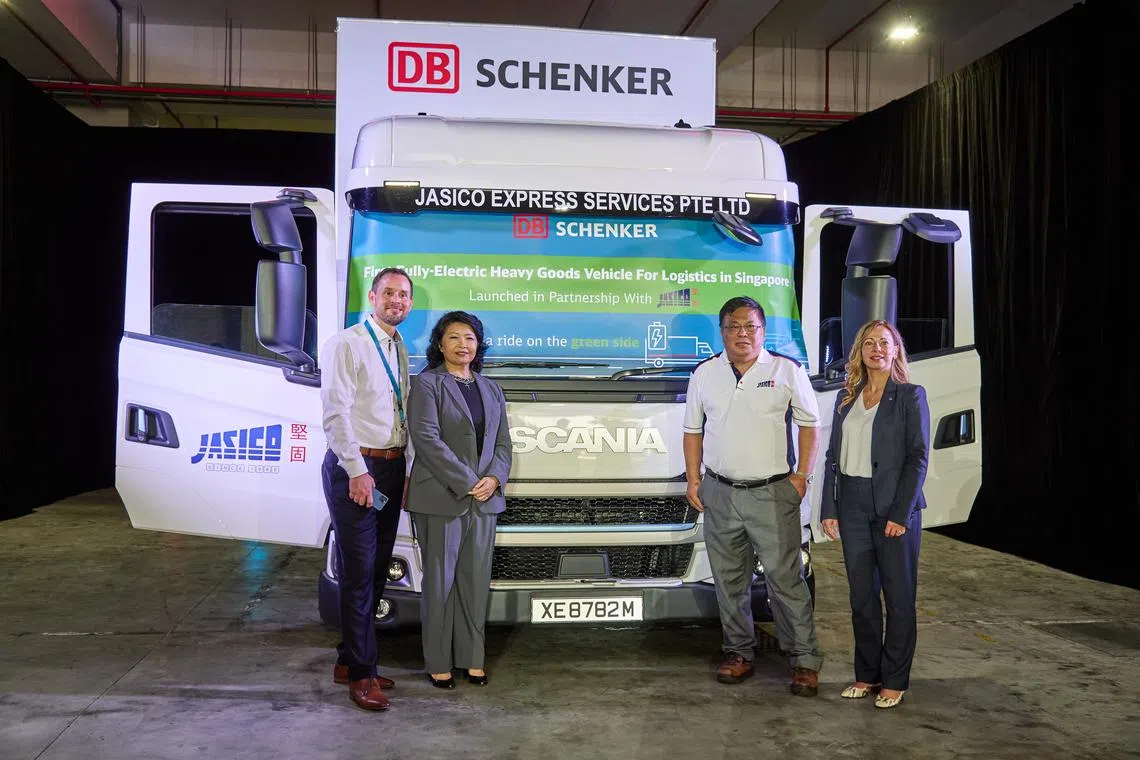
The total cost of owning an eHGV is similar to that of a diesel vehicle. Scania’s eHGV, for instance, has a total ownership cost “comparable to that of its diesel equivalent”, including recharging and maintenance, says Scania Southeast Asia managing director Heba Eltarifi.
But the upfront cost remains higher – which may be the biggest barrier to wider adoption of eHGVs. In general, an eHGV costs around twice as much to buy as a diesel-powered HGV, says Eltarifi and UOB’s Silalahi.
This is compounded by the fact that HGVs are eligible for fewer incentives than LGVs are.
Adoption of eLGVs has been driven partly by incentives: the Enhanced Early Turnover Scheme (ETS) and Commercial Vehicles Emissions Scheme (CVES).
The ETS provides a discount on the Certificate of Entitlement (COE) if owners switch to cleaner goods vehicles, with the largest benefit for models with the least tailpipe emissions. As eLGVs and eHGVs have zero tailpipe emissions, they benefit from the highest COE bonus.
However, HGVs do not qualify for the CVES. This scheme rates goods vehicles on a band of pollutants and gives incentives or penalties accordingly. Here too, EVs benefit the most, standing to receive a rebate of up to S$15,000.
There is also uncertainty surrounding the future of emissions rebates for goods vehicle. The ETS for LGVs will cease after Mar 31, 2025. For HGVs, an NEA spokesman told BT that the ETS “will be reviewed and announced in advance” before that date.
Waiting for a bigger push
Another limitation is the relative lack of eHGV options in Singapore, with only two manufacturers offering them in significant numbers.
ELGVs “are more widely available and market-ready”, but while there are “a few HGVs today that are fully electric… most HGVs do not currently have an equivalent electric model”, said the NEA spokesperson.
LTA figures imply an immature eHGV market. Of the 93 eHGVs registered in H1 2023, 87 were from Toyota. BT understands that these were all heavy-duty electric forklifts which do not run on roads.
Silalahi says this could be representative of the “limited options available in the market”, making it challenging for businesses to find a comparable electric HGV model to replace their diesel ones.
eLGVs provide an example of how a market might mature. The introduction of incentives was what prompted eLGV dealers to introduce more models here.
“When the CVES incentive started, we predicted that there would be growing market demand for eLGV models and began importing our first eLGV from Maxus,” says Dawn Pan, chief operating officer for multi-franchise operations for Jardine Cycle & Carriage.
“Our competitors did the same, and the number of models customers can choose from has expanded greatly since then,” she says. Cycle & Carriage now sells multiple eLGV models from Citroen, Maxus and Mercedes-Benz.
The eHGV scene could similarly change, with no shortage of potential models that could be introduced to Singapore.
According to the International Energy Agency’s Global EV Outlook 2023 report, there were nearly 840 current and announced medium- and heavy-duty zero emission vehicle models available in 2022.
At least two dealerships are looking to import and sell eHGVs in Singapore, but are waiting for more incentives to be introduced.
One of these, which declined to be named, currently sells electric buses and is looking to import a Chinese-brand eHGV to Singapore before 2025.
The other, eLGV dealer Hong Seh EV, is also studying the import of eHGVs – but says this is currently less feasible due to the lack of incentives and high cost.
“Incentives meant there was healthy demand for our (eLGVs), but eHGVs have much fewer incentives. So even with lower running costs and other benefits, it’s difficult to convince clients to switch,” says Edward Tan, executive director of Hong Seh EV.
Still, more eHGV models are set to arrive in Singapore this year, both from manufacturers that already offer eHGVs here and new entrants in this space.
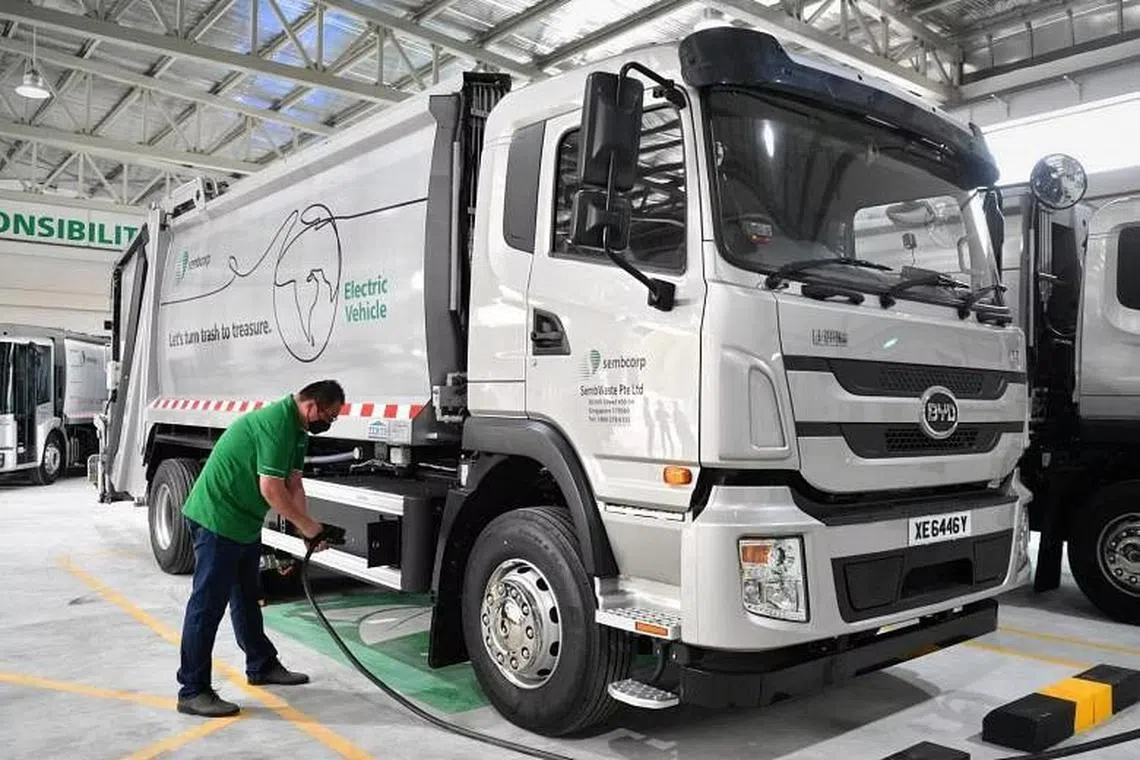
Chinese EV-maker BYD was the first to introduce eHGVs in significant numbers to Singapore in 2018. Local waste management companies 800 Super and Sembwaste now have fleets of its T9 electric truck, with a total of 44 units.
BYD plans to launch an improved version, the T9R, later this year, with other eHGV models in the pipeline.
Scania introduced the CL20N electric heavy-duty truck this April, and now has eight units on the road: seven with waste management company ALBA W&H Smart City and one with logistics company Jasico Express.
By early 2024, three more players will introduce eHGVs here: Volvo, Mercedes-Benz, and Fuso.
Volvo Trucks announced on Aug 17 that it intends to bring its eHGV, the FL Electric, to Singapore in the first quarter of 2024.
Anna Engblom, managing director of Volvo Trucks (South-east Asia and Japan), says that the company was “in discussions with multiple customers about the introduction of eHGVs”. She expects “a lot of interest” for eHGVs in Singapore, “given the strong focus on green transport” under the Singapore Green Plan 2030.
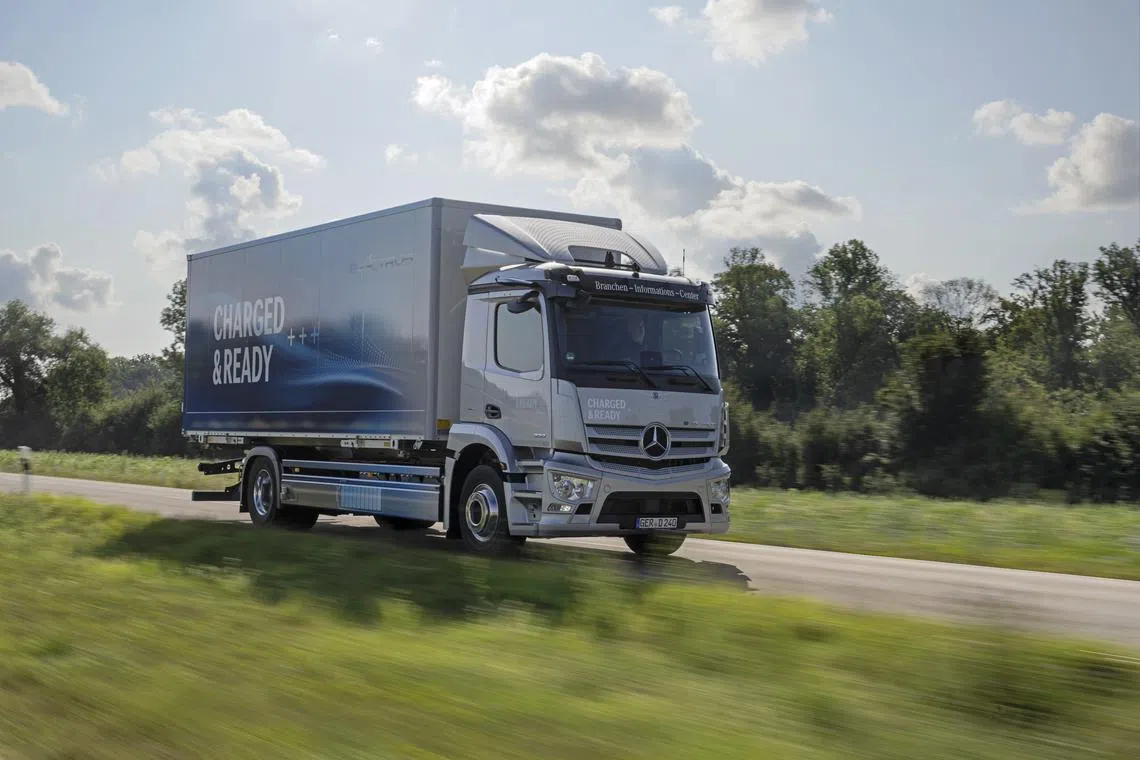
Mercedes-Benz Commercial Vehicles will introduce the eActros, and Japanese brand Fuso will have the eCanter. Both brands are owned by Daimler Truck.
It is the beginning of what will be a “range of fully-electric trucks” as part of the company’s initiative to deliver sustainable solutions to clients, says Harald Schmid, chief executive of Daimler Commercial Vehicles South-east Asia, which is Daimler Truck’s regional office.
Going further
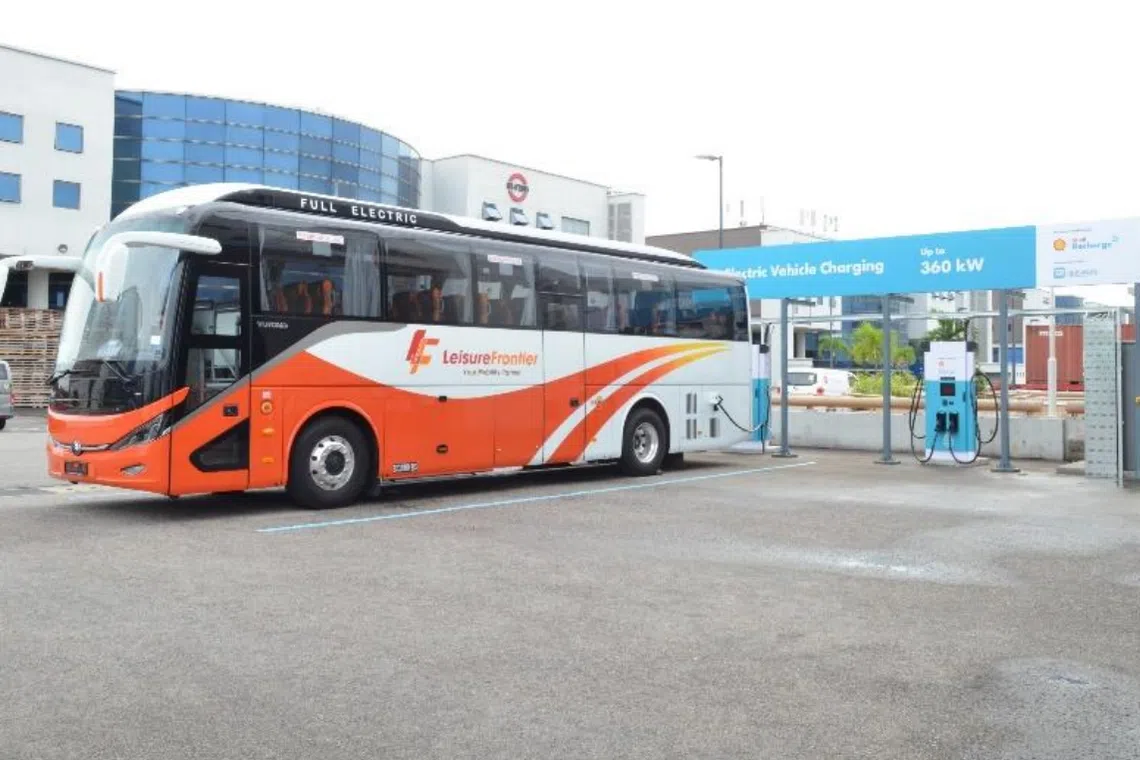
A wider range of model options will lower the barrier for eHGV adoption, says Jeane Toh, the head of business mobility for Singapore at Shell. But as the eHGV supply expands, another obstacle may arise: charging infrastructure.
Currently, eLGVs tend to use so-called “slow-charging”, for which ample charging points already exist. Manufacturers typically offer clients a package which involves both maintenance and charging.
But for high-powered fast-charging, which some eHGV fleets may require to minimise downtime, there are “limited charging facilities” available, says Toh.
Introducing charging infrastructure for eHGVs may be more expensive than comparable infrastructure for passenger vehicles, she added, as more space is needed and the power grid must be upgraded for fast-charging.
Here too, however, cost-effective solutions may be on the way.
Shell and consortium partner Busways Shell are seeking partners for their eHGV fast-charging pilot project in Singapore, as announced on Aug 7. This could pave the way for viable fast-charging of eHGVS for time-strapped businesses.
Beyond this pilot, eHGV charging infrastructure is a challenge that will require collaboration between the industry and government to solve, says Toh, adding that “government advocacy, policies and grants could play a major role in accelerating the process”.
A second concern is range, though this is less pressing in Singapore’s small territory. The SUTD study showed that HGVs travelled an average of 155 km a day, while LTA data from 2022 shows an average of around 103 km a day.
Per charge, BYD’s T9 claims 200 km of range, while Scania’s current eHGV claims around 150 km. Manufacturers say range will be improved in later iterations of the vehicles.
The issue is that with heavier loads or longer ranges, eHGVs need more powerful batteries – which are less green.
The SUTD study shows that an eHGV with a larger, heavier battery (165.5 kilowatt hours) results in 12 per cent greater life-cycle emissions than a diesel vehicle. This means the heaviest vehicles may still need to be diesel-powered.
In the longer term, hydrogen may emerge as a more energy-dense alternative to diesel. The SUTD study showed that a hydrogen fuel-cell truck can achieve up to 30 per cent less lifetime emissions, even when using hydrogen obtained from processing natural gas.
But for now, eHGVs are the most plausible step away from diesel. This is backed up, for instance, by a study that Surbana Jurong did for cement supplier Pan-United Corporation in 2022, on whether its tipper and mixer truck fleet could be powered by hydrogen or electricity.
The study recommended adopting eHGVs first, says Tan Wooi Leong, Surbana Jurong’s managing director of energy and industrial. This was because of difficulties with hydrogen supply and infrastructure, including costs and technical challenges.
Prof Cheah says that more pilot projects and trials should be encouraged to explore hydrogen and other alternatives, including diesel-hybrid trucks or ammonia fuel.
In the meantime, electrifying HGVs could help clean up their act in a big way – and keep Singapore’s industries trucking.