High school musical: Singapore’s hunt for a K-pop star
Plans for a K-pop high school programme in Singapore could fan the dreams of young people hoping to break into the South Korean entertainment industry. But are Singaporeans ready to step into the spotlight?

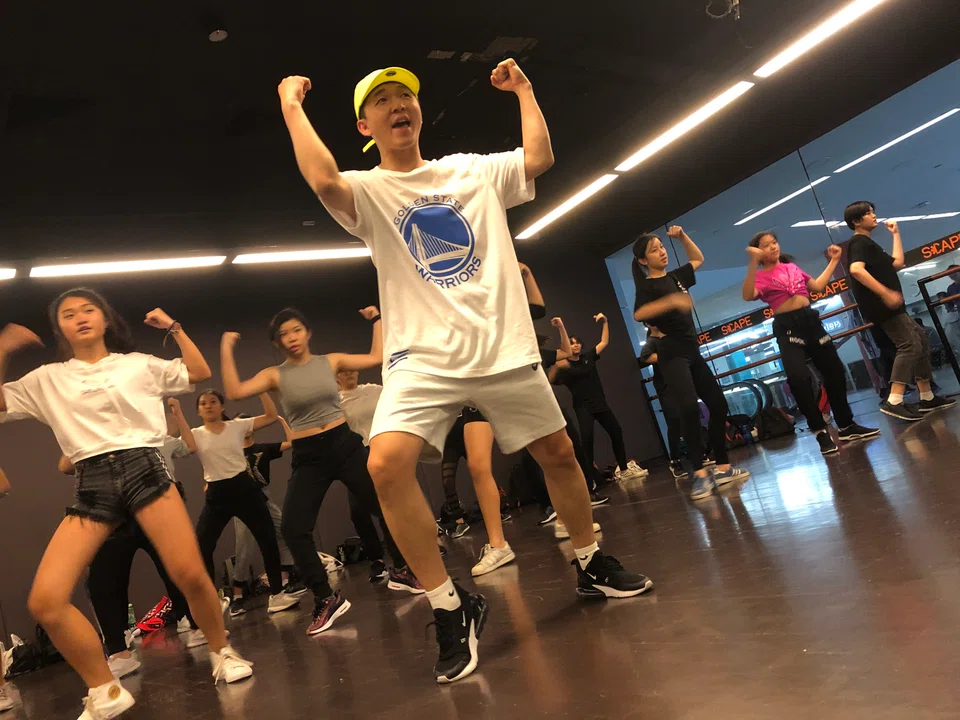
AFTER days of intense training, a crowd of young hopefuls hangs around nervously in a holding room.
One by one, they are called into separate audition rooms, where they are given a single shot to impress a bunch of eagle-eyed scouts.
But, more often than not, their hopes of a chance at Korean pop (K-pop) stardom will be dashed.
The competition for a place in South Korea’s entertainment agencies is cut-throat, says Angela Lee, director of K-pop boot camp The Academy Australia.
Each year, some 100 participants join the boot camp – spanning eight to 10 days – and receive training in singing, dancing and entertaining.
At the end of the training camp, the participants audition to showcase their talent to agencies that have partnered the camp. These include Pledis Entertainment, home of 13-member boy group Seventeen.
Since its inception in 2016, however, not a single auditionee has been accepted into the ranks of its partner agencies.
Despite this, the allure of a career in K-pop – amid the rise of the Korean wave, known as hallyu – continues to be a draw for young people from around the world.
Riding the K-pop wave
Closer to home, youth in Singapore and the region may soon stand a better chance at breaking into the South Korean entertainment industry.
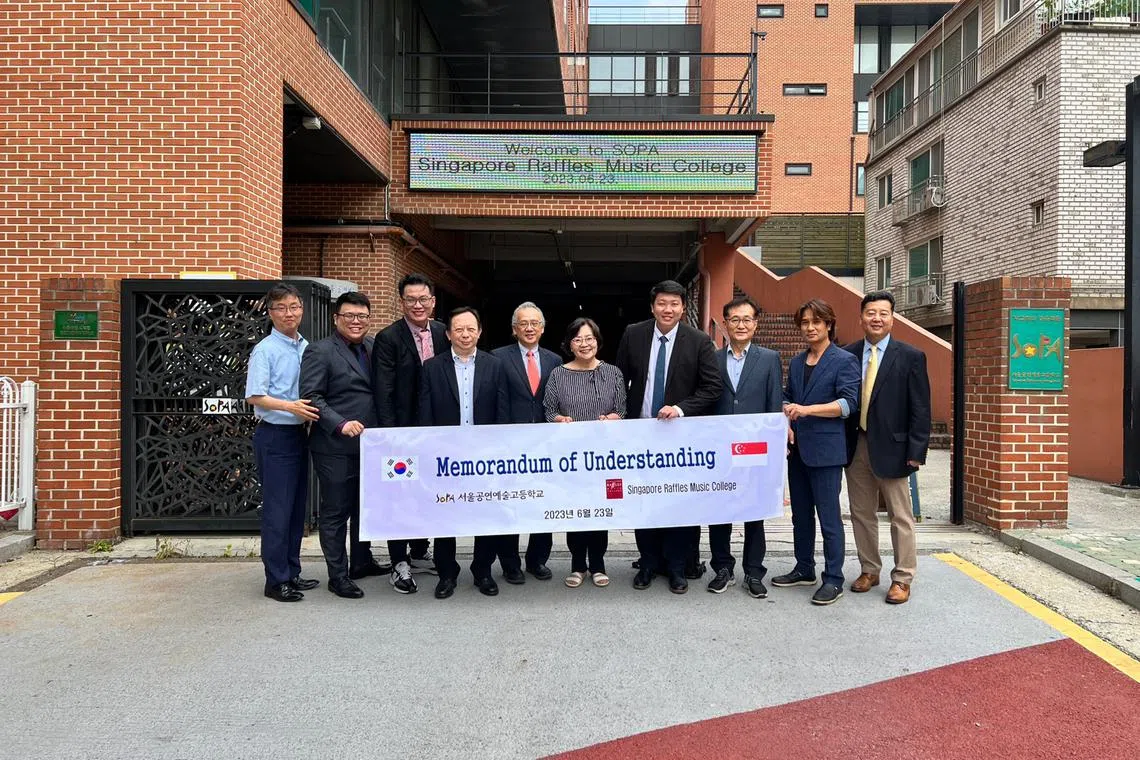
Local music school Singapore Raffles Music College (SRMC) in July announced it had inked a memorandum of understanding with the School of Performing Arts Seoul (Sopa) to establish a K-pop high school programme here.
Sopa is the alma mater of many idols who are now considered the cream of the crop in the K-pop industry. Alumni of the arts high school include Seventeen’s S.Coups, BTS’ Jungkook, EXO’s Kai and IVE’s Wonyoung.
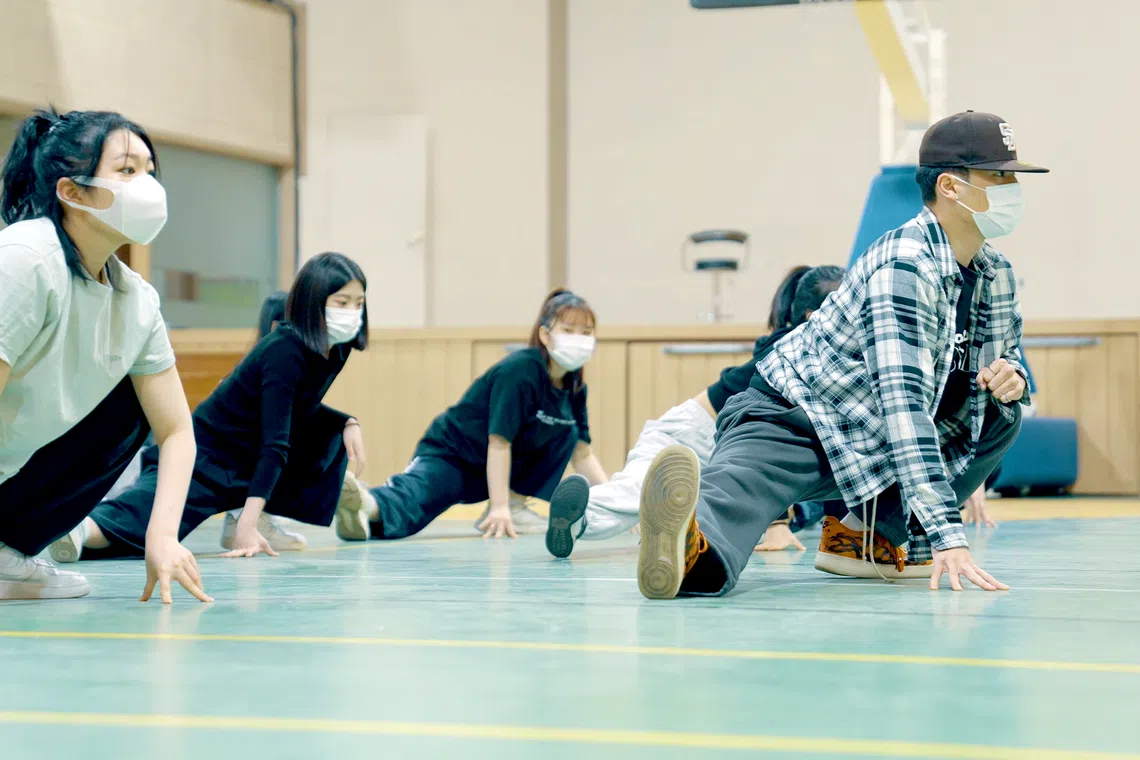
Sopa Performing Arts Center executive director Park Seo-il tells The Business Times (BT) that South-east Asia was a choice location for this collaboration because of K-pop’s popularity and influence on the local entertainment industry.
Singapore’s education system, geographical location and economic level – which is similar to that of South Korea – made the country attractive as the location for Sopa’s first international foray, Park adds.
SRMC executive director Ryan Goh says the collaboration will be used as an “attracting ground” for South-east Asian hopefuls, noting that there have been idols hailing from the region in recent times.
As an example, he highlights the popularity of Lalisa Manoban, or Lisa, a Thai idol who shot to superstardom when she debuted in the four-piece girl group Blackpink in 2016.
Auditions will be required for entry into the Singapore-based programme, which will be open to post-secondary students aged 16 and above.
Goh estimates that the first batch will include about 75 students, with the first few years focused on building a pipeline for talent to come through the system.
SMRC and Sopa are confident that there will be a market for K-pop education here.
South Korea is the seventh-largest music market globally and the third largest in Asia, going by the International Federation of the Phonographic Industry’s Global Music Report 2023.
Data from the Korea Customs Service shows that export sales of K-pop albums jumped 17.1 per cent year on year to reach US$132.9 million in the first half of 2023.
To capitalise on the K-pop wave sweeping across the globe, more South Korean entertainment companies are starting to move towards promoting internationally, speaking in multiple languages and recruiting non-Korean talent.
On the hunt for the next big K-pop star, companies and related organisations have forayed outside South Korea, and Singapore has been one of the target countries.
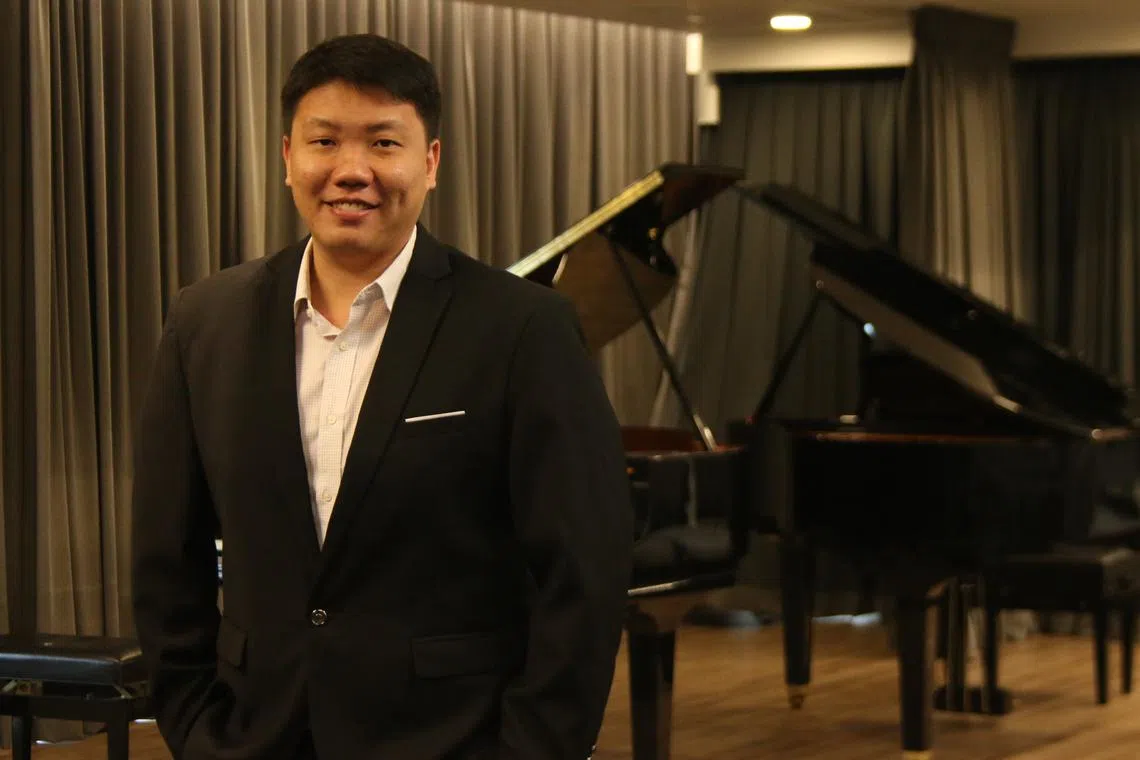
Top companies including SM Entertainment, JYP Entertainment and YG Entertainment have held talent hunts in the Republic, with YG holding its latest just this month.
Regional competitions such as K-pop Star Hunt occasionally pop up in Singapore, while The Academy Australia hosts an audition for its annual boot camp here as well.
*Scape, a Singapore-based non-profit organisation that supports youth development, also offers various K-pop-related programmes. These include dance cover competition and workshop Dance Dance Hallyu, where South Korean dance instructors hold classes or judge K-pop dance cover groups.
Several Singaporeans have entered or come close to breaking into the industry through the years. But few still remain in K-pop today.
The most well-known example is Singapore-Korean girl group SKarf, which was established in 2012 by Alpha Entertainment after a talent search by Alpha and JYP in 2010.
The group has since quietly disbanded, although its Singapore members Tasha Low and Ferlyn G continue to ply their trade in the entertainment sphere as actresses.
Open the doors to stardom
While Singapore’s K-pop high school programme is still in the works, an upcoming Sopa International K-pop Camp will be held in late November, says SRMC.
Participants aged 13 and above will be able to learn from industry heavyweights including choreographer Choi Hyojin of Street Woman Fighter fame and vocal trainer Noh Young Chae, who has guided K-pop acts such as Monsta X and Astro.
Thereafter, these participants will receive priority enrolment for the SRMC-Sopa programme. A spokesperson for SRMC says the camp has attracted “young enthusiasts, mainly teens to young adults living in Singapore”.

However, sentiment among fans, market observers and industry professionals has been mixed – particularly with regard to whether the programme will boost the profile and marketability of Singaporean talent.
Apart from Thailand, most of South-east Asia have yet to make a splash in the competitive South Korean entertainment industry, notes Liew Kai Khiun, assistant professor of social sciences at Hong Kong Metropolitan University.
“You have very big success cases like Lisa, but it is not the norm,” he says.
Singapore’s youth, in particular, may face a disadvantage due to an unwillingness from parents to send their children for music and other arts-related classes.
“It’s a big gamble to commit your kids at the age of 12, between primary and secondary school, to something that requires a lot of emotional and monetary investment,” says Prof Liew, who has been researching the impact of K-pop for close to 20 years.
He adds that being trained as an idol was a “completely different ballgame” from completing a course in K-pop, due to its highly competitive and selective nature.
The Academy Australia’s Lee says that, in her experience working with the South Korean industry, there is an element of luck that is needed in terms of the timing, agency management and the trainee’s appearance.
She notes that among South-east Asians, Thais are “visually closer” to what the South Korean standard of beauty is. “Traditionally, you need someone with a certain kind of shape,” she adds. “The petite look is visually appealing, as they have fine features.”
Some fans who spoke to BT are likewise sceptical about the effectiveness of a school-guided course being a throughway to an idol debut.
Gayle Lin, a Singaporean fan of Starship Entertainment boy group Cravity, says it makes sense to have K-pop as a performing arts course similar to dance or theatre, but it remains “too niche of a genre” to have a programme on its own.
“I just think having a degree (in K-pop) isn’t going to help you skip all these steps or give you much of an advantage,” she says.
Itzy fan Matthew Chye agrees, adding that the course will “have to bring something special to the table”, such as possibly guaranteeing an idol debut for students.
“If not, who’s to say that the students who go through the course will even end up being an idol or not?”
Support local
Scepticism aside, fans say they would support Singapore-born idols and are hopeful that a successful K-pop group will eventually include someone from the Little Red Dot.
“I think such courses, if implemented well and set up with the proper infrastructure with idol companies in South Korea, (could result) in idols being born from Singapore,” says Chye.
A few fans have highlighted the popularity of idols from China, Japan and Australia in their home countries, and believe the same national pride would also be present with a local star.
Prof Liew, who believes a Singaporean idol would garner the same kind of support, says: “Based on historical precedence, Singaporeans are very supportive of Mandopop artists like Tanya Chua, JJ Lin and Stefanie Sun.”
And Singaporeans have made strides in K-music, albeit in different ways. In the field of songwriting, for example, Singaporeans’ works have been featured as singles for K-pop groups and soundtracks for South Korean dramas.
One such songwriter is Hubert Ng. An experienced Mandopop composer of six to seven years, Ng only recently made the jump to K-music after writing the lyrics and melody to his first K-pop track, Calling, for boy group Xodiac.
Unlike many K-pop songs that are translated after the lyrics have been written, his song was released in its original English version.
“Lots of K-pop groups are aiming to go global after BTS made it huge internationally, so there’s an increased advantage for (international songwriters),” says Ng.
This sentiment was echoed by Nat Ho, who co-wrote the lyrics of English song With You with South Korean musician Oh Yu-won. The song was part of the soundtrack of K-drama Sing My Crush and sung by South Korean singer Luce.

No stranger to the entertainment scene, Ho was an actor in Singapore before moving to Taiwan to pursue a music career. In 2022, he made his latest move to Seoul to carve out a niche in songwriting – which has now borne fruit.
Noting that many South Korean companies are actively recruiting non-Korean trainees, he is generally optimistic about Singapore auditionees making it into a group eventually.
“Some strengths of Singaporeans are that we are bilingual and adapt to stress well,” he adds.
A K-pop school may not be the be-all and end-all answer to the lack of Singapore K-pop idols, but it does offer the resources for people who need a platform to start out, Ho says.
Songwriter Awrii Will, who has written tracks for NMIXX and Itzy under studio The Hub, says that having the opportunity and space to learn and study something is important for anyone aspiring to enter any industry.
And that is exactly what the SRMC-Sopa collaboration is offering local talent, she points out.
“Having a mentor or teacher who will take you in and help you is very beneficial,” adds Will, who moved to the Netherlands after graduating from high school to pursue a career in K-pop, as her home country, Curacao in the Caribbean, did not have the resources to support a music career.

She also says that having professionally taught K-pop courses in Singapore could be advantageous to Singapore’s entertainment industry, as it would result in more graduates who could go into the arts.
“This kind of training in Singapore… will also pave a path for music in Singapore itself,” she says. “Even if you don’t get scouted, you’ve still got the training.”
Similarly, SRMC’s Goh believes the programme will prepare students for various entertainment avenues, even if they do not end up in South Korea after graduation.
“At the end of the day, each talent must be able to understand that they are supposed to build a multitude of income streams,” he says. “They have to expand their horizons and understand that there are various opportunities, even in the gaming and streaming industries.”
K-pop’s global impact
With the K-pop genre on the road to globalising – as seen from idols collaborating with US pop singers or when they enter new markets – there may be opportunities yet for Singapore talent.
The Academy Australia’s Lee certainly thinks so. She notes that Hybe Corporation, the conglomerate that manages BTS, collaborated with US record label Geffen Records to produce The Debut: Dream Academy, a survival show with a mostly foreign cast of 20 girls vying for a chance at stardom.
“They’re not called a K-pop girl group, but a global girl group trained under K-pop systems,” she says.
The cast has one South-east Asian trainee: Sophia, from the Philippines. Meanwhile, another Dream Academy member, Ezrela, previously attended The Academy Australia’s boot camp in 2016 when she was 13 years old.
And Dream Academy is not the only show to “go global”.
JYP’s joint venture with Republic Records created VCHA, a six-member girl group, through survival show America2Korea (A2K). As its name suggests, A2K aimed to prepare American girls for idol life through the intensive K-pop regime.
With these shows focusing on foreign youth, it “would be very interesting to see if it is the location or system that matters”, Lee says.
Goh says that SRMC’s tie-up with Sopa will give young people in Singapore and South-east Asian the chance to showcase their skills through agency auditions and other industry opportunities, and could help to “bridge the gap” between education and industry.
This will be key to putting Singapore on the map as a source of entertainment talent that the world can tap, he adds.