Higher interest rates aren’t deterring property buyers, but a lower borrowing cap could
Market watchers say if interest rates hit 4% or more, it could be a tipping point for property demand


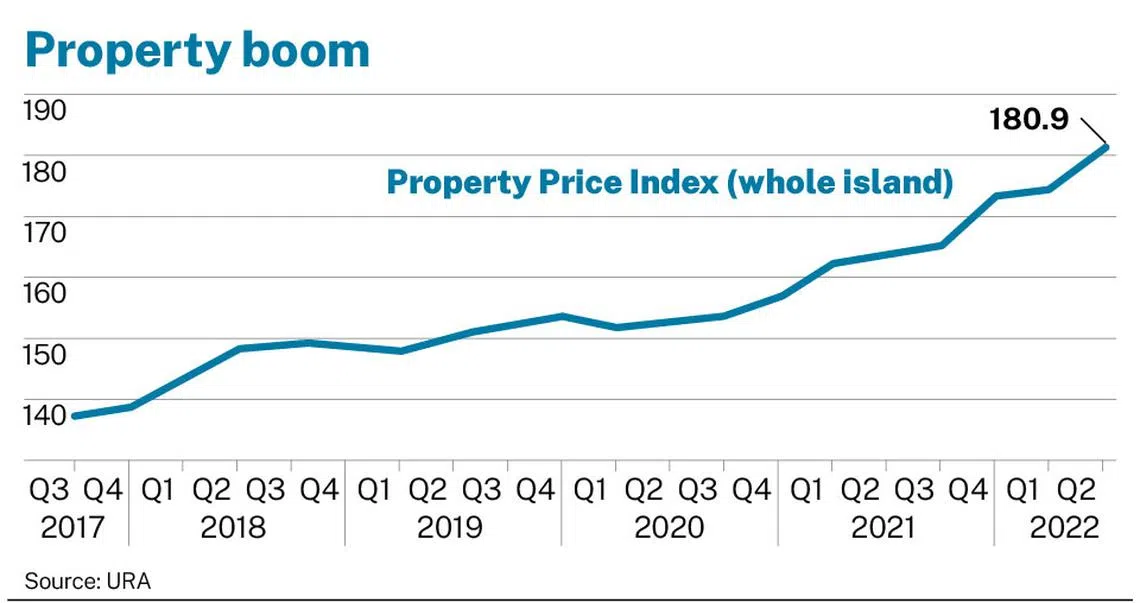
PRICE is a function of supply and demand. Economic theory dictates that higher prices should negatively affect demand, which in turn boosts supply. For months however, Singapore's red-hot property market has been defying such expectations.
Data from the Urban Redevelopment Authority (URA) shows prices of private residential properties rose 3.5 per cent in the second quarter of 2022, building on 0.7 per cent gains in Q1 and 10.6 per cent for all of 2021.
HDB resale prices notched their 25th straight month of gains in July this year, SRX data showed. Overall prices were some 11.6 per cent higher on-year, with the most expensive HDB resale transaction on record – a S$1.4 million 5-room loft unit transacted at SkyTerrace@Dawson – also occurring during the month.
Yet, Singapore's total population has shrunk: from 5.7 million in June 2019 to 5.45 million in June 2021.
What is driving the robust demand? And can anything dampen it?
Market watchers say buyers comprise a mix of new family units as well as investors, some of whom own more than one property. But this latter group could find it challenging to turn a profit on their property investments as interest rates rise.
The buyer demographic
One oft-cited reason for the property market boom over the past year is the pandemic. Delays to housing projects from Covid-19 restrictions have driven buyers to the resale market for their immediate housing needs.
Derek Tan, head of property research at DBS Group Research, says the Covid-19 years should be looked at in the context of buyers who may have deferred their purchases in 2020 to the following year.
There could have been pent-up demand, and returning Singaporeans would also need a place to stay, he adds.
Meanwhile, household sizes have shrunk. Professor Sing Tien Foo, director of the Institute of Real Estate and Urban Studies (IREUS) at the National University of Singapore, says “more small families (means) a lot more demand for housing as well”.
But he believes these fundamental drivers of demand do not fully explain the buying behaviour: “(What) is harder to predict is how many of these people are buying second, third, fourth, fifth houses for investment purposes?”
Christine Sun, senior vice-president of research and analytics at property agency OrangeTee & Tie, says the proliferation of 1- and 2-bedroom units in the past few years has helped investors own more properties.
“We don’t have the stats to prove (this), but if you turn left and right, you will find that a lot of people are holding multiple properties,” she says. “Because the price quantum is more affordable, it makes it easier for people to own a second or a third property.”
Without a doubt, the ultra low interest rate environment in recent years has been supportive of demand.
"This is a very important factor," Prof Sing says. "This 1-per-cent-or-below kind of interest – a teaser rate – really causes a lot of inflation in the prices, and then people actually enter into it, and hope.”
A brewing storm?
In his National Day message, Prime Minister Lee Hsien Loong said the world is “not likely to return anytime soon to the low inflation levels and interest rates that we have enjoyed in recent decades”.
Indeed, such prospects should provide owners of multiple properties lots to unpack – and worry about.
Prof Sing says even a 1 per cent increase in interest rates could cause a “substantial impact” on homeowners’ instalment payments, depending on the amount they borrowed from the banks.
MoneySense's mortgage calculator shows a 30-year S$500,000 loan fixed at 1 per cent annual interest would incur a monthly repayment of S$1,608.
When interest rates move to 3 per cent, monthly repayments increase 31 per cent per month to S$2,108 – far more than most people can expect to receive in annual wage increments.
If rates were to rise further still to 5 per cent, the borrower would face the burden of higher monthly repayments to S$2,684 – an increase of 66.9 per cent.
While this could really hurt the wallet, beyond the immediate hit to one’s monthly cashflow, there is also the impact on the loan’s amortisation schedule to contend with.
Darren Goh, executive director at MortgageWise.sg, says borrowers would be affected by the weightage of principal reduction and interest components in repayments each month.
"When (the interest rate is) 1.5 per cent – many of us are very used to this – you see your loan come down very fast, because… almost 70 per cent of what you pay every month reduces your loan and only 30 per cent is interest,” he said. "If it’s 3.5 per cent, it swings the other way around.”
Even with all these possibilities of a looming higher debt burden, many market watchers appear unconcerned – for now, at least.
Floating rates from banks ranged from 1.9 per cent to 2.1 per cent in early August, MortgageWise website data showed.
OrangeTee’s Sun notes that rates had hit as high as 2.5 per cent in Q2 2019, and that the current interest rate level is still quite manageable.
The bulk of purchases in Singapore are still HDB flats, Sun notes, with a median resale price of around S$500,000.
Based on a 75 per cent loan-to-value ratio and a 30-year loan, an increase in rates from 1.9 per cent to 3 per cent would raise monthly instalments by around S$214 – to around S$1,581.
The numbers may represent close to a 16-per-cent increase in monthly payments, but in the bigger scheme of things, this should be viewed in the context of dual-income households, hence the actual dent to one’s finances may be less.
“Borrowers can use both CPF and cash, and you are talking about (income from) husband and wife,” she says. “The increase of the S$214 may not be that much.”
Singapore’s median monthly household income from work grew 3.6 per cent on year in nominal terms to S$9,520 in 2021, surpassing pre-Covid-19 levels, according to the Singapore Department of Statistics.
During a press conference last month, Monetary Authority of Singapore (MAS) managing director Ravi Menon said the household debt situation in Singapore “remains generally healthy”.
The stringent borrowing criteria for property loans in Singapore will keep this in check too.
Homebuyers in Singapore are subject to a total debt servicing ratio (TDSR) limiting a mortgagor's overall debt obligations to 55 per cent of income.
This ratio is set by calculating mortgage obligations, assuming an interest rate of either 3.5 per cent or the prevailing market rate, whichever is higher.
“The TDSR acts as a sort of cushion or buffer against over extending leverage,” says Leonard Tay, head of research at property consultancy Knight Frank Singapore. “They have that buffer for interest rates to go up, without having the finances come to a crippling type of position.”
The MAS said that the median TDSR for new loans issued over the past year was 43 per cent. The loan-to-value ratio for the outstanding stock of mortgages as of Q1 2022 was less than 50 per cent.
The central bank’s stress tests suggested that most households “should be able to service their debts even under scenarios of sharp interest rate hikes and significant income losses”.
Tan of DBS says that property prices are more correlated to employment and economic performance than interest rates.
He also notes that some owners would have locked in fixed rates when these were lower, and the impact of higher rates would only come later.
“I feel no real stressed sellers, only because the employment situation is still quite healthy for now,” he says.
Booming rentals
Adding to the optimism is the expectation among homeowners of resilient rental yields.
One property investor with such a view is Lim, who has 4 titles to her name – 2 of them fully paid for – mostly in the central area.
Lim, who asked to be known only by her last name, says there has been "huge demand' in the rental market.
She notes that interest rates have reached higher levels of 6 to 8 per cent in the past. “Inflation is already so high, so if one day, it really hits to this high level, I will have no choice but to also increase the rental, and I believe homeowners like me will definitely increase the rental in no time,” she adds.
The current strong rental market with good demand and a lack of supply have enabled owners to raise rents without much difficulty, market watchers say.
URA’s rental index, which has been relatively stable since 2017, began to pick up in early 2021. It has risen some 11.2 per cent in the first half of this year. Vacancy rates of completed private residential units have also remained relatively low at 5.4 per cent.
Knight Frank’s Tay says there have been both local and foreign demand drivers of rents, with rents escalating faster than property prices.
“There’s so much stress with new people coming in, existing people with their houses being delayed, completion being delayed, they also have to rent,” he says.
Market watchers expect that owners like Lim are unlikely to be forced out of the market, and that property pricing should therefore remain high.
It is more the marginal buyers – such as upgraders – who are likely to rethink their purchasing decisions, DBS’ Tan says.
He expects the second half of 2022 to be weaker than the first half, but believes that this would be reflected in volumes instead of the overall price index.
“If you ask me whether a Dawson flat will go from asking S$1 million to S$900,000 – it may, but I don’t think it will come immediately,” he says, referring to the HDB estate in Queenstown, where a number of million-dollar flats have changed hands.
Knight Frank expects private residential prices to rise 5 to 7 per cent for all of 2022, higher than an initial “conservative forecast” of 1 to 3 per cent growth, when new property cooling measures were announced last December.
While home prices have maintained their steady uptrend so far in 2022, volumes have noticeably slowed. The number of private residential units transacted in the whole of Singapore for H1 2022 was down 26.6 per cent year on year, and 28.5 per cent lower than in H2 2021.
OrangeTee’s Sun, meanwhile, notes that HDB flat prices have not been coming down, even though rates were already starting to rise last year.
The increase (in rates) is still quite gradual, so maybe that’s why we have not seen a situation where buyers are pulling back, or buying smaller units. So far we have not seen that situation yet, she says.
HDB resale volumes slipped slightly in H1 2022, down around 6.1 per cent year on year, HDB data showed.
The real pinch
Sun notes, however, that interest rates and cooling measures are inter-related, and rates could have an impact on TDSR if it continues the upward trend.
If TDSR is calculated based on a higher interest rate of 4.5 per cent, housing affordability for many people would be “quite affected”.
“It will affect both the HDB market and the private market,” she says. “When they hit that level, I would think TDSR will play a bigger role in impacting the market more than interest rates.”
A move from 3.5 per cent to 4.5 per cent for TDSR calculations would reduce the maximum loan quantum available to buyers by 11.4 per cent, going by back-of-the-envelope calculations by The Business Times, assuming a 30-year loan and stable household income and TDSR cap.
Several market watchers deem an interest rate of 4 per cent as a tipping point for the property market.
Cushman & Wakefield analysts noted in an H2 market outlook report that demand may be impacted once medium-term interest rates were to rise above 4 per cent. However, they believe that the risks of a severe downturn in prices may be limited unless there are additional cooling measures and an unforeseen deterioration in economic conditions.
DBS’ Tan says: “The problem is only when it goes above 4 per cent. That’s where I think households will be a little bit stretched.”
Even if mortgage rates were to rise above the 3.5 per cent threshold used for calculating TDSR, Tan says he does not expect rates to stay above that level for an extended period.
Goh from MortgageWise.sg is sanguine about the path for interest rates, and urges buyers to study the interest rate cycle and not panic or lock themselves into fixed rates that have already moved higher.
In the first half, he notes that it was a “no-brainer” to go fixed when rates were below 2 per cent.
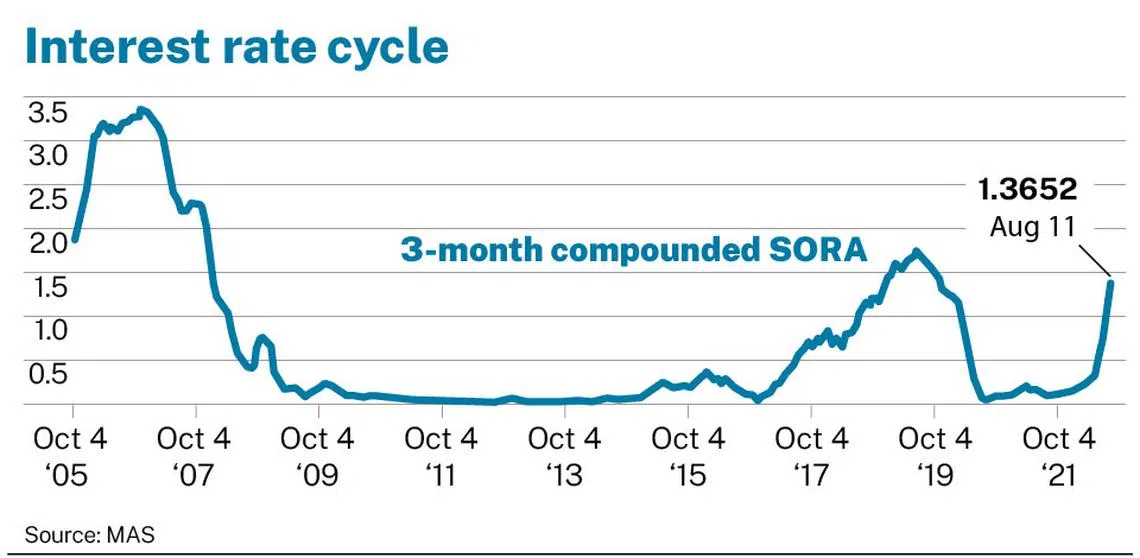
“For the second half, it is not so clear,” he says. “We expect (the 3-month compounded Singapore Overnight Rate Average) to keep rising until it hits the 1.5 to 1.8 range by September.” This would mean floating rates in the range of 2.6 to 2.7 per cent by the end of this year, he added, as well as the possibility of rates reaching the 3.5 per cent TDSR threshold.
But he expects central bank tightening action to eventually have an impact on inflation.
"So our view is that (interest rates) will come down in 2023, because of the pace at which the (US Federal Reserve) is going.”
Prof Sing of IREUS, meanwhile, expresses concern for those who might have stretched their loan-to-valuation ratios and TDSR cap to the limit.
“I think that is quite dangerous,” he says. “If this increase is just one-off, it doesn't matter, but I think interest rates are going to rise further for the next quarter or even the next one year or so, given the current inflation."
He says buyers should exercise caution and prudence and pay close attention to their affordability levels for home purchases.
“What is the rush to enter now?
“People are buying as if the market will continue to rise… but if you look at the history, prices go up and come down,” he says. “It can come down.”