Irish eyes are smiling
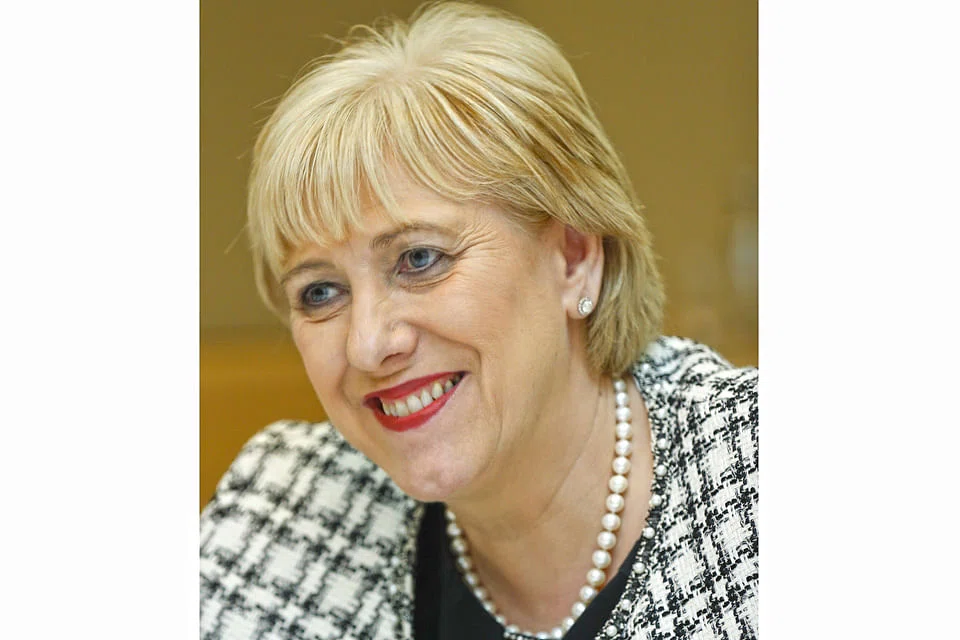
Ireland is a committed member of the EU, and that spells huge opportunities for business, says the country's Minister for Business, Enterprise and Innovation, Heather Humphreys.

Annabeth Leow
SINGAPOREANS are dining on the world's best ducks - which are Irish, Heather Humphreys is glad to report.
Ireland's Minister for Business, Enterprise and Innovation - who, as she notes in her official profiles, lives on a farm - represents the constituency of Cavan Monaghan in the Dáil Éireann, or the Irish legislative assembly.
And County Monaghan, "which is my own county - that's where I live", is home to the world-renowned Silver Hill Farm, purveyor of ducks to Singapore restaurant chains like London Fat Duck and TungLok's Duckland.
"So 20,000 ducks per month go to Singapore from Ireland, from my own home county of Monaghan," she says, with evident pleasure.
"It's under the brand name 'London Fat Duck', but it actually comes from Ireland and we're very proud of that company."
The wagyu of ducks aside, Ms Humphreys is quick to rattle off more ties that bind Singapore and Ireland. "It's easy to do business here, it's easy to do business in Ireland, and I suppose that, as two small, open economies, we do punch above our weight, each of us, respectively, in our own regions," the minister says.
"The Irish have success in Singapore in sectors such as telecoms, fintech, digital health, talent management solutions and construction, where leading Singaporean companies use Irish technology for their competitive advantage. You might not see the Irish brand names around you, but they are in fact all around you.
"For example, seats in the airlines - I went to see ST Aerospace - they are being supplied by Irish companies... that's just one example.
"Of course, if you look at Cylon Controls, it's an Irish company that supplied the energy management systems in the tallest building in Singapore, Guoco Tower."
If this sounds a little like a sales pitch, well, that's understandable too. After all, her sit-down with The Business Times takes place on a two-day trade and investment mission - her first time in Singapore, "but not the last" - to woo partners amid the uncertainty of a post-Brexit world.
Ireland's fortunes are inextricably linked to its neighbour, the United Kingdom, from which it won independence in 1922 after a three-year war.
Besides the natural barrier of the Irish Sea, the island is also divided between the Irish Republic in the south, and Northern Ireland (sometimes referred to by the name of the old province of Ulster), which is part of the UK.
Both countries are now members of the European Union. But, more than two years after a divisive plebiscite, the UK is set to soon leave the bloc - if Westminster can reach agreement on how it would do so.
"Brexit is the biggest challenge, of course, facing businesses," says Ms Humphreys. "But Ireland's economic and political stability, along with a continued commitment to the EU, is a core part of Ireland's value proposition to foreign investors - even more so in the post-Brexit environment."
The Central Bank of Ireland has warned that a "disorderly" Brexit could cut economic growth by as much as four percentage points in the first year. (Otherwise, it has forecast a 4.4 per cent rise in gross domestic product this year, against 7.5 per cent in 2018.)
It said in a January bulletin that "A large and protracted drop in UK demand combined with a potentially severe disruption to trade and a loss in competitiveness in the face of a decline in sterling would lead to a dramatic drop in exports to the UK".
The 'Irish backstop'
The spectre of a customs barrier across the Emerald Isle has been a critical hold-up to the UK's progress on withdrawal from the EU. To avoid that scenario, UK Prime Minister Theresa May proposed a so-called "Irish backstop": keeping Northern Ireland in a kind of customs union with the Republic for the foreseeable future.
But Northern Ireland's Democratic Unionist Party, which is propping up Mrs May's coalition government, calls the backstop its "blood-red line" and sees it as opening the door to a future Northern Irish departure from the UK.
Ms Humphreys makes clear in her interview with BT that the Irish backstop issue is not just economic or diplomatic, but existential as well.
Well within living memory, the island was partitioned by heavily militarised checkpoints along the border. But the Troubles of the past have been now smoothed away, with the two Irish states now sharing a free, open border - made possible by the landmark Good Friday Agreement of 1998, which is an official peace treaty lodged with the United Nations.
Still, there are fears in the UK and Ireland that tensions could flare up again, no thanks to the Brexit process, which are not completely unfounded.
For example, a dissident republican group detonated a car bomb outside a courthouse in the Northern Irish city of Derry - officially called Londonderry, with the place name another source of tension - in January.
All the same, Ms Humphreys stresses, in sharp, clipped tones: "I live six miles from the border with Northern Ireland, okay, and I'm very aware of where we came from. It was a very difficult period. The EU, the UK and the UN have invested hugely in peace in Northern Ireland.
"I obviously don't want to see a border return in any shape or form - because borders lead to criminality, and criminality can lead to terrorism, in its own way."
On her own government's stance, she adds: "We've been there, and there's an agreement right across the board in the UK and Northern Ireland, and in the Republic of Ireland: We do not want to see a border back again.
"And we have to do everything we can - we have the agreement, and it's to find a mechanism that there are no borders between us and Northern Ireland. That's why we refer to the backstop in the withdrawal agreement. But that's exactly what it means.
"It means that people in Ireland, north and south of the border, can continue to travel over and back and continue to do business with each other, as we have been doing very successfully for the last 20 years since the Good Friday Agreement was signed, and that's something that is very important to us all.
"So, first and foremost, in terms of the withdrawal agreement with the EU and the UK, is the peace process; and that is of paramount importance, because there's nothing more important in Ireland than peace."
Open society
The point hits close to home for Ms Humphreys, who has spoken about her identity as a Presbyterian in a historically Catholic-dominated society where partisan politics tended to track ethnic and religious ties. She grew up in Drum, a largely Protestant village in the border region.
"Given my background as a Protestant and an Ulsterwoman who is a proud Irish republican, I appreciate the need to respect the differing traditions on this island," she proclaimed, when she was the Minister for Arts, Heritage and the Gaeltacht, in an Irish Times opinion piece in 2015.
She later elaborated, in a speech this year: "I am a proud Irish Republican in its truest sense - liberty, equality and fraternity."
Fraternity extends, Ms Humphreys makes clear, to welcoming newcomers to the nation.
"We celebrate diversity, and that's what we've been doing over the last number of years in the culture space. It's about how we can, you know, embrace new cultures to enrich our own culture," she tells BT.
"We welcome them, and I have to say, it has worked extremely well. I go in to companies and it's about a celebration of how many different nationalities work there.
"We have access to a pool of talent right throughout Europe, which means that we're going to have people right from all the European countries coming to work. But we also have a very good system to allow critical skills to come in from other countries."
Though she does not mention him, the leader of Ms Humphreys' own Fine Gael party is a bit of a poster boy for Irish multiculturalism too. Leo Varadkar, Ireland's first out gay prime minister, is the son of an immigrant, with Indian and Irish heritage.
Asked whether a wave of populism could exacerbate social fault lines, Ms Humphreys says she doesn't see that happening.
"The Irish people are very welcoming. We have a very open society. And we welcome diversity - and we're curious by nature," she notes, chuckling.
"That helps us, where we want to hear your story and we want you to be part of our communities. And there are many, many initiatives across the country to ensure that other nationalities feel welcome, and that their culture is celebrated within our culture - which, ultimately, enriches us as a nation."
Also high on Ms Humphreys' agenda is making economic growth felt across the board, including in rural areas and small businesses.
"We have a very successful city in Dublin," she says. "One of my priorities is to ensure that Dublin is supported by very strong regions under Project Ireland 2040, which is another whole-of-government initiative.
"We're investing 116 billion euros (S$176.4 billion) over the next 10 years in supporting our infrastructure, in developing our cities, so we're going to have cities in Waterford, Cork, Limerick, Galway, and rural centres in Sligo, Letterkenny and Donegal. They will all feed in to support Dublin as a centre."
Besides offering more regional co-working spaces and creative and digital hubs for professionals to work remotely, her team is also encouraging foreign companies to look beyond Dublin when they first enter Ireland.
"We're encouraging them to look at second sites in the regions, where you have clusters of talent in different areas," she tells BT.
"And we're working very closely with education right across the country, not just in the cities... so that we provide the pool of what companies need, whether they're indigenous companies or whether they're foreign companies coming in to invest in Ireland. We will have that pool of talent ready and waiting."
Another initiative cited by the minister is the Ceantair Laga Árd-Riachtanais (CLÁR) investment scheme, set up in February to fund small-scale infrastructure projects and attract residents and workers to rural areas.
"I have to say, I love the business portfolio," remarks Ms Humphreys, a rural dweller who joined national politics in 2011. She had previously served eight years at the county level, including as mayor of Monaghan.
The former bank manager, who says she's "really enjoying" her enterprise role, adds: "My background was in finance and in business, so this is a great portfolio for me."
Economic resilience
Over the past decade, the Celtic Tiger took a big hit from the global financial crisis, and the central bank recently suggested that the growth clocked by multinational corporations (MNCs) may have hyped up the true size of the economic rebound. But Ms Humphreys downplays the MNC-driven nature of the recovery.
"That plays a part, but we also have a good contribution in terms of our small indigenous companies as well; it's not just all reliant on the medium-sized and the large corporates that are in Ireland," she says.
"Of course, we are aware of that, we're conscious of that. Nevertheless, we'll continue to invest very much in our indigenous sector."
The central bank has also flagged deleveraging among households and small and medium-size enterprises, and high public debt, as risks.
But, asked about how credit and liquidity conditions will affect Ireland, Ms Humphreys describes the economic situation as "very stable".
"We have come through a difficult time, we made some difficult decisions, but they have paid off. We have taken the necessary corrective action to ensure that our banks are well capitalised, to ensure that our economy is strong, and that our growth is right across a number of sectors," she adds.
"Brexit is a challenge, but, if nothing, we're a resilient country", she declares - a possible understatement of how her compatriots have survived the historical misfortunes that came to be euphemistically known as "the luck of the Irish".
"We suffered hugely in the global financial crash. In 2012, we had unemployment at 16 per cent. We're now down to 5 per cent. And that's not just by attracting foreign direct investment into the country," she says.
"That's a very important part - it employs about 230,000 people - but it's also about supporting our indigenous companies... whether it is in fintech, whether it is in medtech, whether it is in pharmaceuticals, whether it is in agri-tech and the different sectors that we have in the food sector.
"We have supported them as well. They have increased their businesses and they have increased employment... We're no longer - we're not reliant on any one particular sector.
"And that's part of our strategy - it's a balanced approach, right across the offering, and we support our companies in all of the different sectors to scale up, to find new markets. And there's a very strong entrepreneurial spirit in Ireland. We continue to feed and continue to nurture that, because we want new companies coming along all the time with new ideas."
Driving home her message, Ms Humphreys adds: "What I do want to mention is the 'Irish Advantage' to Singapore businesses; and that is: people, innovation and trust. And it's the ease of doing business.
"Culturally, we're very similar. And Irish businesses are globalised; they're forward-looking; they're ambitious; and they're some of the most innovative and flexible in Europe. And they're supported by a world-class R&D ecosystem. They grew up alongside the biggest names in tech, life sciences and financial services, to meet the standards of global leaders.
"So, I really do think there are huge opportunities, as I said earlier. We have a highly educated workforce; English-speaking country; and access to the EU. And (we're) committed members of the European Union.
"I just want to be very clear on that: Ireland remains in the European Union and we feel that that is where our interests are best served. And we feel there are loads of opportunities to do more business here - not just in Singapore, but in this Asian region."
HEATHER HUMPHREYS
Minister for Business, Enterprise and Innovation Republic of Ireland
Born in 1963 in County Monaghan, Ireland
CAREER HIGHLIGHTS
2009 to 2010: Mayor, Monaghan County Council
2014 to 2016: Minister for Arts, Heritage and the Gaeltacht
2016 to 2017: Minister for Arts, Heritage, Regional, Rural and Gaeltacht Affairs
Since 2017: Minister for Business, Enterprise, and Innovation