Knack for snacks
Kellogg Company's man at the helm John Bryant is on a cracking pace to grow snacking into a multi-billion dollar business in the world's up-and-coming emerging markets.

Nisha Ramchandani
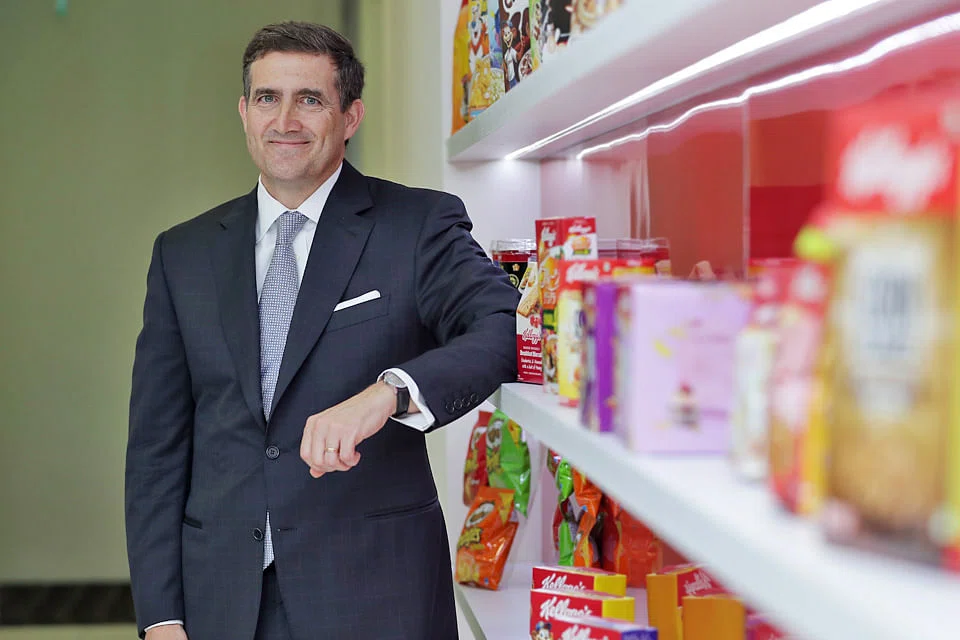
KELLOGG Company is probably best known around the world for its ubiquitous corn flakes. But it might surprise some to know that the world's biggest cereal group is also behind a variety of other popular snacks such as Pop Tarts pastries and Eggo waffles (both of which have been in the market for more than 50 years) as well as Pringles potato chips.
"What has changed is from being the world's largest cereal company, we've become a truly global snacking company," says Kellogg chief executive officer, John Bryant.
Its financial statements bear testament to this evolution. Back in 2000, Kellogg was earning some US$6 billion in revenues, with 70 per cent coming from cereals and 20 per cent from portable foods such as granola bars. In 2016, its revenue was in the region of US$13 billion; snacks' share of the pie has now grown to 49 per cent, while cereals account for 44 per cent of the business.
A string of acquisitions - from the purchase of Pringles from Procter & Gamble Co in 2012, to the more recent deal for Brazil biscuit manufacturer Parati - has also helped fuel growth.
Of the various regions, its Asia-Pacific business has probably seen the biggest transformation of all over the past several years, Mr Bryant reckons. In the last five years, Kellogg has invested about US$1 billion in the Asia-Pacific and Africa, effectively doubling the business in that time frame. Under the helm of Asia-Pacific president Amit Banati, its regional office was moved to Singapore in 2012, giving it greater exposure to the rest of the region. Kellogg's Singapore headquarters oversees growth of the Asia-Pacific and Africa.
"It's been a period of significant change and significant progress," says Mr Bryant. "Now the region is meaningfully larger in terms of volume, (including our) joint ventures."
Today, about 10 per cent of the group's revenue comes from the Asia-Pacific, although its management reckons 15 per cent might be a good fit in time to come. Kellogg employs more than 2,200 across the Asia-Pacific and South Africa; in Singapore, it has a headcount of 150 people across its headquarters, a research and development (R&D) centre - which does work for the emerging markets as well - and its Pringles business.
The company also has nine manufacturing sites in the Asia-Pacific and South Africa which produce food sold in over 35 markets, as well as over 50 distribution centres.
Since 2011 - the year Mr Bryant assumed the role of chief executive - the group has transacted a number of key acquisitions, some of which were in Africa and Asia.
Appetite for synergies
In 2012, it acquired P&G's Pringles business for some US$2.7 billion. Since then, it has gone on to acquire the controlling shareholder of Brazil's biscuit maker Parati Group; snapped up Egypt's largest cookie, cracker and cereal company Bisco Misr, and established a joint venture in Nigeria with Tolaram Africa to develop snacks and breakfast foods for the West African market. Meanwhile, in China, Kellogg has a joint venture with Singapore's Wilmar International to make cereals and snacks.
"If you go back five years ago, we were focused on defending what we had (in the Asia-Pacific)," Mr Bryant emphasises. "Our head office was in Sydney and we were focused on our Australian cereal business. (Now), it's much more focused on investing in the future, investing in the emerging markets, investing in Africa, transforming the region. That's been a massive change.
"The big opportunity that we have as a company, and as an industry, is the emerging markets," he says. "The emerging markets are the defining event in our careers in the food industry. We've made a number of investments to better position ourselves to take advantage of that trend, and I think we need to do more of that. We're making good progress down that path."
He would have preferred that some of those acquisitions had come together quicker.
But such deals in the emerging markets are often built on relationships, he points out, and relationships take time. For instance, hammering out one particular deal in Brazil took a good decade worth of talks.
But Kellogg isn't done yet. To drive growth in the region, Kellogg plans to increase exposure of its cereals, wholesome snack bars and Pringles businesses.
"We have some great markets like India. Our goal is to triple the size of the business in India," he says, adding that India's high milk consumption, grain-based diet and large population makes it ideal for cereal consumption. West Africa is another region that's been singled out as promising.
This comes even as it has grown sales to the emerging markets significantly over the past five years. The target sales volume for 2017, he says, is 80 per cent more than what the group sold in the emerging markets back in 2012.
Mr Bryant also sees room for growth in South-east Asia in particular, where he reckons Kellogg can expand its cereals and Pringles business. He doesn't rule out mergers and acquisitions as a way of scaling up its size in the region either.
As the company expands its footprint, it is trying to make its products suit local tastes, especially when certain foods may be less of a go-to option in Asia vis-a-vis the West. The group also has to take into account emerging trends, such as the greater focus on health and wellness. "Food is inherently local. There are different habits around the world. There are different ways people eat food around the world," he says. "It's about constantly changing the food to be on trend with what consumers are looking for."
For instance, it has set up an R&D centre in India, which focuses on breakfast foods for emerging markets, as well as a snacks R&D centre in Singapore. Work carried out here could range from making its products taste better to enhancing the composition of the food, with additional grains or other additives. Some of these new products may even be exported to other markets. The company also ties up with universities around the world to collaborate on research. About one per cent of sales is channelled towards R&D at a global level.
"Because food is local, we need to do a lot of local food development work," he adds. "But good ideas travel. We want to leverage the global scale of the company."
In some markets in this region, for instance, Pringles chips are sold in bags rather than the traditional cans, allowing for the product to be sold at a lower price point. In addition, Kellogg sells a cereal flavoured with mango in India - which has proven popular there - as well as a special granola catered to the Chinese market. In other markets, the group has had to cut sugar levels in its cereals, or roll out products with more fibre or protein.
The rise of e-commerce and social media is also changing the way the group does business. In developed markets for instance, click-and-collect is gaining popularity, while in markets such as China, the trend is for direct-to-consumer e-commerce. What all this means is that Kellogg - like most companies - has to do things differently to reach out to today's customers. In the US, for instance, it offers a direct-to-consumer product under the Bear Naked brand, enabling consumers to customise their own mix of granola. (Fun fact: strawberry-, chocolate- and jalapeno-flavoured granola have proved popular among consumers.)
"We are an industry that's going through transformation," Mr Bryant says. "We're seeing the transformation in how consumers consume media, (in) the definition of health and wellness, (in) retail changes. The only thing I can be sure of is there'll be more change... in the next decade."
He adds: "If someone isn't going to even walk down the aisle anymore, it changes how we market our foods and how we think about it. It requires us to have an outstanding digital shelf, have (an) accurate description of what's in the food and beautiful shots of the food. It's a very different way of activating in that environment."
Changes in both the retail landscape and consumer shopping patterns are also prompting the company to tweak its business model at home. As part of a multi-year restructuring programme dubbed "Project K", Kellogg is poised to exit its direct store delivery network for its US snacks business from the second quarter in favour of shifting to a warehouse distribution system; the latter is already used by Pringles and the rest of its North American business. Simply put, the group will now ship products to its customers' warehouses, as opposed to delivering them to individual grocery stores; this is expected to cut costs and boost profitability. It will, however, lead to the closure of some distribution centres and as a result, retrenchment. While Kellogg hasn't revealed figures, some 1,100 employees could be affected, according to media reports.
Project K - which was launched in 2013 to offset declining sales - is expected to generate US$600-700 million of annual cost-savings through 2019.
Well positioned for the future
While headcount was expected to come down by seven per cent when Project K was first initiated, the total staff strength has actually gone up by historical standards, due to acquisitions overseas, Mr Bryant highlights.
Referring to Project K, he says: "We're doing that to re-invest back into the business and improve operating margins over time. We're on track to hit the operating margin goals we've set ourselves for 2018."
As the group continues to undergo changes in a dynamic operating environment, Mr Bryant reckons that Kellogg is today well positioned for the future.
"Snacking is on trend, health and wellness is on trend. We're changing our emerging market footprint dramatically and we're still in the process of doing that," he says. "Change creates both risks and opportunity. The challenge for us is to ensure we turn any changes into an opportunity and not a risk.
"That's why we're investing in e-commerce, that's why we're understanding how those models work - so that we can adapt, move and take advantange of these changes."
When asked what he does in his free time, Mr Bryant jokes about not having any.
The Australian, who has six children, finds that work and family keeps him plenty busy. But he also finds time to run "one or two marathons" a year.
"Between family and Kellogg, which is a family business, that's about all I have time for," he adds.
John Bryant
President and CEO Kellogg Company
Born November 6, 1965 in Brisbane, Australia
1987 Bachelor of Commerce, Australian National University
1992 MBA, Wharton School, University of Pennsylvania - Palmer Scholar
1998 Joined Kellogg Company after a decade in finance
2002 Became Chief Financial Officer
2006 Appointed President (International)
2007 President (North America) and CFO
2010 Appointed Chief Operating Officer, and to the Board of Directors
2011 Became President and CEO
2014 Elected Chairman of the Board
Serves on Macy's Board of Directors, WK Kellogg Foundation Trust Board of Trustees, Consumer Goods Forum Board of Directors and Catalyst Board of Directors
TRENDING NOW
One-third of Singapore-listed firms at risk in severe AI downturn: MAS
‘We don’t want to stay as we are’: CEO Patrick Ng builds a more resilient Huationg
He built the Vingroup empire. Now South-east Asia’s richest man is handing some key roles to his sons
Radiant World table shows six lenders with US$870 million exposure