Laos wants more control of its gold – by building the bullion market it never had
The focus now is on how the country’s moves to reclaim value from its reserves of the metal will pan out

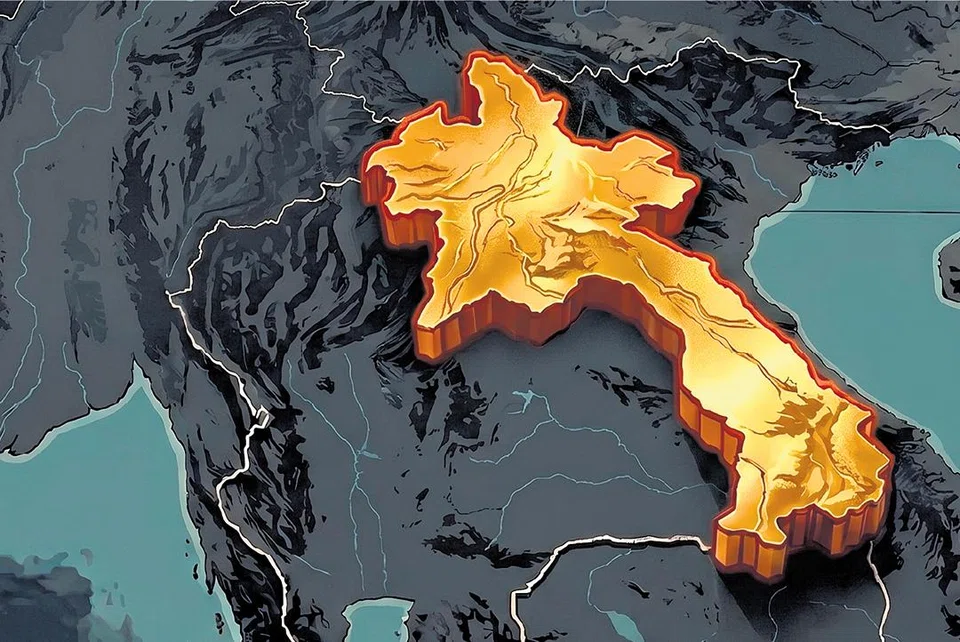
[SINGAPORE] More than a century ago, French explorers in Laos told of peasants panning for gold in river valleys or mining rocks that contained the precious metal, before crushing the ore, swirling the powder in coconut shells and melting it into nuggets.
Today, artisanal miners dig in open pits – alongside the excavators and rotary drills of multinational giants that have long cashed in on the country’s mineral wealth.
Despite abundant reserves of the yellow metal, Laos captures only a fraction of its value due to the absence of a domestic bullion ecosystem.
Both its government and enterprising locals intend to change this.
National reforms are aimed at strengthening the regulatory environment, while the private sector is investing millions to build liquidity, processing capacity and infrastructure in trading and vaulting.
The aim: to ensure more of Laos’ gold flows through domestic hands.
Deep roots
Home to more than 570 known mineral deposits – including of copper, zinc and lead – Laos ranks among Asia’s most resource-rich countries.
But gold in particular is woven into its cultural fabric and economic security. For generations, families have relied on the safe-haven asset as a store of wealth and a hedge against inflation, favouring it over a non-convertible local currency plagued with repeated bouts of depreciation.
Under French colonial rule that began in the 1890s, gold mining in Laos evolved from a rudimentary industry undertaken by peasants in the dry season to organised production tapping modern mining technologies and Western know-how.
Commercial extraction expanded sharply in the 1990s, after the World Bank identified mining as a key sector for socio-economic development and revenue generation.
The Lao government liberalised the sector, granting mining concessions to foreign investors. Under the World Bank’s guidance, Australian mining companies were among the first to enter Laos, establishing some of the country’s largest mines.
Since then, ownership of some major operations has changed hands as firms were bought over by Chinese companies.
Today, most of the country’s gold output still comes from foreign-backed operators – including from China, Vietnam and Australia – running large-scale, heavily mechanised mines.
Existing alongside this is an informal economy of artisanal miners. Because land concessions granted to foreign operators often overlap with local land rights, villagers still dig for gold with simple tools, metres away from heavy mining equipment.
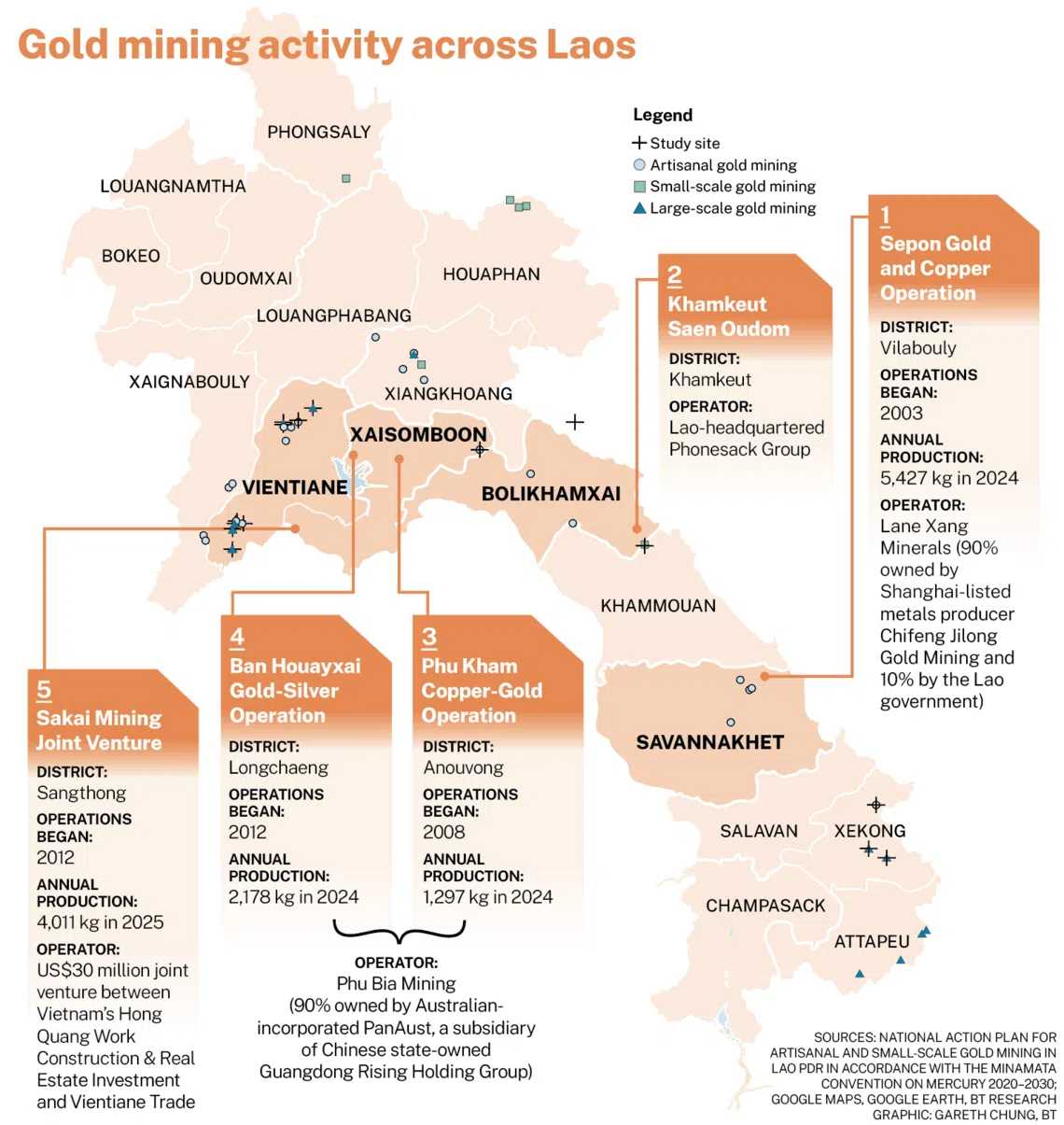
Estimated at some 15,000 in studies from the late 2000s, these artisanal miners are generally tolerated due to weak enforcement and a fragmented regulatory environment.
Meanwhile, 968 companies are authorised to operate in the mining sector, according to latest available data – as at June 2024 – from the Ministry of Energy and Mines.
This is up from 127 in October 2008. More than half of the companies were Chinese, and nearly a quarter Vietnamese.
Revamp under way
The gold-rich country now wants to recapture the metal’s value, while also strengthening regulatory oversight.
The government has stepped up efforts to formalise the mining sector: intensifying crackdowns on illegal operations, suspending unsafe worksites and introducing regulations on gold mining and broader mineral exploration.
In February 2025, it stopped issuing new mining licences, so it could relook and improve laws governing its mineral trade.
Under a notice issued by the Prime Minister’s Office this May, all existing exploration projects intending to transition to extraction must either sell their minerals to an existing refinery, or build their own processing plant.
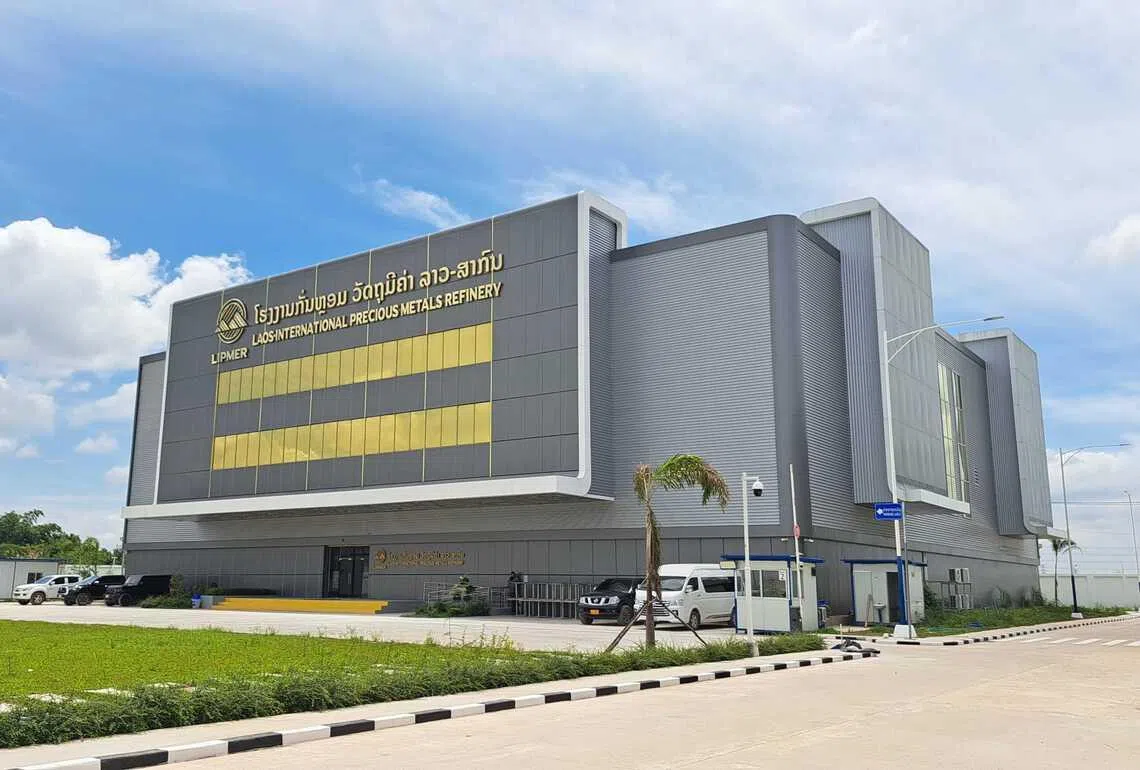
This means all raw and semi-processed gold mined in Laos will have to be refined domestically – which is where the newly opened Lao-International Precious Metals Refinery (LIPMER) comes in, says chairman and founder Chanthone Sitthixay.
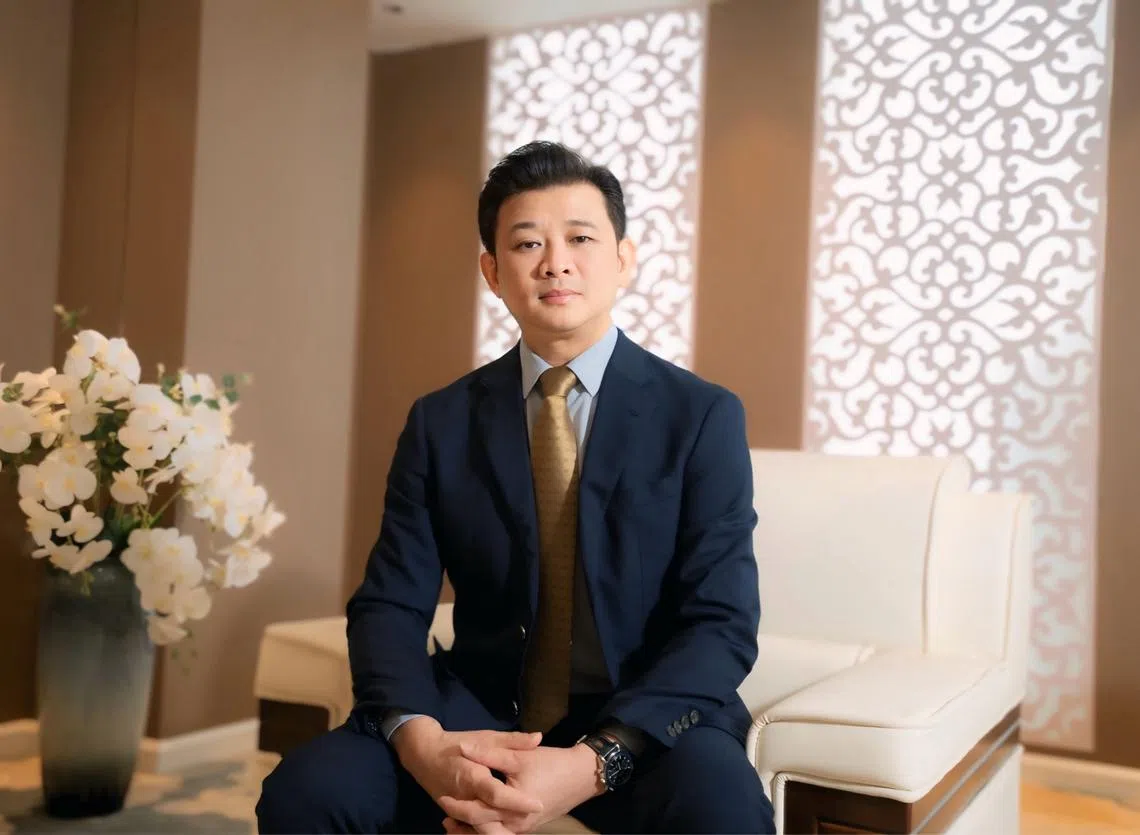
“The key thinking is that we would like to utilise our national resources and (shift) from being an exporter to a producer,” he tells The Business Times in an interview at the refinery in Vientiane.
Launched in March, the facility sits on a 4.5-hectare piece of land and has a combined production and refining capacity of up to 150 tonnes a year. It can refine gold to purity levels of 99.99 per cent and 99.999 per cent.
With the new decree, LIPMER becomes a critical link in the country’s emerging bullion ecosystem, says Dr Chanthone.
The 50-year-old tycoon is also the chairman and founder of family-owned PTL Holding. The diversified Lao conglomerate funded the US$200 million refinery and holds full ownership, though Dr Chanthone hopes the government will eventually take a stake too.
While the plant’s feedstock is mainly gold with some silver, it can process other precious metals such as platinum.
Some 70 per cent of LIPMER’s input is expected to be supplied by domestic mines, and the rest imported.
The refinery intends to sell its output to overseas bullion houses and foreign precious metals traders, as well as to the domestic market: goldsmiths, gold traders, the central bank and government reserves. This will reduce Laos’ reliance on imports, says Dr Chanthone.
LIPMER was built in accordance with international standards, with one goal in mind, he adds: securing accreditation under the London Bullion Market Association’s Good Delivery List, the “gold standard” for refiners looking to supply gold bars globally.
If the refinery meets this standard, its gold bars will be more readily accepted by international bullion banks, traders and exchanges.
South-east Asia’s first bullion bank
Another private sector-backed initiative – also by Dr Chanthone – is the Lao Bullion Bank, opened in December 2024 as South-east Asia’s first dedicated gold bank.
The goal is to draw tonnes of the yellow metal back into Laos’ formal financial system.
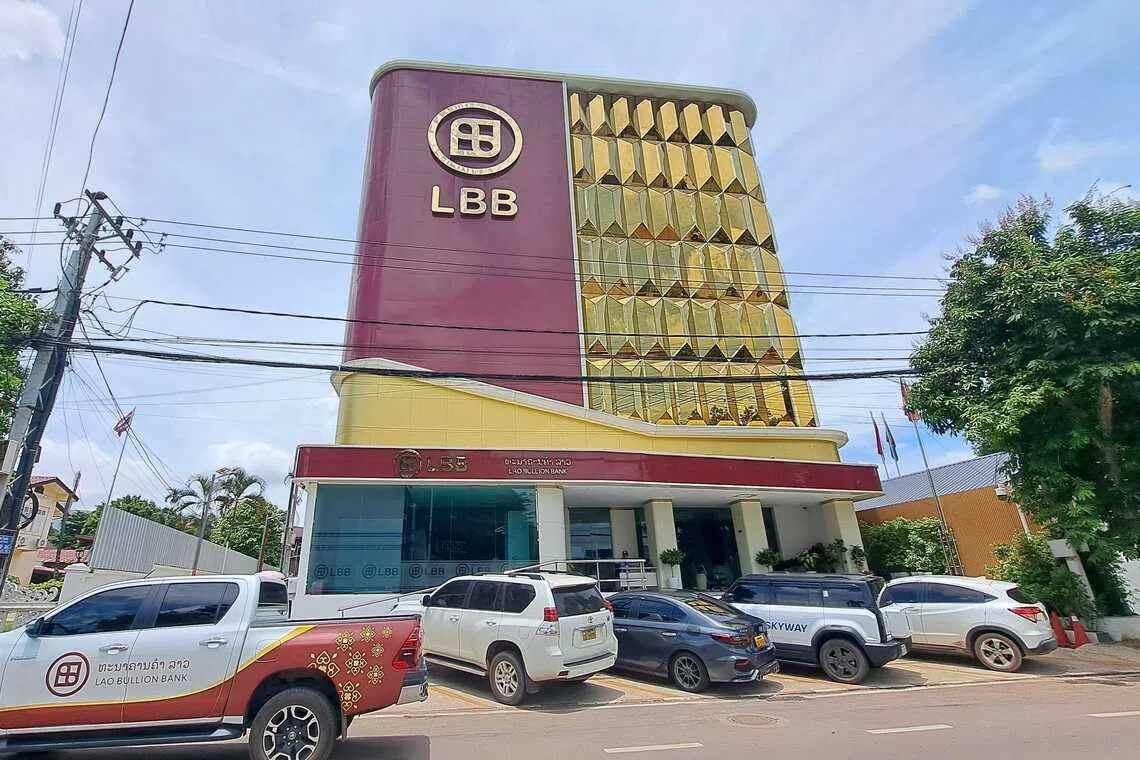
The bank offers deposit, withdrawal and transfer services, like any traditional commercial institution. Clients who deposit gold are issued certificates that can be used as collateral for loans from commercial banks and financial institutions in the country.
Lao Bullion Bank was set up as a public-private partnership, with the Lao government owning a 25 per cent stake and the rest belonging to PTL Holding. The initial capital injection of US$60 million came from the conglomerate.
By mid-2025, the bank had more than 500 kg of gold from private households; that figure has since grown to around 2,000 kg.
In its first six months, more than 2,000 accounts were opened; now, the bank has nearly 50,000.
Lao Bullion Bank has launched a gold trading mobile app and developed gold vending machines with a recycling function. Jewellery placed in these machines is melted, the resulting metal weighed, and the corresponding cash credited into the client’s account.
This year, the bank plans to issue credit cards as well.
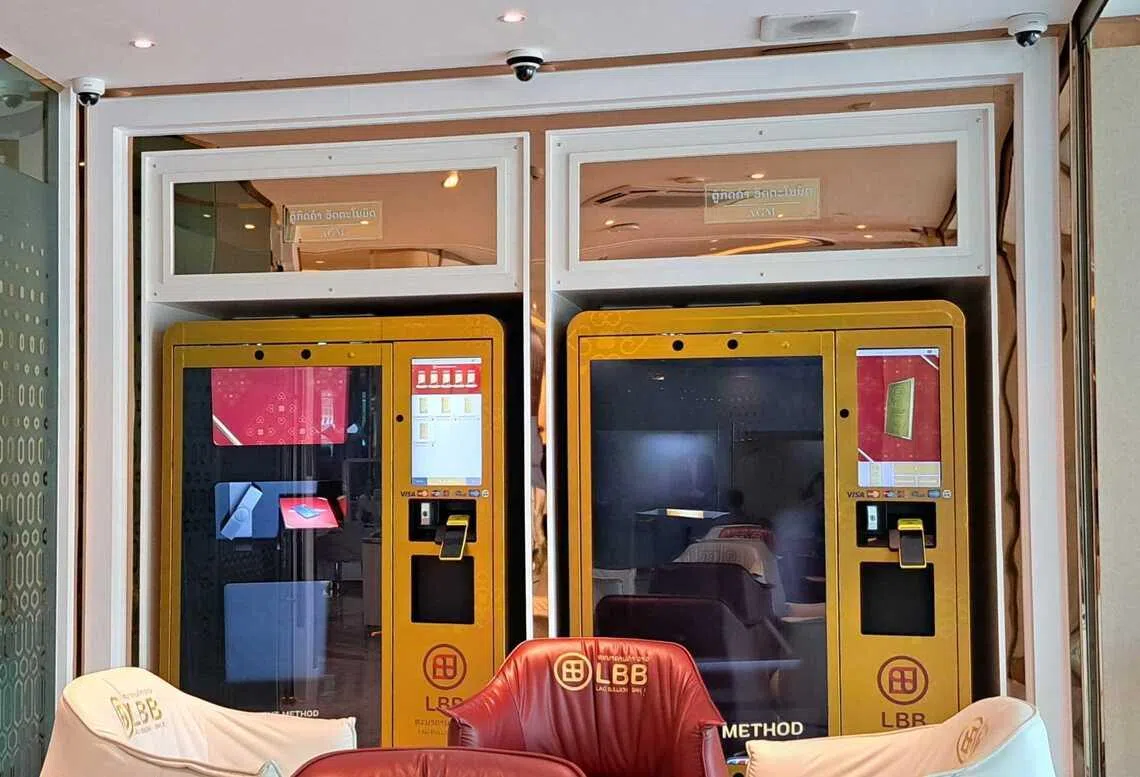
All of these moves, Dr Chanthone says, are aimed at building the foundation of a domestic gold ecosystem, with the goal of turning Laos into a gold trading hub.
The bank is also a foreign associate member of the Singapore Bullion Market Association (SBMA). In October 2024, both parties pledged to work on boosting regional cooperation and expanding Laos’ role in the global precious metals market.
A stronger and more transparent bullion market in Laos will contribute to the broader development of the regional gold ecosystem, says SBMA CEO Albert Cheng.
“Developing local refining, gold vaulting as collateral and bullion banking capabilities can support economic growth and, over time, enhance regional connectivity within South-east Asia’s precious metals ecosystem.”
Where does Laos fit?
Laos is arguably a latecomer in South-east Asia’s gold scene.
Elsewhere in the region, Singapore stands out as a gold trading and storage hub, with more than 2,000 tonnes of commercial bullion vaulting capacity.
To strengthen its standing as a trusted node for capital, investment and trade flows, the Republic rolled out a slew of upcoming initiatives last month: an over-the-counter gold clearing system; central bank gold vaulting services; and letting funds hold greater allocations of physical precious-metal investments while still qualifying for tax breaks.
Thailand is another mature trading hub. One of Asia’s oldest and largest bullion markets, it has seen rapid growth in its trading infrastructure and ranks among the world’s leading physical gold traders.
On the supply side is Indonesia, a major global gold producer with substantial reserves, strong domestic demand and a dynamic online gold trading scene.
Like Laos, it aims to move up the commodities value chain. It opened its first two state-owned bullion banks in February 2025, two months after the Lao Bullion Bank’s launch.
Though Laos is still early in its gold journey, it could play a greater role in feeding larger regional markets, says Fan Shaokai, global head of central banks and head of the Asia-Pacific (excluding China) at the World Gold Council.
“Being situated next to major gold-consuming markets like Vietnam, Thailand and China gives Laos a unique advantage as it can feed the growing demand for gold in these neighbouring countries,” he says.
“I could see a future stage where Laos starts exporting more gold to Vietnam.”
Laos’ efforts, he adds, “underscore the fact that gold is incredibly important in the economies in South-east Asia, and that a lot of South-east Asians turn to gold as a means of storing wealth, of having confidence”.
Bernard Dahdah, executive director and senior commodities analyst at Natixis Corporate and Investment Banking, says Laos also has a major advantage in its lower operating costs compared with neighbouring gold hubs such as Hong Kong and Singapore.
He notes, however, that the country has a steep development curve ahead before it can compete with its largely well-established regional peers in the gold industry.
It is paramount that Laos keeps expanding upon the reforms it put in place earlier, he adds.
“The country needs to develop a strong reputation when it comes to legal, regulatory and anti-money laundering measures, (which) would help attract foreign capital and deepen its gold liquidity pool.”
SBMA’s Cheng sees the Lao Bullion Bank’s ambition to turn Laos into a gold-trading hub as a worthwhile aspiration – but a long-term one.
“Building a successful bullion hub takes time and requires much more than refining capacity,” he explains.
“It depends on trusted regulation, internationally recognised standards, supportive government policies, efficient logistics, market liquidity, strong financial institutions and active industry participation.”
He concludes: “Ultimately, a successful bullion market is built on trust. Trust is earned through consistent standards, sound governance, market integrity and sustained collaboration with international market participants.”