

Living for the better
Jonas Samuelson, CEO of the century-old consumer electronics giant Electrolux, has his sights set on the booming South-east Asian market. His strategy? Doubling down on sustainability, while taking a "glocal" approach to design.

Sharanya Pillai
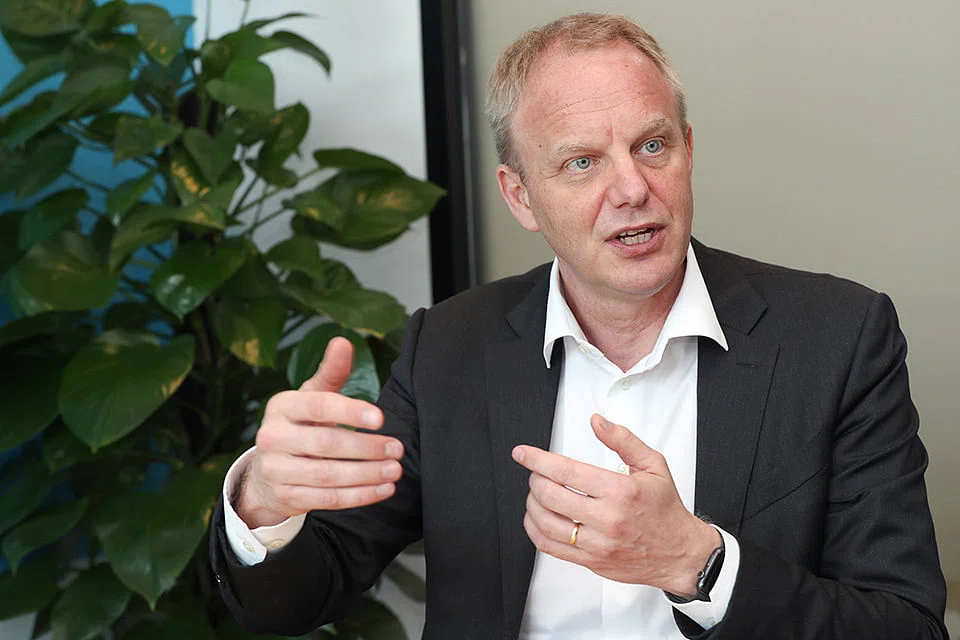
ASK Jonas Samuelson about his favourite household appliance and the chief executive of Electrolux, the Swedish home appliance giant, does not hesitate for a moment. Electrolux's CombiSteam range of ovens, Mr Samuelson declares, takes the top spot for its ability to combine "regular convection with various levels of steam" for perfect results, in the manner of professional kitchens. "When you bake bread for example - just to be a little bit of a nerd for a moment - the really ideal way to do it is to raise the temperature and then give it an initial steam burst," the 52-year-old Swedish national says with gusto.
"That makes the crust caramelise more quickly and you get a sort of crispiness, but it doesn't dry out the actual dough. So you get the crispy-on-the-outside, soft-on-the-inside type of experience," he notes during an interview with The Business Times in mid-February.
From his own passion for bread-related thermodynamics, Mr Samuelson understands that the business of selling home appliances isn't just a pricing game. Rather, it is about connecting with people's emotions and convincing them to purchase an experience for "better living", he says.
This is the art Electrolux has sought to perfect in its history of over 100 years, and will continue to tap on to grow in the burgeoning Asian market, particularly in South-east Asia, Mr Samuelson tells BT. And it's not just about using the latest tech tools, but also about keeping sustainability front and centre.
"To really focus the company more on consumer experience innovation and leveraging all the digital tools that are available to make that even more personalised, is one side of it. The other side is to do that in the most sustainable way possible... more energy-efficient, more water-efficient, and also helping consumers to make sustainable choices," he says.
The multinational firm has come a long way from its humble origins in 1919, when it dealt in vacuum cleaners that were premised on a simple idea - that these everyday machines should be lighter and easier to use. Since then, Electrolux has grown to cover the full range of household appliances, from washing machines to cooking appliances, and even air purifiers.
Along the way, Asia has grown to be a core pillar in Electrolux's global growth story, with South-east Asia playing an increasingly important role. Last year itself, the Asia-Pacific, Middle East and Africa market contributed to about 12.6 per cent of Electrolux's net sales. Within the region, South-east Asia was cited as one of the markets that had grown year-over-year in the fourth quarter of 2019.
To be sure, Mr Samuelson's plans for the region come amid unprecedented headwinds. Since his interview with BT, the global Covid-19 outbreak has taken a turn for the worse. On March 23, Electrolux released a statement that it expects a material financial impact from the crisis, starting from the first quarter of this year, due to "the severity of the situation, including large-order revisions from retailers in recent days".
However, even during the relatively calmer period a month ago, Mr Samuelson had already indicated his readiness to deal with the unexpected this year, while keeping the company's broader strategy on track.
"The only thing that's certain is that it's going to be volatile and uncertain, so we need to have a combination of being very agile and very, very flexible to meet those challenges. But we also have to be very true to our core direction and journey," he says.
Going "glocal" for better living
The home appliance revolution has saved consumers "billions of hours from daily chores", Mr Samuelson notes, but the consumer electronics industry, as with every other industry, realises the need to promote more sustainable behaviour through its products. But this cannot mean a complete negation of all technological advancement. "We don't want people to have to go down to the creek to wash their clothes, right?" Mr Samuelson quips.
What's a century-old company to do? As part of its centenary celebrations last year, Electrolux took the opportunity to launch the "Better Living Programme", a list of 100 actions that the company pledges to implement by 2030.
The Stockholm-based company has kicked off with four ambitious targets: To make sustainable eating the preferred choice; to make clothes last twice as long with half the environmental impact; to improve homes with smart solutions for air, water and floors; and perhaps most importantly, to make Electrolux's operations climate-neutral and circular within the next decade.
These targets have become integral to Electrolux's product design. For example, last year it launched the NutriFresh Inverter Multi-Door Fridge, which "allows ingredients to stay fresh for much longer, reducing food waste and also encouraging people to use more fresh ingredients instead of buying ready-made meals", Mr Samuelson explains.
Such an emphasis on sustainable living may be commonplace in Scandinavia and much of Europe, but can it fly in a price-sensitive market like South-east Asia? After all, as Electrolux noted in its latest financial results, the South-east Asian market faced some "price pressure" last year.
However, Mr Samuelson also points to the rising middle class in the region that has the desire and ability to afford better living. For instance, dishwashers are growing in popularity in Asia, contrary to the traditional aversion towards such technology, Mr Samuelson notes. Instead, now there is more awareness that consumers can "trust an intelligent machine" to dose detergent and water efficiently.
Electrolux's front-load washers have also become "iconic" in South-east Asian markets like Thailand, he adds. And the company is investing more resources towards localising its laundry range, to better care for the delicate fabrics of various cultures here, such as batik and hijabs, the head covering worn by Muslim women.
"We want to give people the confidence to put their favourite clothes in the washing machine and we'll help them stay new and fresh with less energy consumption in the washing process. The UltimateCare range, for example, has something we call 'sensor wash', auto-dosing which senses the need for detergent and water based on the dirt level," he says, in reference to the company's range of washers.
This is all part of a "glocal" approach to product design, he adds: "We have very specialised programmes, depending on the country. We have batik and hijab programmes to make it suited to the specific type of garment... It's a global platform of product architecture we have, but then we tailor programme selections to local needs."
Ultimately, Electrolux's strategy is not to foist sustainability on each market, but to produce tangible benefits that are relevant to local consumers. To reach the 600 million-strong South-east Asian market, for instance, it has a design team based in Singapore that is sensitive to the region's specialised needs.
"If we can show that look, your energy bill goes down, you're able to wear your favourite clothes as often as you like because they're not going to lose their shape or colour, and you don't have to buy as many clothes, all of those things are sustainability, but they are meaningful benefits to the consumer in their daily lives," he says.
Value chain maven
Mr Samuelson's own journey in Electrolux all began with a fascination with the mechanics of supply chains, particularly in the consumer goods segment. Trained in business administration and economics at Sweden's University of Gothenburg, he had in fact kicked off his career in the finance world, at the treasury department of Swedish carmaker Saab Automobile.
But his attention then shifted to business development. "I was really interested in the product, marketing, pricing and profit management. I very quickly got into the business and commercial end," he says. Pursuing these newfound interests, he moved to General Motors, where he spent seven years in the United States, in commercial and finance roles.
"Then, I really caught the bug for consumer durables. To me, it's just a fascinating, fascinating industry segment," Mr Samuelson says with a grin. "You have to know everything - what's the price of steel, how do I design the most efficient manufacturing process; sales and distribution, brand-building and consumer interactions, and then even after-sales support.
"It's one of the most complete value chains you can imagine. It's really interesting, very challenging. But the auto and appliance industries are very similar in that way. So I've basically spent my career in that environment and it's very stimulating," he adds.
In 2008, Mr Samuelson joined Electrolux as its chief financial officer and soon began climbing the ranks. One of the biggest tests of his career came when he was in charge of the EMEA (Europe, Middle East and Africa) division of the business, which had then been facing immense price pressure.
"The challenges in Europe, in particular, was that we'd gone through two recessions and at the same time, a lot of new competitors were coming out into the market... That became quite a challenging mix for the business, very weak demand and very tough competition. It's easy to become defensive, but we decided, let's focus on things that we can do really well, and do it even better; let's go on the offensive," he recalls.
From those headwinds, Electrolux refined its focus on "taste, care and well-being", while streamlining its cost competitiveness. For example, Mr Samuelson decided to double down on built-in kitchens, a strategy that paid off. "That was a segment that we really decided we wanted to win, because it comes with very highly-designed products, of higher value," he says.
The resilience built over the years has come in handy. Mr Samuelson's ascent as chief executive in 2016 also came at a trying time for Electrolux, just after its botched attempt in 2015 to acquire the appliances unit of General Electric for US$3.3 billion. The US blocked the deal on anti-competitive concerns, sending Electrolux's share price down as much as 10 per cent in the aftermath.
But five years on, Electrolux has moved past the failed deal, Mr Samuelson says. Instead it has found other ways to create value. Earlier in March for instance, it completed the spin-off of Electrolux Professional, which supplies equipment to restaurants and hotels, in a move to "get closer to the end-consumer" as it focuses on its consumer appliance business.
"You need to be a global scale player to be successful in this industry. So that's not changing... We're way past the disappointment of the GE deal; we're not suffering from that. But then the spin-off of the professional entity is really to ensure that both entities are fully focused on their business opportunities," he says.
Preparing for the next century
Even as an age-old business, Electrolux needs to stay young-at-heart, Mr Samuelson emphasises. Like many business leaders, he is eyeing the millennial segment, but not with cutting-edge tech tools. Rather, it is more about the inclusive culture and sustainability mindset.
"I honestly do believe that the Electrolux brand is very right for millennials. Our values in terms of inclusion, an egalitarian mindset and helping people achieve experiences in an open and sustainable way is something that is well-suited to millennials," he says.
"The fact that we are a leader in sustainable development and also perceived as that, is actually a big advantage for us when it comes to young talent. More and more, people want to work for a company that has a clear purpose, a sustainability agenda and thoughtfulness... As a company of Swedish origin and soul, inclusivity and diversity are also both very important to us."
To be sure, technology developments will play an important role. Electrolux is investing more resources into making its appliances ever more connected, drawing data insights to personalise experiences.
Summing up his vision for the next 100 years of Electrolux, Mr Samuelson says: "It's very simple, we talk about our purpose to shape living for the better. The opportunity that we have is to continuously get closer to our consumers... We will deploy a lot of fancy technology to achieve it, but those are all tools to achieve the purpose of being there for our consumers."
JONAS SAMUELSON
President and CEO Electrolux
1968: Born in Sweden
EDUCATION
MSc in Business Administration and Economics, University of Gothenburg
CAREER HIGHLIGHTS
1996-1999: Business development and finance positions, General Motors, USA
1999-2001: Treasurer and Director of Commercial Finance and Business Support, Saab Automobile
2001-2005: Senior management positions within sales and finance, General Motors, North America
2005-2008: Chief Financial Officer and Executive Vice President, Munters
2008-2011: Chief Financial Officer, Electrolux
2011-2016: Chief Operations Officer, head of global operations for major appliances, head of major appliances in Europe, the Middle East and Africa, Electrolux
Since 2016: CEO and President, Electrolux
OTHER POSITIONS
Since 2010: Board member of Polygon AB
TRENDING NOW
Temasek’s Wan Chee Foong to helm PIL, Lars Kastrup to be board adviser
Chagee, Mixue and Luckin won the market. Sustaining their edge is the harder part

He built the Vingroup empire. Now South-east Asia’s richest man is handing some key roles to his sons
One-third of Singapore-listed firms at risk in severe AI downturn: MAS

