

Mehta, maestro
Zubin Mehta rose from being a starving student in Vienna to a hotshot conductor of top orchestras to an elder statesman of music diplomacy. But he believes his work is not done.

Helmi Yusof
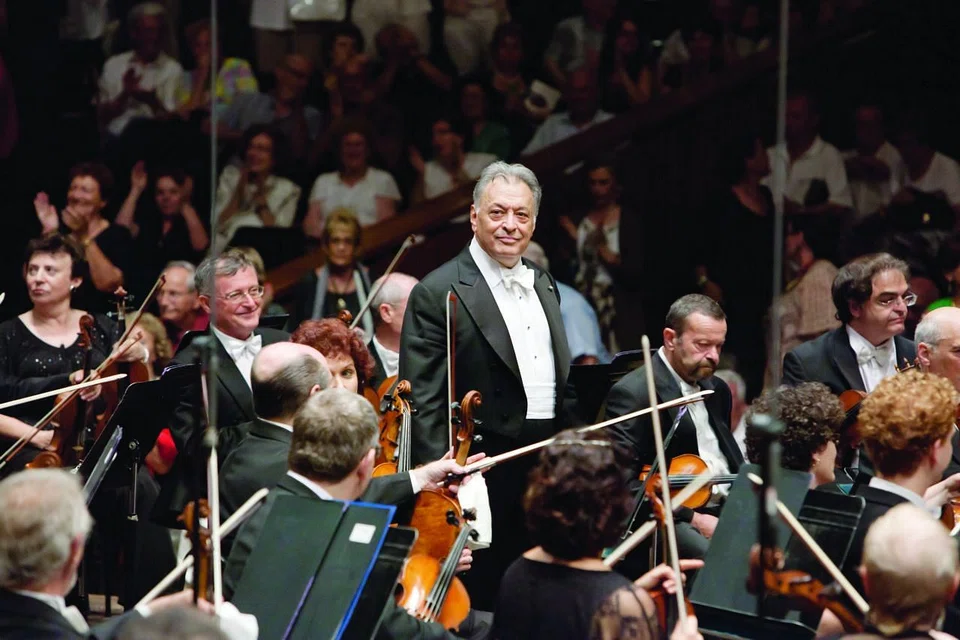
WHEN he was 15, Zubin Mehta stood trembling before the Bombay Symphony Orchestra and attempted to conduct it. His father, Mehli Mehta, had founded the small orchestra out of his love of Western classical music. Failing to attract enough members, he had instructed his young son - to whom he taught everything he knew - to stand in front and conduct them.
"I'll never forget that day. I still remember every second of it. My father was screaming at me the whole time," he reveals with a downward gaze and a hint of melancholy - before swiftly looking back up and bursting into belly laughs.
That situation - standing terrified before dozens of musicians older and more experienced than him - was to repeat itself over and over again until he became the world-renowned maestro who frequently performs to sold-out audiences and draws standing ovations, a scenario that would likely play out when he gives a concert with the Israel Philharmonic Orchestra (IPO) in Singapore on Nov 11.
In 1958, when he was barely 22, he won a competition in Liverpool for young conductors. The prize included the opportunity to work with the Liverpool Orchestra for a year as the assistant to the famous conductor Sir John Pritchard, a master interpreter of Mozart and Rossini.
As it turned out, Sir Pritchard left a lot of conducting duties to the young Mehta, who was ill-equipped to handle the complicated programmes Sir Pritchard had arranged. For his first concert, Mehta had to conduct the overture to Verdi's La forza del destino, Glazunov's Violin Concerto in A Minor, the Adagio from Mahler's Fifth Symphony and Tchaikovsky's Sixth Symphony - the classical music equivalent of a Japanese extreme obstacle course.
"I wasn't given enough time to rehearse and it couldn't have been good. The orchestra was as dissatisfied with me as I was with my work," Mehta admits. But there was something else. In one of the few times in his life, he says he felt "a little bit of bias against my ethnicity".
Still, the yawning abyss between his lack of experience and the orchestra's high expectations were perhaps the biggest gifts of his life. His frequent fish-out-of-the-water situations meant he had to force himself to work very hard day and night to vault over the abyss, sometimes foregoing sleep, so that he could master every phrase, every note, every nuance of his scores.
And that extreme work ethic carries through to today. At age 78, he rehearses with the IPO six days a week and conducts concerts for a good portion of it. On top of that, he's trying to save the world through his personal brand of music diplomacy.
Made for melody
Mehta was born in Mumbai in 1936, the son of a Parsi cotton mill owner and a housewife. His father, Mehli, was an ardent music lover who taught himself how to play the violin. As Mehta was growing up, Mehli taught him how to listen to music and read scores.
Mehta began harbouring dreams of becoming a conductor in his teenage years, even though he had no clue as to how to get there. But his father had been something of a miracle worker, learning about Western classical music on his own when there was so little of it in India. So Mehta aspired to do the impossible too. Even though the family wanted Mehta to study medicine, they eventually gave in to his desire to study music in Vienna.
It was in Vienna that Mehta's life changed completely. While enrolled at the Musikakademie, he studied under the great teacher Hans Swarowsky and watched concerts given by legendary conductors such as Karl Böhm, Herbert von Karajan, Bruno Walter and Josef Krips.
He struck a lifelong friendship with a young Claudio Abbado and an even younger Daniel Barenboim, both of whom would eventually emerge as two of the world's finest conductors. The boys spoke of music all day and night. Mehta sometimes didn't eat because he had little money. He desperately longed for Indian food, of which there was none in Vienna.
"But I immersed myself in music. I did everything to gain experience. I sang in the choir, I studied, practised, played double bass in the orchestra. That gave me a very good grounding for the rest of my life," says Mehta in an interview in Tokyo, two days before a concert at the famous Suntory Hall, which Karajan himself described as "a jewel box of sound".
In Vienna, Mehta had fallen in love with Carmen Lasky, a Canadian soprano student who was a few years older than him. Two years later, in 1958, the couple were married. As struggling artists, they were desperate for money and work.
Mehta recalls: "My father had by then moved to Manchester. He was working as the concert master of the Halle Orchestra. But what he earned, he couldn't support me. I had to do it all myself."
But "talent is talent", as the maestro says, and Mehta's talent and strong grasp of the classical canon made him the winner of two competitions for conductors, one in Liverpool and the other in Tanglewood, Massachusetts. The prize of the former was a position in Liverpool Orchestra as Sir Pritchard's assistant. And though Mehta was far from happy with the performances he gave in Liverpool, it certainly gave him a foot in the door into that exclusive, invitation-only world of conducting.
Other opportunities began to trickle in: A summer concert with the Philadelphia Orchestra and three summer concerts with the New York Philharmonic. While the audience must have been "a little surprised", as Mehta puts it, to see an unknown Indian conductor, the concerts were a success. A Philadelphia newspaper prophetically announced: "The sky is the limit for this man."
Hitting the high notes
In 1960, his conducting career kicked into high gear. Reports of his successful concerts in the United States circulated through the grapevine. After he was invited to conduct Berlioz's Symphonie fantastique for the Montreal Symphony Orchestra, which garnered a warm reception, he was offered the very next day the post of permanent conductor of the orchestra.
It was his first full-time position and he felt he could finally breathe. His wife had just given birth to their second child, son Mervon, and Mehta had been tremendously worried about their finances.
Mehta says: "In life, it is important that you get a first chance. But the real test - the real test - is whether you get called back to work with them again. And I was always called back by the orchestras I worked with. That's even more important than the public reception. Because there are times when you could be a huge success with the public, but the orchestra itself may not like you, the musicians may not take to you."
Indeed, hundreds of musicians of numerous orchestras must have thought highly of him. For Mehta rose to the rank of chief conductor of the Montreal Symphony Orchestra and held the post of music director until 1967. Simultaneously, he was named assistant conductor of the Los Angeles Philharmonic in 1961.
However, the latter appointment proved extremely controversial as the orchestra's music director designate, the great Sir Georg Solti, was not consulted on the appointment. Sir Solti resigned in protest. But instead of backing out on Mehta, the Los Angeles Philharmonic appointed him as music director of the orchestra, a post he held from 1962 to 1978.
By now the entire classical cosmos was opening up for Mehta, as he went from one successful concert to another. Mehta, however, never once took his successes for granted, staying up as late as 3am on numerous occasions to study musical scores till he could commit much of it to memory.
He says: "There is no substitute for homework. Before you stand in front of an orchestra, you have to know the work at hand, to convince the orchestra of your interpretation. You have to be convinced of what you're doing. And to be convinced, you have to know that music very well, the composers' intentions well. You almost have to know the composer personally, even though many of these composers come from the 17th, 18th and 19th centuries.
"Passion may be a big portion of succeeding. But knowledge must be behind it. All your ambition, personality, charisma are important, but behind these must be knowledge."
In 1978, Mehta was named the music director and principal conductor of the New York Philharmonic, one of the world's premier orchestras. He remained there until his resignation in 1991, becoming the longest holder of the post.
Mehta says, apart from his talent, passion and diligence, he is also blessed with another important virtue - "loyalty".
Since 1985, he also held the post of chief conductor of the Teatro del Maggio Musicale Fiorentino in Florence, with which he conducted the first ever Three Tenors concert in Rome starring Placido Domingo, Jose Carreras and Luciano Pavarotti. From 1998 to 2006, he was music director of the Bavarian State Opera in Munich. He is also an honorary conductor of the Munich Philharmonic.
Have his successes been the result of 99 per cent perspiration and 1 per cent inspiration? "It certainly used to be," he replies, before laughing again.
Diplomacy through music
Mehta's involvement with the Israel Philharmonic Orchestra (IPO) began as early as 1961, when he was asked to take over for Eugene Ormandy who had to cancel due to an illness. When Mehta arrived in Israel, he felt completely "at home". The bustle of Tel Aviv, with its organised confusion, reminded him very much of his childhood city of Mumbai.
In 1966, Mehta went on a tour of Australia and New Zealand with the IPO, once again because the conductor - this time Carlo Maria Giulini - had to cancel. Mehta formed a strong bond with the orchestra and was appointed its music adviser in 1969 and music director in 1977. In 1981, he was made its Music Director for Life. He has conducted more than 3,000 concerts with the IPO.
It was through his involvement with Israel that Mehta became more politically conscious. Learning more about Israel's political and historical circumstances, as well as the plight of Palestinians, made him determined to play a part in helping to promote peace through music.
In his autobiography The Score of My Life, Mehta writes: "I like speaking for minorities. After all, being a Parsi in India, where we are but a fraction of the population - 80,000 among 1.2 billion - gives me some authority on the subject . . . In Vienna, I was often referred to as 'the Indian'. It may have been meant as a kind of endearment, but in fact it was nothing but a form of exclusion."
Mehta wants to use music to form bridges between people. Last year, he conducted the Bavarian State Orchestra for a 90-minute performance in the war-torn region of Kashmir. Mehta recalls: "The reason for the concert was to have Muslims and Hindus sit together. One concert doesn't change things - we're not that naive. But, at least, they sat and smiled and were inspired by Beethoven for 90 minutes. And 70 per cent of Kashmir watched the concert on TV. We brought people together. It was a huge success."
Similarly, Mehta has held free concerts in Israel to promote peace between the Israelis and Palestinians. In 2009, he established Mifneh (a Hebrew word for "change") which provides music education for Israeli Arabs, in cooperation with Bank Leumi and the Arab-Israel Bank. There is also the Buchmann-Mehta School of Music founded in 2005 as a partnership between Tel Aviv University and the IPO.
Mehta says: "There are about eight or nine Arab students learning music in my school. My great hope is that, one day, when I carry out an audition for the IPO - and, you know, we place the musician behind a curtain so that we can judge him or her on musical talent alone - my great hope is that the curtain would rise, and I would see standing before me an Arab boy or girl, and I would say: Welcome to the Israel Philharmonic Orchestra."
Mehta says, just as he, a Parsi Indian conductor, has achieved great success in the field of Western classical music with minimal prejudice towards his ethnicity, he wants to see other talented musicians - regardless of race, nationality and gender - rise to similarly stratospheric heights.
"I strongly believe that talent is talent," he says. "You're either wanted or you're not."
As Mehta stands up to go for his next interview - he has six more to do - The Business Times poses him one last question: If you weren't a conductor, would you have been (A) a major general, (B) a sports coach, (C) a university professor, or (D) a high priest?
Mehta replies, once again with a generous laugh: "Well, you know, being a conductor is a combination of all these four. You only left out 'father confessor' because my musicians tell me about all their family problems and personal problems. I talk to them all the time."
ZUBIN MEHTA
Music Conductor
Born in Bombay (now Mumbai) in April 1936
1961-1967 Music director of the Montreal Symphony Orchestra
1962-1978 Music director of the Los Angeles Philharmonic Orchestra
1963 Made debut as an opera conductor with Tosca in Montreal. Since then he has conducted operas at the Metropolitan Opera New York, the Vienna State Opera, the Royal Opera House and others
1969 Made music adviser to the Israel Philharmonic Orchestra, then music director in 1977 and Music Director for Life in 1981
1978-1991 Music director of the New York Philharmonic
1990 Conducted the first Three Tenors concert in Rome
1995 Co-founded the Mehli Mehta Music Foundation in Bombay to educate children in Western classical music
1997-1998 Worked with Zhang Yimou to stage Turandot in Florence, Italy and Beijing, China
2005 Co-founded the Buchmann-Mehta School of Music to train Israel's young musicians
2009 Established Mifneh, a music education programme for Israeli Arabs
2011 Received a star on the Hollywood Boulevard
2013 Received the Tagore Award for Cultural Harmony from the Indian government
Copyright SPH Media. All rights reserved.
TRENDING NOW

Grab executives buy back shares after stock hits 3-year low on Atome deal

Simba admits exceeding spectrum limits amid failed M1 deal; parent company Tuas’ full-year profit surges 277%

He built the Vingroup empire. Now South-east Asia’s richest man is handing some key roles to his sons

StarHub, Keppel confirm talks over potential M1 deal

