More companies want to hot-desk now. How can they make it work?
Hot-desking saves space and cuts costs, but both bosses and employees need to be on board

Jessie Lim




LOVE it or hate it, hot-desking has taken offices by storm. The trouble is, the buzzy “future of work” move can leave workers feeling as if they’ve been taken hostage. The cost benefits may seem abundantly clear, especially as hybrid working becomes the norm and companies require less real estate. Yet progress in adopting flexible seating remains slow.
In 2023, 52 per cent of companies had dedicated seating arrangements, only slightly lower than the 58 per cent before the Covid-19 pandemic that forced workers out of the office, a CBRE survey published in June found.
The shift may be slower than workplace gurus envisioned, but the trend is set in place. By 2025, only 20 per cent plan to retain fixed seating, the survey shows.
The CBRE Asia Pacific Office Occupier Survey in 2023 surveyed 80 multinational and domestic companies across various industries including financial services, technology, and professional services.
The report noted: “Large corporations are almost universally seeking to improve workplace efficiency by shifting away from fixed seating to create a broader range of work settings.”
Perhaps the most attractive proposition about hot-desking is that it saves money. Companies that give up office space to make the move can save millions of dollars.
Workplace design firm Unispace is currently working with an insurance company to reduce their floor space by giving up one of their floors and optimising the remaining floor, says Joanne Morris, head of design and delivery, Asia.
“(This) could save about S$1.7 million per year in rental alone and potentially more if utilities, maintenance, or operational costs are included,” she says.
Save on costs, increase collaboration
“With more embracing working from home, hot-desking eliminates idle spaces and allows for better and more efficient use of the office space,” says Desmond Sim, chief executive of Edmund Tie.
Law firm Dentons Rodyk gave up two of its five floors at UOB Plaza in 2022 and expects cost savings to be in “the seven-figure range” yearly.
Daryl Ho, managing director of WE Communications Singapore, says that through hot-desking, the company has achieved significant cost savings both in terms of its real estate footprint and also operating expenditure savings of about 20 per cent.
Last November, the public relations and marketing firm relocated from its office in Tanjong Pagar which spanned about 10,000 sq ft, to a 6,500 sq ft space in Harbourfront.
Increased opportunity for collaboration between employees is another major reason why companies want to move to hot-desking, says Unispace’s Morris.
She says: “It removes the physical barriers and encourages employees to interact and work in a different area. That also enhances communication and a lot of companies prioritise that collaboration.”
Trip.com shifted to hot-desking from April this year due to a 40 per cent increase in headcount, and to accommodate visiting colleagues from overseas who could then easily be seated in the office.
Ru Yi, general manager at Trip.com Singapore, says: “When we started with a small team, everyone knew everyone very well. With more team members joining, hot-desking would provide the opportunity for team members to know each other better.”

Developers are starting to pay attention to the trend, and some are incorporating flexible working options into their buildings. To support tenants’ future expansion needs and shift towards hybrid working, Guocoland will be opening a five-floor business networking club called Network Hub at Guoco Midtown by the end of 2023.
The five-level building will include hot-desking areas, meeting rooms, event spaces, and a rooftop swimming pool. Short-term office suites are also available on six to 12-month leases.
Valerie Wong, GuocoLand’s managing director of asset management, says: “With hybrid working here to stay, demand for flexible spaces, short-term office suites and meeting spaces will grow.”
Why hot-desking may not be for every company
First introduced in the 1980s, hot-desking is now used interchangeably with terms such as flexible and unassigned seating. Despite the benefits, changing up workspaces can be difficult, consultants say.
Simon Raper, head of Savills Workplace APAC, says: “If you talk to someone about hot-desking, there will definitely be haters because they think about call centres from 15 years ago. Unassigned seating, the modern term for the same thing, is a more workplace-friendly term.”
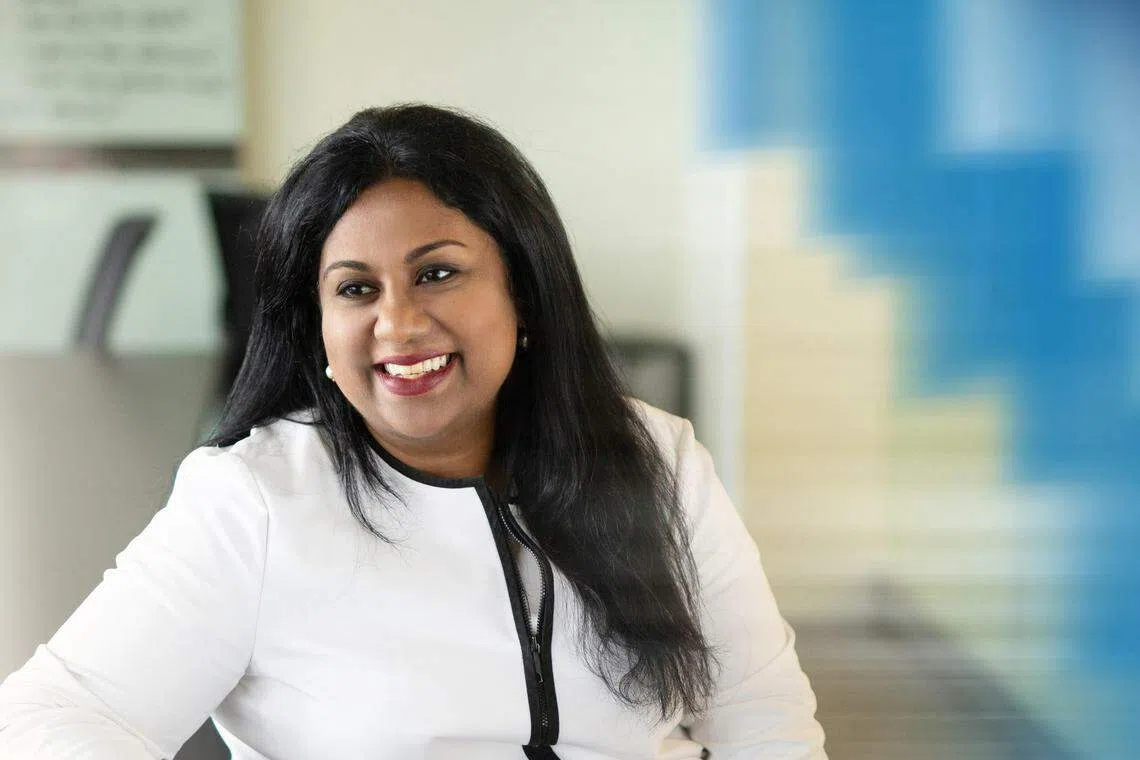
Jaya Dass, managing director of recruitment at Randstad Malaysia and Singapore, says: “When employees hot-desk, there is less personalisation of workplaces. As a result, people may feel like they don’t belong where they can’t quite get comfortable with the space that they are in, when they are always moving from desk to desk.”
In certain jobs, unassigned seating simply does not work. Jane Foden, head of change management (South-east Asia) at CBRE, points to traders who buy and sell stocks, who generally need to be in the office, and require multiple screens and specialist equipment.
In contrast, employees working in sales take a lot of meetings and are often on the road, which makes having a desk less important to them, says Dass.
Whether hot-desking is suitable for a company may also depend on its work-from-home policy, she says.
If people can choose when they come in to work, then the occupancy at any point in the office may be lower than expected and hot-desking makes for more efficient use of space.
“However, if it’s mandated that you should return several days a week, employees will expect to have one fixed desk to work from. If an employee is always working in the office, it is critical for them to form a sense of having their own workplace.”
The importance of change management
How employees perceive the change matters. Staff push back if companies are unable to show how such measures benefit employees instead of just the bottom line.
Ben Hamley, data-driven design and innovation director for Asia-Pacific at JLL, says: “People will focus first on what they are losing rather than what they are gaining.”
Chen Tang, founder of workplace consultancy Kulcha, says: “It’s not a positive impact on the morale of staff if people think that the company is just cutting costs again.”
Companies will need to think about how they engage senior leaders, managers and employees to prepare them for the change, says Tang.
“One way to ease the transition could be showing employees the office attendance levels and explaining how the business is re-investing cost savings generated by hot-desking into staff benefits such as gym memberships,” he says.
A catalyst for the change – such as a refurbishment or a move to a new location – can also make things easier, says CBRE’s Foden. “However, success is dependent on employees being supported and engaged through the change.”
The dollars and sense of it
Shifting to unassigned seating may also come at a cost, which companies must be prepared to pay.
According to Cushman & Wakefield’s APAC Office Fit Out Cost Guide 2023, fit-out costs in Singapore range from US$86 per sq ft to US$205 per sq ft for different types of workplaces.
Costs were typically higher for advanced hybrid offices, which the report defined as those with more than 50 per cent non-assigned work stations, with a variety of meeting rooms, lifestyle elements and client-facing areas on par with those in the hospitality sector.
There are also upfront costs involved in transitioning, including office reconfiguration, infrastructure and technology upgrades, floor reinstatement, employee relocation, and office improvements, says Morris.
How to make hot-desking last
Miguel Bernas, co-founder of influencer marketing company Nexplay, experienced hot-desking twice when he was working at a telecommunications company in 2013 and at a media company in 2018. Both times, the shift to hot-desking did not quite last.
He says: “Departments still sat in the same place. People still gravitated towards the old system of sitting together.”
“The irony was that the whole point of hot-desking is that you have greater interaction across departments and it was supposed to help you spark ideas that normally would not come about because you are exposed to people you don’t always work with.”
Noting that certain teams need to be able to quickly share information without having to book a meeting room, JLL’s Hamley says it is important to understand how the work in a company is done, with whom the work is done, and what those typical rhythms of work are.
“If you don’t understand how the work is being done, you might make some unfortunate mistakes and create unnecessary disruptions for certain teams.”
Most companies that have adopted hot-desking opt for a neighbourhood seating arrangement where people are grouped by functions or teams which work together, says Kulcha’s Tang.
“For instance, the product team needs to be next to distribution and marketing, whereas teams like finance and legal may be on a different floor as they need more confidentiality,” he says.
Having a suitable desk-to-employee ratio is also important, as is ensuring that staff don’t feel hassled that they need to come into the office early to snag a spot.
Hamley says: “If your company is growing, you shouldn’t increase that ratio too much and have more people than desks.This would result in a terrible work experience for those people.
“Similarly, you don’t want to have an empty office. The whole premise of an office besides being a place that is well designed to facilitate deep and focused work without distraction is to enable connection, collaboration and the development of culture.”
He adds: “There’s definitely a degree of stress involved in finding somewhere to sit. Having a more diverse office in terms of work settings can help mitigate that.”
Carol Wong, total workplace lead APAC in Cushman & Wakefield, says there has to be a very intentional effort to sustain appropriate workplace etiquette.
She says: “Companies that do not make a sustained effort to ensure a clean desk policy could be at risk of having employees fall back to their previous behaviour such as leaving personal items on tables.”
Booking systems can be set up so that when an employee sits down at a desk, they will automatically be checked in, says Savills’ Raper.
“Some booking systems can also show you the availability of desks over the next two days so you can see where your colleagues are seating and find them,” he adds.
Gathering feedback will help identify areas for improvement and allow managers to make adjustments for better employee experience.
Dass says: “Hot-desking is definitely a pivot that comes with the hybrid work arrangements that people now expect. If that flexibility is provided, people may be willing to accept that hot-desking is the way forward.”