

From neanderthals to cyborgs
He's a historian, futurist and social critic all rolled into one. Yuval Noah Harari sees his role as a bridge between academia and the public, to explain simply the story of humankind, both its history and technology.

Annabeth Leow
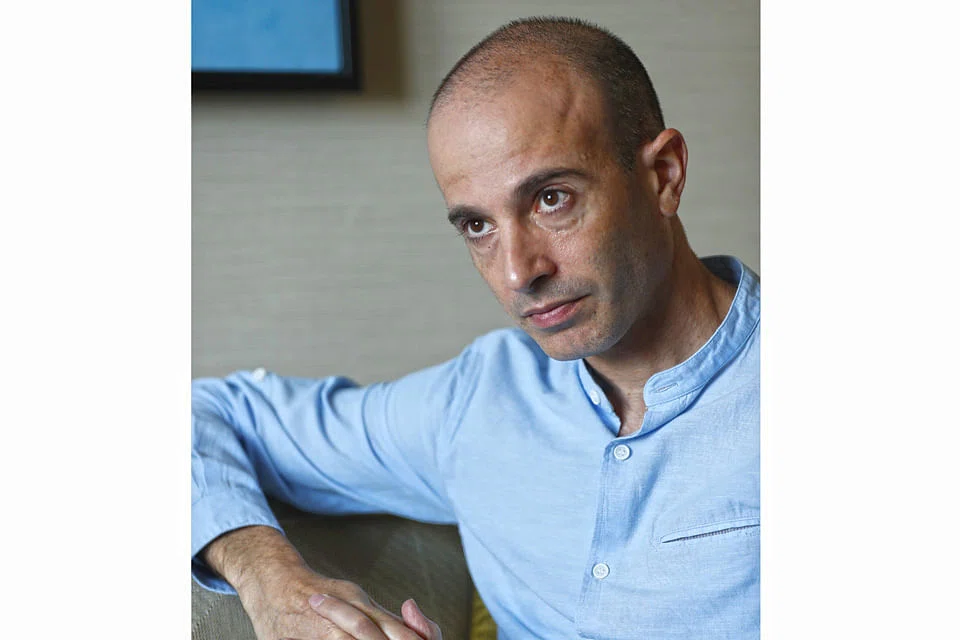
FOR a best-selling author who doesn't hold back on certain politicians, historian Yuval Noah Harari seems a tad reserved in person.
Can this diffident, bespectacled 42-year-old academic, sitting stiffly on the sofa of his hotel suite, be the man French magazine Le Point would put on its cover in September captioned "The most important thinker in the world"?
But, as Dr Harari warms up, he goes from toying with his glass of water to pronouncing the ideas that have propelled him to stardom: "The most real thing in the world is suffering", or "There are no gods or banks or states in the world, objectively".
Such polemics, plucked from the pages of his blockbuster Sapiens: A Brief History of Humankind, were possibly what made Dr Harari a headline act at July's DBS Asian Insights Conference, when he visited Singapore. A self-styled futurist, the history lecturer at the Hebrew University of Jerusalem began his career studying mediaeval European military history.
But he has since garnered far greater fame with popular science books that promise to unpack human history and technology for laypeople.
"As a teenager, I was always interested in the big questions of history and of the human condition, of really understanding the big picture of 'What are we doing on this planet?' " he says. "I didn't get any real answers from school, from my teachers or parents. Then I went to university and thought, 'Okay, this is like the temple of wisdom and finally I'll get some answers'.
"But, actually, it was the opposite - not all lecturers, of course, but the general impression you get is that the pressure is to specialise more and more on narrow questions . . . Only when I got tenure did I feel secure enough to go back to these big questions."
Cow and chicken
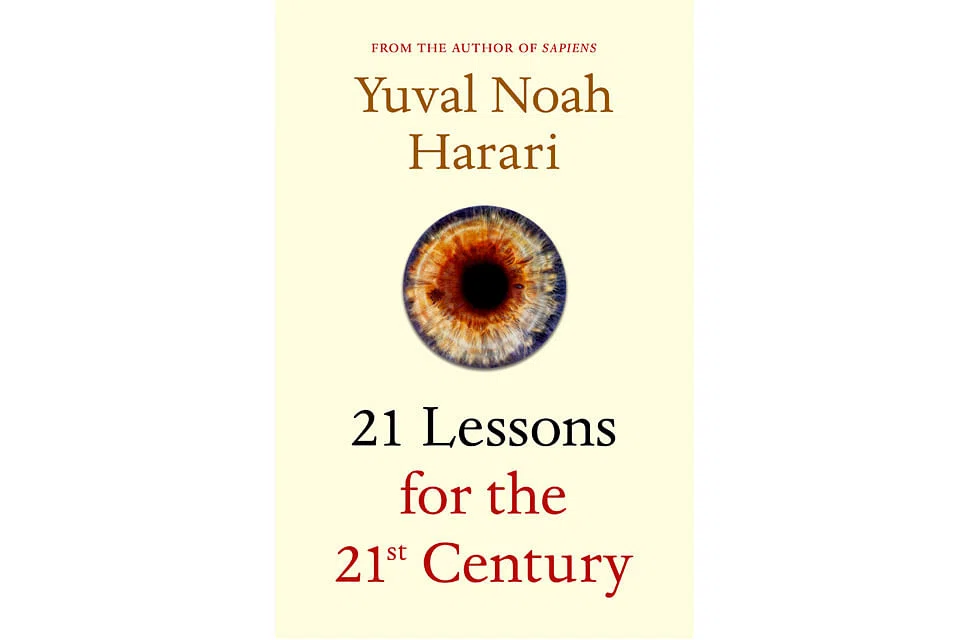
British newspaper editor Helen Lewis has compared Dr Harari - whose latest publication is an essay collection grandly entitled 21 Lessons for the 21st Century - to a self-help guru. She wrote in a review of the book that Dr Harari is now seen as a member of "general all-purpose Clever People, rather than as academics with a particular specialism".
But, trite as some of his remarks may sound, Dr Harari still comes across as a true believer in the philosophical chestnuts on which he has staked his claim to fame. For instance, he forcefully declares: "My idea of ethics is that ethics is about reducing suffering in the world, not about following the commands of some god or some holy book or whatever.
"Based on this approach, you can say very forceful and objective things about morality - what causes suffering and what alleviates human suffering."
He is sincere enough about these beliefs that he even turned vegan. "When writing the history of humanity, I realised, firstly, the immense importance of biology and the similarities between humans and other animals, and secondly, that animals have played an enormous part in human history," says Dr Harari, who lives in a moshav - a type of village-like Israeli workers' co-operative.
"As I read more about how animals are treated, especially in the meat and dairy industry - that their emotions, their feelings, their experiences are completely ignored and they are treated as just machines for producing meat and milk and eggs - I was quite shocked and horrified.
"Now, I try to minimise my involvement - not eating meat, trying not to drink milk and eat eggs, and so forth." In his view, the question of animal welfare eventually leads him to faith in an "absolute ground of reality - not just for historical processes but also for making ethical evaluations" about the nature of good and evil.
"I think that the most real thing in the world is suffering - that suffering is not a social construct," he says. "It can be caused by social constructs. A lot of the suffering in the world is caused by people believing in all kinds of fiction about, again, gods and nations and corporations and money and so forth. But the resulting suffering is 100 per cent real.
"Maybe the ultimate test of whether an entity is a real entity or a social construct is whether the entity can suffer. A nation or a bank cannot suffer . . . But a human being or a cow or a chicken, they can really suffer, and this is not a fictional story in our mind."
The prof as public critic
But Dr Harari's hand-wringing extends far beyond cows and chickens. He is an outspoken political critic as well, taking shots at United States President Donald Trump and Israeli Prime Minister Benjamin Netanyahu alike.
He made headlines in his native Israel in July when he reportedly decided to skip an event hosted by the country's consulate in Los Angeles, citing opposition to government policies.
According to reports, Dr Harari was protesting against both a controversial "nation-state law" that limits the right of self-determination to Jewish citizens and elevates Hebrew as the national language, as well as the denial of surrogacy rights to same-sex couples in Israel. Dr Harari wed his husband and manager, Itzik Yahav, in an overseas ceremony, as the country does not recognise civil marriages.
In fact, he tells BT that he feels it is the duty of the academic to speak out as public intellectuals. And he also hits out at scientifically illiterate politicians, not just the populist ones.
"It would be very bad if all professors would do what I do - like if everybody would stop doing their research on Neanderthals and just write popular science. Then we wouldn't have any basis for these popular science books!" Dr Harari says. "But then we do need at least a few scholars - like me - who serve as a bridge between the academic world and the general public.
"And this is becoming extremely important because . . . all the biggest political challenges of our era really depend on a good academic understanding. The biggest questions we face politically are things like climate change, like artificial intelligence (AI), like bio-engineering, like nuclear physics.
"One of the problems I see today in politics is that the main questions are becoming more and more scientific, but many of the politicians and most of the voters have almost no knowledge of the underlying scientific theories and models. Without this knowledge, they are really unable to engage in serious political discussion."
Science, technology, engineering and mathematics (Stem) evangelists, whether in schools or the private sector, are not spared his ire either.
"The immense advances in fields like biology and physics and computer science raise extremely difficult political and ethical questions, which are the domain of the humanities and not of computer scientists," he says.
"Computer scientists know how to develop artificial intelligence. But there is nothing in their background that qualifies them to engage with questions like how AI will influence the political system and how to make ethical judgements about AI.
"I think that, when we talk about Stem, it's almost a scandal that in many universities - like my own, and I think many others - when people go to study computer science, they are not obliged to take even a single course about computer ethics.
"Today, algorithms shape the world, and if you don't study the ethics of writing algorithms, you can make terrible mistakes." He cites how job recruitment can unwittingly abet racial or gender discrimination, because human biases have become encoded into an automated process.
"All the corporations and all the startups in fields like AI and biotechnology, they tend to emphasise all the opportunities and advantages of the new technologies. So it is the role of historians and philosophers and social critics to highlight the dangers," he says. "Not in order to prophesise that these will happen, but in order to raise human awareness of the dangers and hopefully prevent these dangers from being actually realised."
Dr Harari also bemoans the idea that some of his colleagues may be less than enthused about boning up on the latest scientific developments.
"I think the biggest problem of the humanities is not that they are becoming less relevant. They are becoming even more relevant, I think. The problem is that a lot of people there are afraid of engaging with the new scientific developments. You have philosophers or historians who don't want to read about algorithms or about genetics, and then they are left outside of the discussion," he says.
"Just as computer scientists need to learn at least a little philosophy and ethics, philosophers and historians don't need to learn how to code but they need to understand algorithms and genes in order to be relevant.
"And I think that the interesting thing about the period in which we are now living is that philosophical questions that for thousands of years remained just theoretical are now becoming practical questions of engineering . . . On whether humans have free will, you have thousands of years of discussions about it in philosophy, which have no practical implications.
"And suddenly, now, because of breakthroughs in AI and bio-engineering, the discussion of free will becomes practical."
Telling the human story
Dr Harari, by his own confession, doesn't voice many new ideas. He describes his method: "I read a very large variety of academic research, on issues from Neanderthals to cyborgs, and I try to digest them and then bring them in a simpler way to the general public."
A glaring influence on his work is Jared Diamond's Pulitzer-winning Guns, Germs and Steel, about the geographic factors that helped European civilisations to flourish. He calls the 1997 tome "maybe the most important" book that he has read, because it "showed me that you can write a very deep and well researched and scientific book about an extremely big question, an extremely big subject".
Beyond Guns, Germs and Steel, Dr Harari says that he was very influenced by primatologist Frans de Waal, who specialises in chimpanzees, bonobos and other apes.
"It is maybe funny for a historian to be influenced so much by primatology, but the basic insight is that Homo sapiens is also an ape - we are also animals - and if you want to understand human history, you must take biology into account. If you separate history from biology, you can't really understand much.
"Where I differ from Frans de Waal . . . is that biology is not enough. You can gain insights about humans from comparing them with chimpanzees and bonobos and gorillas and so forth, but it's not enough. There is another layer, there is another dimension, to human history, which goes beyond biology. You cannot explain things like the First World War or the 2008 financial crisis just by biological theories.
"The big difference between humans and all other animals, including chimpanzees, is from, as we know, the human ability to create fictions, to create imagined realities.
"And all the most powerful actors in history, against biology, are imaginary entities: They are nations, states, banks, corporations, gods."
This is a well-worn theme in Dr Harari's writings - some critics have even complained that his work is a retread of other, earlier theorists' - but he backs away resolutely from being branded a postmodernist who eschews all structure and categories.
"There is some common ground between my way of thinking and the postmodernist way of thinking, in the doubt about all the great narratives of religions and ideologies and nations. To say, 'Look, all these things are just stories invented by humans', this is a very postmodernist argument," he concedes. But he still has at least two axes to grind with postmodernism.
"First of all, postmodernism is extremely suspicious about any grand narrative. And my view is - no, there is truth. I am not suspicious of truth. Once you understand that nations or gods are just fictional stories that we invented, these are characters within the true grand narrative of the world - and I'm not sceptical about the existence of a truth.
"This is also related to the different attitude to biology. Postmodernism is, again, very sceptical and very suspicious about biology. In the more extreme circles of postmodernism, you would find people saying things like, 'Biology and the body and evolution, these are all just cultural constructs. The body is just a cultural construct. Sex is just a cultural construct'. And I think that this is nonsense. This goes way too far."
He concludes with gusto: "There is an objective biological reality, and this is the ground of history. If you think that biology is just a social construct, then you cannot really understand history, because you ignore the objective biological forces that shape human culture, shape human thinking, shape the human mind."
There is no getting away from Dr Harari's interest in the human mind, even though anti-anthropocentrism may be all the rage in some pockets of cultural theory these days.
"As a historian, my hero, my character that I'm researching, is humanity - is humankind," he explains.
"I broadened the perspective because I'm very interested in the relation between humans and other animals, and between humans and the ecosystem. But, still, the main character is humankind.
"If I were a geologist, then of course, my character would be the Earth, and humanity would play a very small role; and if I were a cosmologist, or an astrophysicist, obviously humanity is a tiny, tiny speck of dust in the enormous universe, which runs according to laws that have nothing to do with us. It's really a question of what story you are telling."
Over the past hour, he's spoken with gusto, in the persona of the superstar academic who parlayed a massive open online course and a Hebrew-language treatise into book tours and public dialogues with everyone from DBS chief executive Piyush Gupta to compatriot and Oscar-winning actress Natalie Portman.
But, all too soon, this particular story may be coming to a close. The interview over, the reclusive Dr Harari thanks BT, hands us over to his staff, and then ducks politely - but quickly - back into his room.
YUVAL NOAH HARARI
Lecturer, Department of History, Hebrew University of Jerusalem
Born: 1976 in Haifa, Israel
Education
BA and MA in history, Hebrew University of Jerusalem
PhD in history, University of Oxford
Publications
2004: Renaissance Military Memoirs: War, History and Identity, 1450-1600
2007: Special Operations in the Age of Chivalry, 1100-1550
2008: The Ultimate Experience: Battlefield Revelations and the Making of Modern War Culture, 1450-2000
2011: Sapiens: A Brief History of Humankind (Hebrew edition)
2014: Sapiens: A Brief History of Humankind
2016: Homo Deus: A Brief History of Tomorrow
2018: 21 Lessons for the 21st Century
TRENDING NOW

Fed hike throws Singapore banks a margin lifeline; UOB most likely to feel impact

He built the Vingroup empire. Now South-east Asia’s richest man is handing some key roles to his sons

Real-estate veteran Desmond Sim quits from CEO roles at Realion, ETC

Chagee, Mixue and Luckin won the market. Sustaining their edge is the harder part

