

No nonsense
Morgan Stanley president Colm Kelleher cuts through the fluff and gets to the heart of banking, history and populism.
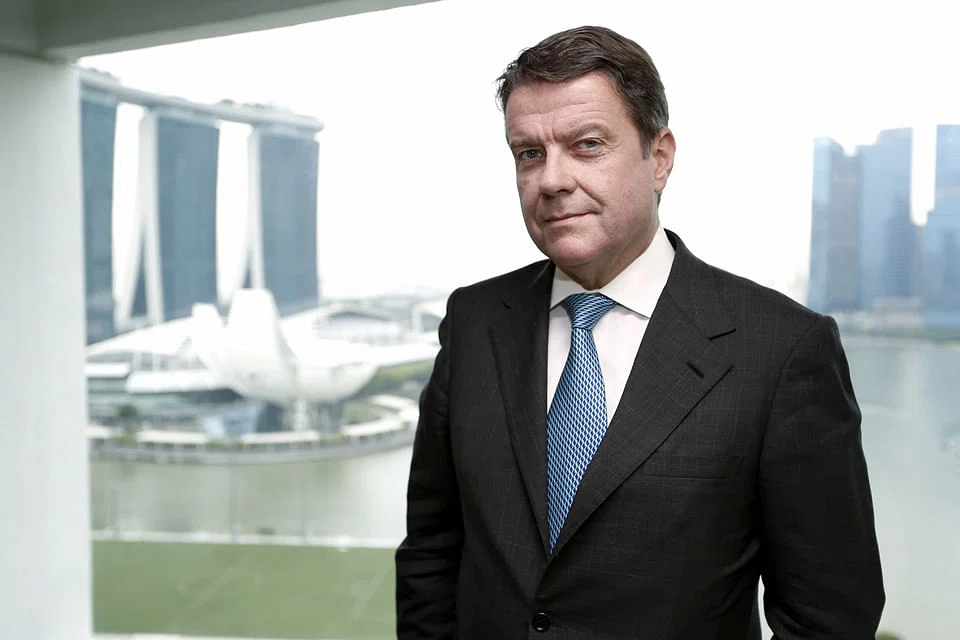
MORGAN Stanley president Colm Kelleher really does not want the interview to be about him. He is happy to share his views on current events, banking and leadership, but ask him about himself and his first response is to try to change the topic.
"Most people at Morgan Stanley actually don't particularly like the cult of the individual. We do think it's about the firm, we do think it's about the team, and we kind of get a bit embarrassed, with respect, when we talk about ourselves, right? You know? So you don't see much written about me in the newspapers, and that's deliberate. I think I'm a steward of this franchise, passing it on to other people. But you still want to ask your question, right?"
With that unspoken warning not to pursue the kind of fluff pieces that focus on the subject's football team (Chelsea in the Premier League) or choice of sins (cigars and fine wine), Mr Kelleher made it clear that what matters to him is substance. You want an interview? Let's make it about things that matter. You want to run a bank? Let's not lose sight of our duty to our clients. You were surprised by the latest election results? Let's see what the actual policies are going to be before passing judgement.
It would be a mistake to read Mr Kelleher's reluctance to talk about himself as a sign of shyness. He is quite the opposite. Once described by Reuters, rather accurately, as "brash and outspoken", Mr Kelleher is not afraid to speak his mind and is casually confident about his intellectual wherewithal.
When the interview turned to the topic of the US presidential elections, which had taken place just a week earlier, a diligent public relations minder interrupted Mr Kelleher mid-response to remind him that events could change between the time of the interview and actual publication. That earned the minder a mild rebuke from Mr Kelleher, a message to those around him that he is perfectly capable of handling an interview, thank you very much.
"Well, I haven't said anything on the US yet," Mr Kelleher said to the minder. "I'm not being chaperoned before I answer the question."
Perhaps being able to speak up and hold your own is an indispensable trait when you are one of nine children. Mr Kelleher grew up in County Cork in Ireland, but moved to England as a teenager when his father, a doctor, moved there.
He was no academic slouch, eventually gaining admission into the University of Oxford where he was a budding scholar of the Byzantine empire. If things had gone according to plan, Mr Kelleher would have become a history professor, doing research and teaching students about Constantinople and the Crusades. He has given up those plans by now, but he shared that he hopes to one day write a novel set in Byzantium.
"I fell into banking purely by mistake," he said. "I wanted to be an academic, I wasn't clever enough to be the quality of academic I wanted to be, so I then went to my university appointments board and said, what's good? So I did a whole lot of interviews, and I joined banking."
As a new banker, it did not take Mr Kelleher long to apply his analytical mind to his career.
"A year into banking, I realised then - this was all pre-Big Bank - that the only people who got on in banking quickly were people who'd either been lawyers, chartered accountants or had had 10 years' experience already," he said. "So I left and qualified at Arthur Andersen as a chartered accountant in the UK, then got back into banking," he added. "I'm a frustrated academic."
Mr Kelleher appeared to make the right calculations. Since joining Morgan Stanley's fixed income business in 1989, he has climbed steadily through the ranks, earning a reputation as a career survivor who not only helped to keep the bank afloat as chief financial officer during the global financial crisis, but also outlasted rivals for prime leadership positions. Mr Kelleher notably took solo control of the reins of Morgan Stanley's investment bank in 2012 when co-head Paul Taubman retired. He was again in a co-pilot position shortly after that, being co-president in charge of the investment bank together with Greg Fleming, who led the wealth management business. In January 2016, Mr Fleming left Morgan Stanley after chief executive James Gorman named Mr Kelleher as the firm's president - and his heir apparent.
Mr Kelleher's rise to the top has been fuelled by his ability to deftly guide the ship in troubled waters.
The book Too Big to Fail by Andrew Ross Sorkin reveals how close Mr Kelleher was to the heart of the action during the darkest days of the global financial crisis in 2008, as Lehman Brothers was going down and every other bank on Wall Street was wondering who would be next.
Mr Kelleher became chief financial officer of Morgan Stanley in 2007, just as the world was getting the first whiff of what would be the biggest financial crisis since the Great Depression. In his book, Sorkin noted how an alert Mr Kelleher had been building up liquidity to guard against a run on the bank.
In a Morgan Stanley meeting just after the weekend in which Lehman filed for bankruptcy, Mr Kelleher also described the industry's situation as "Darwinism", telling his colleagues: "Weak people are taken out. Strong people, I believe, are going to do very, very well."
Of course, those words were said before Morgan Stanley's own survival became questionable amid redemptions and its own investments in toxic assets. The bank, with former chief executive John Mack leading the way and Mr Kelleher running the finances, eventually saved itself by transforming into a bank holding company and by negotiating an investment by Japanese bank Mitsubishi.
"We've taken this firm from 2007, a US$1.326 trillion balance sheet with US$29 billion of capital, to today, an US$800 billion balance sheet with US$70 billion of capital, US$160 billion of deposits, and we have a value proposition," Mr Kelleher said.
"What you're seeing with us, from being the 'gang who couldn't shoot straight' . . . We have suddenly rebuilt ourselves back up to the peak of excellence, I believe, on a relative basis outperforming our competitors."
It has been quite the journey for Mr Kelleher, whose recollection of the early days includes relics such as accepting houses and the Plaza Accord.
"When I joined banking, the Americans were not a factor in the UK," he said. "It was the British accepting houses, the merchant banks. I went to work for one of those initially. Globalisation hadn't happened. You were only coming out of the Plaza Accord. Freedom in markets, the growth of the eurobond markets. I mean, the very fact that in the US now that 80 per cent of lending is via the capital markets is telling you just how vibrant capital markets are."
He continued: "Of course, that's the problem Europe has; Europe hasn't got a developed capital market, and London could have given it, but now they have this issue (with Brexit). So banking has changed dramatically.
"Now, banking went through a bad period in the 10 years from 1997 to 2007 when leverage became the guiding model and as a result all sorts of perverse things happened. The excesses in proprietary trading, the excess compensation that was paid out and so on. But I think banking is in a much better place now as a result of the regulatory changes that have happened since then. I think we've kind of come full circle to the business I joined."
Fundamentals come first
That's where Mr Kelleher's no-nonsense, fundamentals-first philosophy comes into play. One of the core problems for banking is that bad apples had been getting rewarded along with the good ones.
"The issue is that banking by definition is well-paid business, and it has to be a well-paid business because it needs very capable people," he said. "The pay has clearly come down from the excesses, I accept that, but nevertheless you need a certain skill set for people to be good bankers. By definition when you have an industry that is well paid you will have bad apples. The trick is to make sure that you have a culture and a governance to ensure that those bad apples are caught quickly and expelled. Where you have banks with bad cultures, it's obvious. Where you have banks with strong cultures, it's obvious. You cannot regulate for culture . . . What you have to be is punitive in punishing bad behaviour and good at encouraging good behaviour."
Building that kind of a culture is easy to aspire towards, harder to actually execute. But there are aspects of it that are rather straightforward, by Mr Kelleher's telling. Take the rigging scandals that involved the London Interbank Offered Rate (Libor) and foreign exchange rates, for example.
"If you were manipulating Libor, you knew that what you were doing was dishonest. You may have thought that it was market convention, but there's a smell test," he said. "You must have known as a trader that what you were doing was dishonest. The same thing with foreign exchange. If you were manipulating at the end of the day closing rates - Morgan Stanley was not involved in either of these cases, by the way - what you were doing was dishonest. You know, you have a fiduciary duty . . . That's what we have to police ourselves against."
Bankers can avoid these situations if they put their heads down and carry out their functions like they are supposed to, he said.
"The industry's reputation is massively in tatters, but we have an ability as a reconstituted industry to bring value back to society, to help lubricate economic growth, to help in the sharing and redistribution of goods and services, which is what banking is here for. It was Dick Fisher, who was another chairman of Morgan Stanley, who said, 'bankers should be boring'," Mr Kelleher said.
"Bankers should be boring. We should not be in the news. We should be doing our job. We get well paid, but our job is to actually facilitate trade, balance of payments, growth and so on, and that's what we should go back to doing. Part of that is that we have to take out the compensation excess, which I think we're doing. I do think these deferred payments are very good, I do think clawbacks are very good. And I think we get people better aligned with their stakeholders again. Look, bankers will never be loved, right? By definition. But we should not be in the news, and I think that's where our ambition is."
A new challenge has appeared on the horizon with the rise of populism around the world. Britain had voted to leave the European Union a few months before the interview, and in the United States Donald Trump and his anti-establishment rhetoric had just won the presidential election.
Mr Kelleher adroitly identified that there was a difference between the appearances that show up during a campaign and the substance that emerges during actual governing. Hence, he was hesitant about making a quick judgement on the impact of a Trump presidency.
"What Donald Trump was saying during the political stages of his campaign may be very different from the transition period and as president," Mr Kelleher said. "Certainly his acceptance speech was conciliatory in tone, interviews he's given since show some practical consideration of big issues."
For Mr Kelleher the historian, the rise of populism is more troubling on a personal level.
"It's very worrying," he said. "We are in the 100-year anniversary period of World War I, 1914 to 1918, a number of new history books have come out in the last couple of years, and one of them is Christopher Clark's The Sleepwalkers, which if you've read, actually shows how a number of unconnected mistakes led to a terrible cataclysm. And what it feels like at the moment is that a number of unconnected things are causing strange things to happen. Now, I'm not saying there's going to be global thermonuclear conflict, but clearly I'm worried about the knock-on effects of some of these things. Populism can go so far.
"At heart, I'm Irish, as you know. I'm a big believer in the European Union, I'm a big believer in the integrity of the European Union (EU)," said Mr Kelleher, whose eldest brother Declan Kelleher is Ireland's permanent representative to the EU and was the Irish ambassador to China from 2004 to 2013. "So I'm very concerned about this situation in Europe and the attack on the European project that's going on, whether it's from Geert Wilders in Holland or Marine Le Pen in France, or wherever it is. So I do think we are living in very worrying times, actually. History may not repeat itself, but as Mark Twain said, it does rhyme."
COLM KELLEHER
President Morgan Stanley
Born May 30, 1957
Education
History degree from University of Oxford
Career
1983 Qualified as chartered accountant at Arthur Andersen
1989 Joined Morgan Stanley fixed income
2000 Head of fixed income sales Europe, Morgan Stanley
2004 Co-head of fixed income Europe, Morgan Stanley
2006 Head of global capital markets, Morgan Stanley
2007 Chief financial officer and and co-head of Strategic Planning, Morgan Stanley
2010 Co-president, institutional securities, Morgan Stanley
2013 President of institutional securities, Morgan Stanley
2016 President, Morgan Stanley
TRENDING NOW

Keppel Reit to buy 51% stake in Keppel South Central for S$610.9 million
Singapore to use ‘every legal and regulatory lever’ against companies linked to haze: Shanmugam

Mi Material focusing on ‘things that we can control’ as it launches S$215 million SGX IPO

Once staunchly pro-China, Malaysian Chinese businesses are now distancing themselves from Beijing

