

Paper chase: Andrew Rose, dean, NUS Business School
Andrew Rose, dean of NUS Business School, talks about the business of running a business school, and why students should be more intellectually adventurous.

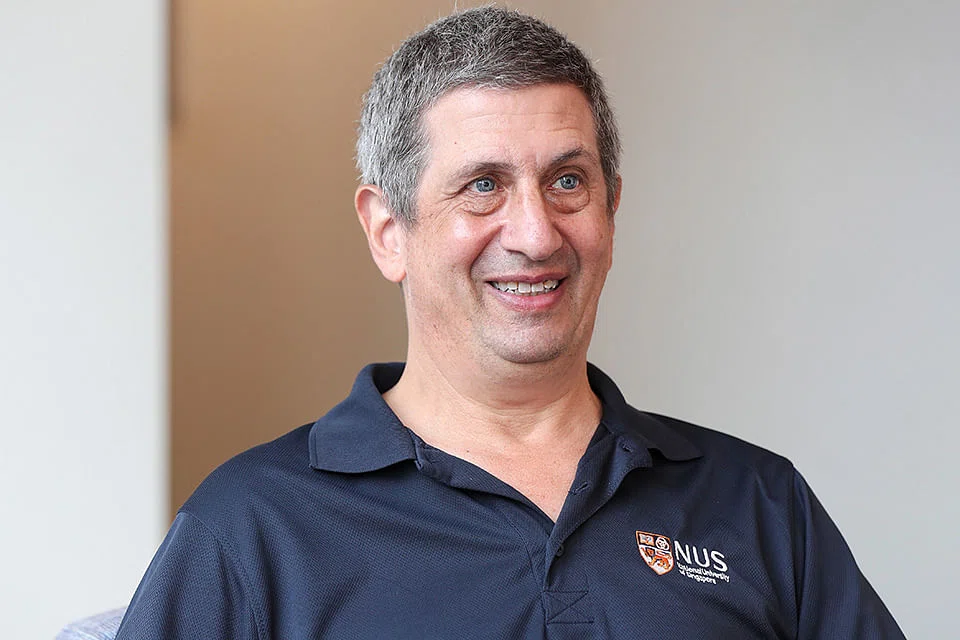
PROFESSOR Andrew Rose doesn't believe in having academic visions. The dean of NUS Business School, who assumed the role in mid-2019, says he "came here explicitly without a strategy", believing it's "completely inappropriate" for an "outsider" like himself to bring one.
"My view is, either it's really obvious what your strategy is, in which case, there's no reason to because it's obvious, or it's something we're not doing already, in which case, why would you imagine we have a comparative advantage in it?" says Prof Rose.
As he developed his strategy for the school in the initial weeks that followed, one of his first challenges was how to chart a sustainable way forward for the school, which he said had been struggling with finances.
"We were not in a situation of fiscal sustainability, the school was losing money, and under no circumstances should a business school ever lose money," he says, adding that this was one of the first challenges he'd faced since assuming his role.
There was a need to look for a new revenue stream, given that undergraduate enrolment is likely to shrink alongside the falling birth rate in Singapore, he tells The Business Times.
The school is also constrained to an extent by government-set quotas, since autonomous universities admit only 40 per cent of the graduating high school class, mainly from the junior colleges and polytechnics.
In addition, the majority of its 3,000-strong undergraduate student body needs to be Singaporean, he says.
And so that's led to the expansion of the school's Master of Science (MSc) programmes, which are typically attended by self-funded graduate students from overseas.
There are 10 programmes to choose from, covering areas such as business analytics, finance, and supply chain management, according to the school's website.
These programmes are targeted at fresh graduates with no work experience - a markedly different group from experienced professionals who are keen to pursue a Master of Business Administration (MBA).
It's an "under-served market", says Prof Rose of the MSc programmes.
"We have tremendous flexibility because MOE (Ministry of Education) only really cares about undergraduates. We have lots of flexibility, we can charge whatever tuition is appropriate and treat the students really well.
"It's attractive to the faculty because the (MSc) students feel less entitled than our MBA students, but you can also teach more technical and interesting material than our undergraduate students, and they're more mature than our undergraduate students," he says.
Prof Rose says many of the students - who hail from North America and Europe - have not spent much time in Asia at all, making this a valuable opportunity for them.
"If you want to have an easy year in Asia, which is perfectly safe, perfectly clean, they speak English and you don't have to worry at all, Singapore is great," says Prof Rose, adding that Singapore also boasts of ethnic and religious diversity.
"Singapore is a very attractive destination for the kid who graduates in geography from Oxford and has no idea what to do... So our major thrust is to push forward and make our MSc programmes very attractive to students from all over the world," he says.
Value of higher education
But with a pandemic raging, and the economic outlook still uncertain, is this really a good time to be pursuing higher education?
After all, some human resource specialists would dissuade new graduates from going to school and potentially chalking up more debt, given the bleak job prospects, while others would conversely encourage it precisely because of the weak labour market, as the downtime can be used to learn new skills.
"I think it's always wise to get more qualifications," Prof Rose says.
This is because education levels have been rising "in the entire world" in the last 50 years.
"So anyone who's entering the labour force is going to be competing with peers who are more educated than they would have been a decade before or 20 years before, and steadily, very clearly over time, the entire labour force is becoming more educated," he says.
As the labour force becomes increasingly educated and people pay a premium for more qualifications, Prof Rose says young people should pursue their dreams and get the maximum amount of qualifications that they can, as this is an investment that pays off very well.
Granular grading
However, there's also something to be said about students who're all work and no play.
Prof Rose believes university is a great time for students to also pursue interests outside of school, whether it's violin, water polo, German opera or Chinese calligraphy.
"University is a great place to meet people who are doing these sorts of activities that can make you very happy outside, and employers don't want students who can just handle well-defined tasks," he says.
"They also like students who can figure out solutions to problems that the employers didn't even know they had, and to spot opportunities."
Singaporean students, he believes, tend to love well-defined tasks and can become obsessed with their grades, and this can cut down on teamwork.
"Students are less likely to engage with their friends and colleagues if they're in competition with them. They're less likely to take experiential learning seriously, they're less likely to be intellectually adventurous and in the business school, we have very few students who take physics or geography because they're worried about getting a bad grade and they'd be scarred by life," he says.
Instead, being adventurous is a tremendous part of having a good broad-based university experience, as well as being successful in business later on, he adds.
With this in mind, the school is planning to do away with more granular grading such as "A+" and "A-" for its Masters students.
Rather, the vast majority of students will get one grade - honours, distinction and pass.
Honours is reserved for students who have excelled with very high grades, while three-quarters of the cohort will get distinction.
"So they won't be competing with each other for grades. Hopefully, they will then take the opportunity to engage in teamwork and experiential learning more seriously," he says.
Noting that this is modelled after Harvard Business School, he says: "If they can do it without worrying, I feel confident (and) we're happy to follow."
Hybrid teaching
With the pandemic still ongoing, one other challenge for the school is having to conduct classes in a hybrid fashion.
This means a lecturer goes into a classroom with mask-wearing students who are socially distanced, and this lesson is simultaneously being streamed to students who are dialling in from home.
"The instructor has to deal with the students in the classroom and also those online who might be chatting, using the chat, where they might want to intervene and speak and have their interactions come over the loudspeakers," he explains. "Managing that is not easy, everyone hates hybrid teaching, and I understand that."
But this is the "best of terrible alternatives", Prof Rose concedes.
Asked how he managed to get buy-in from the faculty to continue with hybrid teaching, Prof Rose says he only ever tries to win arguments through logic, theory of data and evidence.
He recounts how students began asking for discounts a year ago when teaching moved online because they felt the quality of teaching was lower.
"My argument to the faculty was, basically, how many times have you heard of students complaining because of hybrid teaching and asking for a discount? None," says Prof Rose.
Unlike online lectures, students recognise that the faculty is "working hard to make it as best as possible" with hybrid teaching, even though they recognise that it isn't perfect.
Living in Singapore
Prof Rose lives with his family on campus and he especially enjoys bumping into familiar faces as he goes about his daily activities.
"These days, we can have a maximum of two people, once a day, over, but even having two colleagues over for a cocktail to socialise but also to discuss business and to talk about what the school should be doing, that's great," he says, referring to restrictions on house visitors amid tighter Covid-19 rules during Singapore's Phase 2 (Heightened Alert).
Although students don't live where he lives, he makes it a point to be close to them by walking around the campus - usually in his signature polo shirt and shorts.
"Before the pandemic, I always encourage students to tap on my shoulder and shake my hand and tell me what's happening," he recalls.
"Now they can't do that as I don't shake hands, but I still like to interact with the students by walking around," he says.
Some students talk to him about interesting or challenging problem sets, their difficulties in getting into a module, as well as feedback on a class or instructor.
But what strikes him is the large number of complaints sent in by students' mothers, who believe their children deserve a better grade for an assignment or module.
"It's almost always mothers of sons, not mothers of daughters, which is sort of wild because if you're a Singaporean undergraduate here, that means you've been through the military for two years," he notes, a little wryly.
Asked whether Singaporean parents tend to be more involved in their children's education, compared with their counterparts from other countries, he agrees immediately, but offers this explanation: "One of the ways that Singapore is a little bit different than most other places I've been is that most of the undergraduates live at home with their parents - voluntarily. So yes, it is different."
Prof Rose has taught in a number of countries, including Belgium, the Netherlands, France, the United Kingdom, Canada, Israel and the United States, and he has never experienced this - the close involvement of parents in their undergraduate children's studies - other than in Singapore.
Prior to joining the National University of Singapore as a Wee Cho Yaw Visiting Professor in 2016, Prof Rose was associate dean for academic affairs and chair of the faculty at Berkeley's Haas School of Business.
But Prof Rose was no stranger to Singapore, having been here as a visiting professor at both the NUS and Singapore Management University for a number of years since 2004.
In 2015, the Monetary Authority of Singapore (MAS) and NUS jointly appointed him MAS Term Professor in economics and finance.
"Singapore was also a very easy place for my family to spend time, but when all is said and done, probably the most important thing was, my wife and I decided... that if we had a kid, we wanted the kid to speak and to be really conversant in another important language," he said.
This turned out to be the Spanish language, since the couple was living in California, but the other language that they chose was Chinese.
He adds: "From a very early age, we wanted to spend a lot of time in a Chinese-speaking community so that our son wouldn't (just) be able to speak, but also read and write Chinese, which he does. And Singapore is just the easiest place to both live and work and converse in Chinese."
ANDREW K ROSE
Dean NUS Business School
1959: Born in Toronto, Canada
EDUCATION
1977-1981: BA, Trinity College, University of Toronto
1981-1983: MPhil, Nuffield College, University of Oxford
1983-1986: PhD, Massachusetts Institute of Technology
CAREER
1986-2019: Professor of Economic Analysis and Policy, Haas School of Business, University of California at Berkeley
Since 2019: Dean, NUS Business School
OTHER APPOINTMENTS
1995-2001: Managing Editor, Journal of International Economics
Since 1991: Research Associate, National Bureau of Economic Research
Since 1992: Research Fellow, Center for Economic Policy Research
Since 2013: Senior Fellow, Asian Bureau of Finance and Economic Research
TRENDING NOW

First Resources blames El Nino, outside fires for Kalimantan hotspots amid haze scrutiny
High Court rules against Julius Baer’s Singapore trust arm in US$50 million family trust dispute
Singapore key exports jump by higher-than-expected 68.4% in September, led by non-electronics
MSCI proposes downgrading Indonesia to standalone market status

