Passport to the good ol' days
Blackberry CEO John Chen believes the iconic smartphone giant has merely lost its way, and its market is growing in ways that most people don't know about yet.
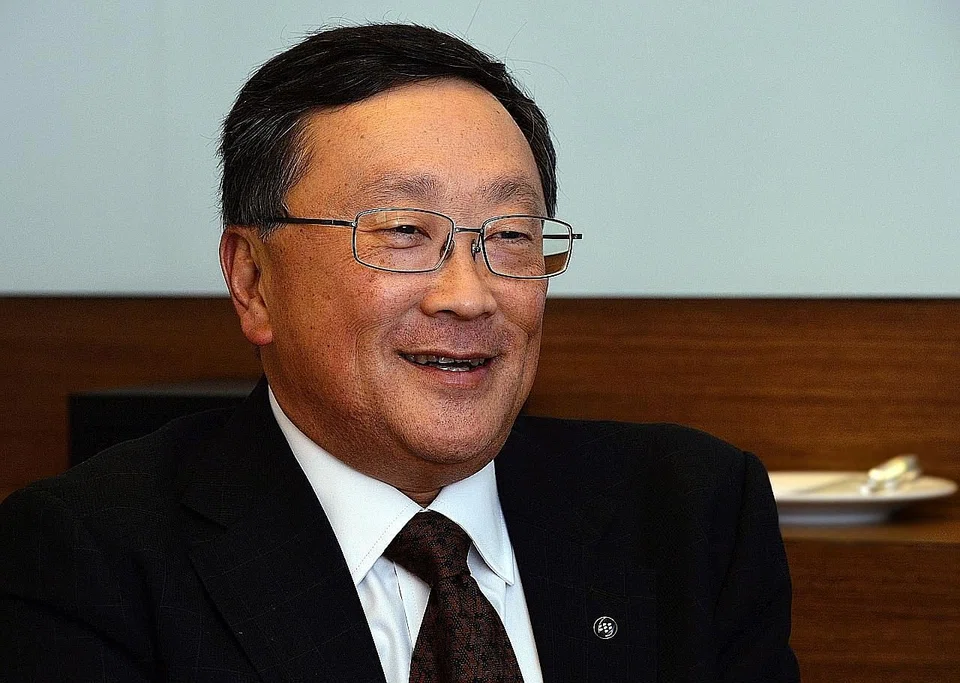
JOHN Chen's smartphone is a bit like him - it stands out from the crowd. The BlackBerry CEO carries the latest flagship phone from his company called, interestingly, the Passport. In a sea of rectangular screen-only candy bar-shaped smartphones, the Passport is an almost square phone (actually it's shaped like a passport and hence the name) with a physical keyboard. You look at it and wonder: "Gee, who's going to use this?"
But once it's in your hands, it begins to make sense and you may even start to like it. It's early days yet but BlackBerry may be finally onto a winner with this phone.
The Canadian company - a smartphone operating system (OS) and devices pioneer - has been pushed to the sidelines by Apple's iPhone and devices running Google's Android OS. BlackBerry has been reduced to a bit player in the fast growing and highly lucrative market.
This is what Mr Chen wants to fix. An engineer with an enterprise software background, Mr Chen's appointment in November 2013 as head of BlackBerry came as a bit of a surprise considering his lack of experience in the highly competitive mobile phone market. However, he has developed a reputation for being a turnaround artist and that's probably one of the reasons he got the job. That, plus the fact that he loves to take on a challenge. A year on, BlackBerry's stakeholders are hoping that Mr Chen will be the company's passport to a return to its glory days.
And what glory days! In 1984, two engineering students, Mike Lazaridis and Douglas Fregin, set up a company called Research in Motion (RIM), specialising in electronics and computer science consultancy. It went through years of obscurity till it hit its big breakthrough. It created a smartphone which was easy to use, secure and allowed people to send and receive e-mail while away from their office computers. They called it BlackBerry. This ability to send and read e-mail, in an easy and secure way on a phone, may seem ubiquitous now but when the first BlackBerry device came out, it was considered revolutionary.
This allowed RIM to grow into one of the world's leading tech companies and the BlackBerry phones became the constant companion of heads of state, business executives and even Hollywood stars. RIM seemed invincible until one day in 2007, the late Steve Jobs of Apple took a rectangular candybar phone out of his back pocket after saying: "One more thing . . ." The iPhone and phones based on Android took the smartphone world by storm and swept away both RIM and Nokia, the two big giants in the industry.
RIM was renamed BlackBerry in 2013 and at the same time, the company played its last card in an effort to recapture market share in the high-end smartphone world. This was the Z10 smartphone, a 4G high-end device that used the new BlackBerry 10 mobile system. It was a great phone but the company made the mistake of pricing it in the same ballpark as the iPhone and high-end Android devices. The Z10 suffered from a lack of apps due to BlackBerry not having the rich eco-systems that sustain Apple and Android. Eventually, the Z10 was a marketing disaster and resulted in a huge inventory loss that almost killed the company. More on that later.
Mr Chen was appointed after BlackBerry had failed to find a buyer to rescue it and a US$4.7 billion deal to take it private collapsed. In a stellar career, the Hong Kong-born executive has worked in a number of top positions in a diverse set of companies. He's best known for his time as CEO of enterprise software maker Sybase. Like BlackBerry in the smartphone world, Sybase was once a pioneer in the enterprise software business and used to compete with the likes of Oracle and SAP till it fell on bad times in the late 1990s. Mr Chen took over in 1998 with a mandate to turn around the company which, at that time, was worth just US$362 million and staring at the prospect of going under.
Mr Chen recalls that after he had joined Sybase, Forbes ran an article with his picture prominently displayed. The text said, something to the effect: "Somebody tell this man that turning around a software company is impossible."
Impossible or not, in 2010 SAP bought Sybase for a cool US$5.8 billion. Mr Chen recalls wryly that after the deal, Forbes carried another one-page article headlined: "The Phoenix Rises".
"I have the later article by Forbes. I wish I had kept the earlier one also; unfortunately even the magazine couldn't find a copy for me," he says with a smile.
When he came on board at Sybase, all enterprise software companies were developing e-commerce solutions. "Instead of being a follower, I decided to skip a generation and go straight into mobile commerce or m-commerce. We were laughed at for getting into mobility so early and (were told) that everyone was losing money in mobile and (that) wireless was 'just a dream'. Well we became the largest enterprise software provider in wireless technology."
Indeed one of the reasons SAP paid so much money for Sybase was its expertise in enterprise wireless technology.
Mr Chen wants to do an encore with BlackBerry - not in terms of prepping it up so that someone buys it, but because he believes that BlackBerry, like Sybase before it, is a very iconic company and its current difficulties stem from having lost its way.
"I want to return this company into a very competitive player in this market . . . and this is a huge market and is evolving. It's really about rebuilding the company."
He adds that the one good thing about the telecommunications market is that it's going to grow in areas and forms and shapes that most people don't know about yet.
There is still a way to go, as Mr Chen would be the first to admit. But the start has been promising. In the fiscal second quarter of last year, the company had to write off almost US$1 billion of inventory and cut some 4,500 jobs. The writedown was mainly due to the company failing to sell the Z10 in sufficient numbers.
Since then things seem to be looking up for the Waterloo, Ontario-based company. For the three months that ended on May 31 this year, the company posted quarterly financial results better than what some analysts had expected. It said it recognised hardware revenue on 1.6 million BlackBerry smartphones in the quarter, up from 1.3 million in the previous quarter.
Media reports quoted Mr Chen then as saying during the earnings call that over the previous six months, the company had focused on improving efficiency in all aspects of its operations to drive down costs and improve margins.
Mr Chen feels that the trick to preventing an established market leader from falling on its own sword is to create an innovative environment that encourages and incubates but does not distract.
BlackBerry needs to concentrate on what it does best - which is enterprise, security and productivity - and then stick to it. "Yes people always tell me then you left this part and that part. But if I go do every part, then we're back to exactly where we were before.
"What we decide to do, we'll do it very well and we are going to win on those and we will then create enough value for us to get the company financially well and then start investing in other areas. So that's the plan."
He reckons this plan is a six-to-eight quarter journey. "Arguably I'm in the third quarter of this journey. We want to make sure that we repair our balance sheet and we generate cash from our operations. That's most important. If you don't have cash, you cannot go on."
The second thing, he adds, is the need to be profitable because profitability instils confidence in the market and "also allows you to invest (as) otherwise you can't generate cash and be non-profitable for very long as that doesn't line up".
In its revamped state, BlackBerry is focusing on four business areas: handsets, enterprise, automotive business and BlackBerry messenger.
For lower range handsets, Mr Chen has cut a deal with Foxconn, which builds the iPhone and many of the world's top electronics devices. Under the deal, Foxconn will help design the hardware for BlackBerry's future low-end devices as part of a five-year deal. BlackBerry itself will remain focused on software technology. The deal has been set rolling in Indonesia, the world's fourth most populous country but an under-penetrated market in terms of smartphone sales. One of the first phones in this range, the Z3, has generated good demand.
In the high-end range, demand for the Passport has been more than the company expected, leading to inventory shortfalls. This is a good problem to have, Mr Chen says, and while BlackBerry is ramping up production, it's already planning a follow-on device for the Passport. In order to make BlackBerry devices more user-friendly, the company has added the Amazon Appstore to its phone so that users can access the thousands of Android apps available on Amazon.
Mr Chen has also laid emphasis on BlackBerry's mobile device management business, which is a collection of software tools that allows IT departments to manage different devices connected to their corporate networks. The company's iconic BlackBerry Messenger application, which is somewhat like an enterprise class WhatsApp application, is now available on both Apple and Android devices.
Another business that has received a lot of attention is the company's embedded QNX software, which is used in in-vehicle infotainment systems and industrial machines.
BlackBerry acquired QNX Software Systems from Harman International back in 2010 for around US$200 million. The company has used QNX to power its Playbook line of tablets and build its BB10 OS.
However QNX's main market is in providing the basic software for automotive infotainment systems. Applications such as Google Maps run on QNX in cars. BlackBerry has around 53 per cent global market share in this business. The second biggest player is Microsoft with around 27 per cent market share.
But beyond the automotive business, Mr Chen says, QNX can provide BlackBerry with a solid infrastructure offering in the emerging IoT (Internet of Things) business, especially the security aspect of inter-connected devices. That's something which he is keeping a keen eye on. However, being the pragmatist he is, Mr Chen is now focused on the more mundane challenge of turning around the company. He's managed to stem the rot and reduce the panic that had set in. Now he's determined to go the full distance.
As he says, he doesn't need the money that comes with being BlackBerry's CEO. However, the challenge is something he relishes and his love for a good fight is what has stood him in good stead as an Asian American in the highly competitive technology industry.
"I have this philosophy that I would rather grow my own food than beg you for food. From a career perspective, you have to be genuine and real. You have to work well with others. And you never back away from danger or problems and I've always had this philosophy that makes me go and pick the toughest assignments."
He recalls that when he was a hands-on engineer, he would inevitably raise his hand for the most difficult tasks. "Someone needs to fix this module and the whole shipment of the mainframe depends on fixing it. Most people say 'Ooh if I fix it, I'll be the hero but if I don't, they will chop my head off'.
"Being an Asian in the US, it seemed like even if I fixed it, the credit went to the boss who is usually not Asian. I've gone through a lot of that. But I realise that the truth is always there as nobody is really that stupid. If you have fixed it, you have fixed it, you don't need to broadcast it. If you don't get recognised, you just move on."
And Mr Chen is a fighter to the last: "If you come at me strong and hard, you have to prepare to fight me. You could just kill me but you better not just hurt me because if you don't kill me, I'll get right back at you . . . You need to beat me down to the point so that I can't fight anymore."
The net result of this attitude is he gets up every day and looks forward to new challenges.
"I do long days and I do worry a lot but at the end of the day, what does worry do for you? Just worry, it's nothing else. I don't lose hope. I will always work, this might be a job that is bigger than I can do but I will always work to the point that people ask me to stop."
Mr Chen loves to play golf. But he's not too sure if he can relax during the game. "I love playing golf. But sometimes I'm so intent on winning that playing golf is not very relaxing. I don't like to lose. Honestly speaking, you need to like what you do and I like what I do and so I don't need relaxation."
This just about sums up BlackBerry's CEO who's a passport to a better future for the iconic company.
JOHN CHEN
Executive Chairman and CEO, BlackBerry
1955: Born in Hong Kong
1978: BS in Electrical Engineering, Brown University
1979: MS in Electrical Engineering, California Institute of Technology
1979-1990: Various positions in Burrough Corp (now Unisys), including Design Engineer and Vice-President
1991-1995: Chief Operating Officer, President and Director, Pyramid Technology
1995-1997: Chairman, CEO, President and Director, Siemens Pyramid
1998-2012: Chairman, CEO and President, Sybase
2013 to date: Executive Chairman and CEO, BlackBerry