

A People-Enabler
Joseph "Yossi" Vardi, pioneer Israeli entrepreneur and tech godfather, finds the human spirit in technology. When he invests - he has put money in more than 90 companies - he looks not so much at the idea behind the venture as the talent of the people behind the pitch.
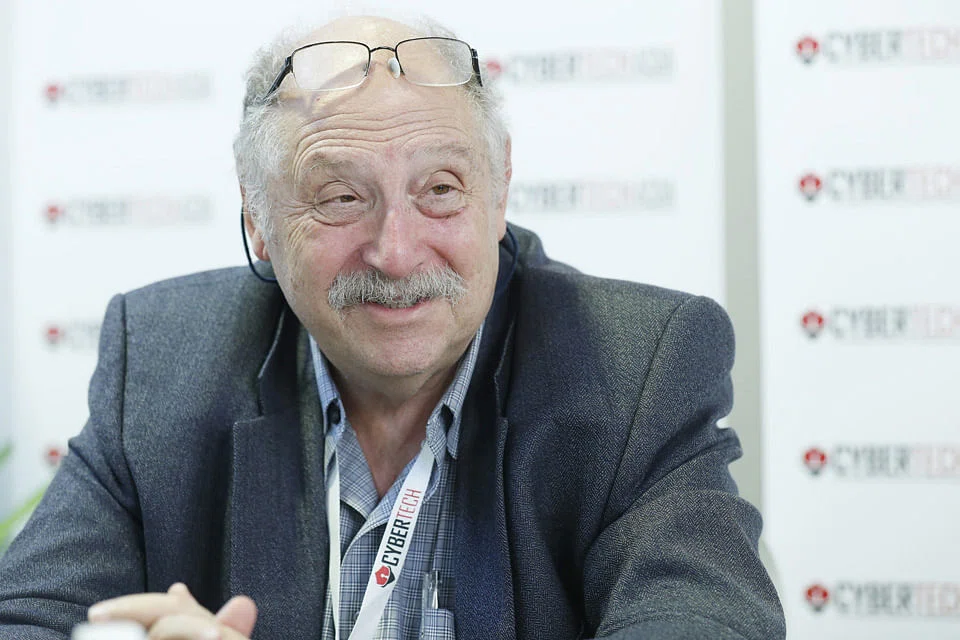
GETTING a friendly thwack over the head with a rolled up brochure was not what this reporter was expecting after an interview, but Joseph "Yossi" Vardi is anything but ordinary.
"Make sure this young man sends me his story," he bellows at the young PR liaison, before lightly tapping me on the head with an event brochure he has on hand.
That absurd but humorous encounter reflects but one part of what makes up one of tech's biggest luminaries, a man who has worked in the technology sector all his life, and who now devotes his time - and money - into investing in startups.
The interview is taking place just after he had gone on stage as conference chairman to address the crowd at Cybertech Asia 2018, an Israeli-led symposium for international cybersecurity companies to display their wares and network.
Most of the speakers of the day were from the Israeli government or tech sector, underscoring the massive number of Israeli startups there are in the world.
So widespread is Mr Vardi's reputation among the technorati that he has been bestowed the moniker "Godfather" of tech, reflecting his decades of deep experience in technology, as well as the multitude of startups he has helped fund.
"Probably the best description is that I am an enabler of other people," Mr Vardi says. "Mainly younger people on the cutting edge of technology because all my life, I was into building companies, investing in companies.
"So (now) I enable other people to grow and execute their visions. And I do it in different ways and areas. But it's always around tech, energy, these sorts of things."
Mr Vardi has a sharp eye for identifying people and ideas with the potential to make it big - after all, he has invested in more than 90 companies. The chairman of 4YFN, a startup platform that link startups, investors and companies, lays claim to having invested in a firm which laid the groundwork for instant messaging as we know it today: ICQ.
The company which owned ICQ, Mirabilis, was set up in 1997, and was co-owned by his son. He invested US$75,000 in Mirabilis at his son's request. By the end of 1998, the Israelis had sold the firm to AOL for US$400 million.
(For those with long memories, ICQ is still around, available for all major operating systems.)
Out of the firms that he has invested in, according to him, he has had 31 exits, but also another 30 companies which closed.
ICQ is but one of the many startups he has helped build and seen to fruition. Many, like Alon Energy and online video platform Brightcove, have gone on to become public companies, while others like Gteko and Tivella have been acquired by major multinational tech firms.
But not all were successful.
"I lost my money. Disappeared, vanished, evaporated, became nothing," he recalls, "which shows you that sometimes you win, and sometimes you lose.
"It's part of the game. If you don't lose money, it means you didn't take enough risk. And if you don't take risk, you cannot soar. If you want the thrill of flying higher, you have to take the risk."
People maketh the product. When he invests, he's less interested in what the idea is, but more in the talent of the people who are pitching their ideas.
Some people have ideas, but the difference between an idea doing extremely well, and going nowhere, is in the talent of the people driving those ideas, he maintains.
He looks for talent, energy, drive "...and luck", he says.
"Luck is very important, but I tell you, the secret god doesn't distribute luck evenly. God likes to give more luck to people who are working harder. He sees someone working very hard, he gives him more luck," he declares, in his trademark tongue-in-cheek brand of dry humour.
An Israeli upbringing
His love of technology began in his formative years; he unabashedly uses words like "geek" and "nerd" to describe himself back when he was younger.
"When all my friends were chasing girls, I used to sit down and say, what a bunch of idiots, why are they chasing girls when they can chase vacuum tubes, which are much more fascinating," he deadpans.
It was part of life in Israel, where everyone looks to "tie in to some higher cause".
People, he says, are not building startups. They are building the economy, helping them feel like they are part of something bigger.
"To add to it, the fact that every Israeli boy has a Jewish mother who from the (boy's) age of five begins to say, 'after all that we have done for you, is asking you to bring home one Noble Prize really too much?'"
That collective spirit of striving for excellence is key to Israel's rise as a hub for startups, and as home to many of the world's top technology companies today.
The country even has "Silicon Wadi" - a play on the more well-known Silicon Valley. Many high-tech clusters can be found in major cities like Tel Aviv, Haifa and Jerusalem, and a good number of multinational technology corporations have offices in these places.
One of the most prominent chronicles about Israel's startup culture is the book "Start-up Nation: The Story of Israel's Economic Miracle".
Published in 2009, it remains relevant today. In it, authors Dan Senor and Saul Singer investigate the reasons why Israel - a nation almost constantly in a state of war and with a population just shy of nine million - has the world's highest number of startups per capita.
The usual explanations are the level of education, the level of technology, government policy and the effect of Israel's strong military, Mr Vardi says. But there is something else driving the spark in the country.
"It has to do with the spirit of the individual, who is willing to venture and to risk. It has to do with the community and society at large.
"You need, in order to have a thriving startup society, kind of a social group. And when you take the people of Israel and you begin to look at the heritage and what motivates them - not only now but through the ages - you will see how the ethnic properties of this group lend itself to this time in history to high-tech startups," he says.
The trend goes back 100 years, not in technology but in other things, Mr Vardi points out. The creation of the state of Israel, kibbutzim (a kibbutz is an Israeli collective community traditionally based on agriculture), smart agriculture and employment creation all helped give rise to the spirit of community and entrepreneurship.
"It's a group of industrious people, much like Singaporeans," he says of Jews. "You also took a piece of land - which was like a village - and you turned it, in no time, into something which is quite amazing. And this has to be by the spirit of the people."
And it's people whom Mr Vardi sees as key to any startup's future. He prefers to focus on the human element when he invests in companies, even if they sometimes fail.
To those who are afraid to take the first step, he refers to a speech made by former US president Theodore Roosevelt in 1910, called The Man in the Arena.
In the speech, Roosevelt spoke of the virtue of attempting, and that recognition should go to the person who attempts and tries to make something big, even if he fails.
It's applicable today to angel investors and venture capitalists as much as it does to fledgling startups, who need to understand that failing is part of the game, says Mr Vardi.
The person who tries, he adds, should be credited much more than the people who are sitting around the arena and just watching what's going on.
"It's not a question of failing. It's a question of attempting. If you don't attempt to climb Everest, there is no chance you will get to the peak.
"So if you want to achieve anything, you have to try... since achievement is always associated with a probability that you may or may not make it, then failing is part and parcel of this whole package of attempting. So (if) you attempt, you (may) win; if you fail, you just try again. If you don't try, you will never succeed."
Cyber insecurity
One of the topics close to Mr Vardi's heart is cyber-insecurity, the antithesis to the more common "cybersecurity".
It's the other side of the coin, the exploration of a system's vulnerability, he says.
"Every large system that you build, the larger the system is, the more complicated it is. It's hard for the architect of the system to take into consideration all the possibilities," he notes.
"So you always have spaces which are vulnerable, and unfriendly entities can sneak into the system through these holes. This is even more aggravated when you deal with legacy systems."
Large banks and utilities fall under that category, he says, as their systems are sometimes so large that to replace them wholesale would require tens of millions of dollars and valuable time, making it unrealistic to attempt such an undertaking.
"It's not trivial. You will need more and more manpower to work on these issues and this is why dealing with cyber (threats) is a growing proposition," he says.
The problem is that the ongoing war between hackers and cybersecurity experts is asymmetrical in nature.
"The hacker could lose some time, some computing resources. Practically, they can't lose.
"The world is just beginning to wrestle with this issue and the more damages there are, the more the incentive will be to collaborate."
How do we do it better?
Technology can help solve the world's ills, but it's a tool at the end of the day, which can build or tear down depending on whose hands it is in.
"Technology is like a hammer. You can take your hammer and build wonderful things, or you can take a hammer and break somebody's skull. It's not the tool, it's the hand which holds the tool," Mr Vardi says, which makes the difference.
However, the benefits of technology, startups and all this enormous development are not evenly distributed. In Israel, only 8 per cent of the population work in the high tech sector, and this is the highest number in any country in the world, he notes.
"This means that 92 per cent are excluded from it. It's like having a great party, with 92 per cent of participants standing outside looking at the party and wondering why they cannot share this. It doesn't create anything positive," he says.
And what does he envision the tech scene becoming in the next 20 years?
"In 20 years I see myself lying in my grave, very happily. In 20 years I will be 96, I don't think I will see much, but maybe I'm wrong," he muses.
"There will be a lot of changes in technology, but there will be no changes in basic human aspirations, in understanding what is good and what is bad, what is just and what is not just.
"The interactions and emotions among people, feelings like love and hate, and affinity and jealousy, all these things will never be changed like in the past few thousand years. I think they will continue to prevail."
JOSEPH "YOSSI" VARDI Technopreneur Chairman, 4YFN (4 Years From Now)
Born 1942, Tel Aviv, Israel
Education: Technion, Israel Institute of Technology
Career highlights
1969 Co-founder and CEO of TEKEM, one of Israel's earliest software firms
1970 Appointed youngest-ever Director General of Israel's Ministry of Development
1996 Founding investor of Mirabilis and ICQ, world's first instant messaging service
1998 Sold Mirabilis, together with ICQ, to AOL for US$400 million
2000s Adviser to Amazon CEO Jeff Bezos
Current - Chairman of 4YFN; member of World Economic Forum, among various appointments






