People problem fixer
Krishnan Rajagopalan, who heads Heidrick & Struggles, talks about the "new breed of leader" organisations seek and how he plans to take the business forward in a digital world.
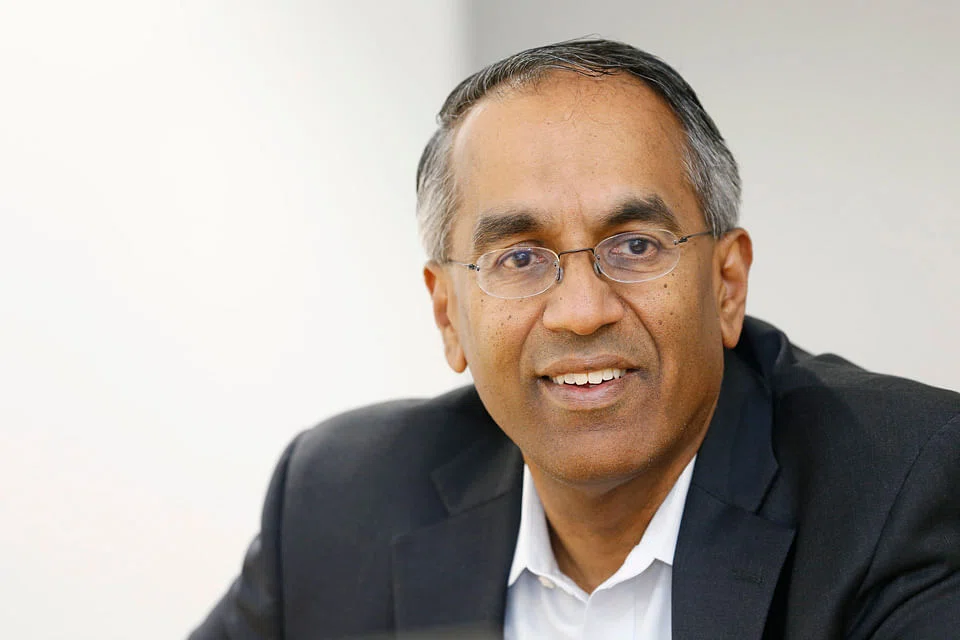
WHEN it comes to solving business problems, the "who" is more important than the "what", declares Krishnan Rajagopalan. What the veteran consultant means is this: more often than not, the leader driving the outcome matters more than the solution itself. It is a conclusion that he has reached after 16 years in the headhunting industry, where he has seen first-hand how people at the top can make or break an organisation. And now, as the newly-installed global CEO of executive search firm Heidrick & Struggles, it is his turn to carry the mantle of leadership. The Chicago-headquartered, Nasdaq-listed recruitment powerhouse helps top organisations around the world find and develop senior talent, with some of their most notable placements including Eric Schmidt as CEO of Google (now known as Alphabet) and Satya Nadella for Microsoft.
As human capital continues to rise in significance even with disruptions coming fast and furious, Mr Rajagopalan has his work cut out steering a traditional behemoth through uncharted territory. Recently in Singapore to celebrate the 21st anniversary of the firm's office here, he tells The Business Times how he intends to take the business forward in a digital world.
The head honcho of one of the world's biggest executive search firms did not have his roots in HR. Neither did he start off immediately as a management consultant. Mr Rajagopalan began his career as an engineer in satellite communications dealing with technical issues.
The common thread tying his past and present is his passion in fixing things.
"I've been interested in solving problems all my life, but I realised quickly I wanted to solve higher-level problems," he explains.
With that, he went to business school to get his MBA before moving into management consulting, where he got to deal with organisational problems first-hand, which he described as "quite exciting".
But it was his desire to solve problems at the heart of an enterprise - around its leaders - that led him to make the switch to the more people-focused executive search and leadership consulting.
While Mr Rajagopalan is no stranger to search and management consulting after decades of experience, becoming CEO is a whole different ballgame altogether.
"You get humbled by something like that. Our brand is enormous - to be asked to lead that kind of organisation to the next level is a humbling experience," he says.
Stepping into the shoes of a giant is not one without some new discoveries, as Mr Rajagopalan quickly found out.
"I think there are a few surprises when you become CEO - you realise that there's no on-off switch, particularly for a global company," he laughs.
Breaking down silos
Another was the realisation that silos exist, even in small businesses. As CEO, his role is to break these down, he says.
"I've been very privileged in my career to work with a handful of CEOs and observe them closely as our clients. I've seen who's successful and who's not," he declares.
"The ones I have seen and resonate with most are those who are highly authentic. They are not trying to be somebody different. They're playing to their own strengths. If there's something that I've learnt, it's learning what your strengths are, and staying with that."
And even as he advises top companies around the world on leadership, his own style is one that is direct and to-the-point.
"I'm fairly direct. I'm very hands-on. I tend to like people who are fast - speed counts for me. We see the world changing fast and you need to accelerate your performance," Mr Rajagopalan says.
But that said, speed is not the only attribute he looks for.
"I'm okay with people who say they don't know the answer, but they'll go find out. I'm more uncomfortable with people who try to bluff it," he adds.
The most significant leadership mistake he sees is leaders not trusting their gut instinct on what they need to do and end up hindering progress in the organisation.
That, Mr Rajagopalan says, is the biggest problem that he sees over and over again.
"They conceptually knew it had to happen, and by the time it took them to do that, the move was just too slow."
Since he started his journey in executive search, a lot has changed in the industry.
The retained executive search model, which he says Heidrick & Struggles pioneered, has been around for over 60 years. This model entails companies paying fees upfront to a firm through an exclusive engagement to conduct a search - typically for high-level positons.
"The first 55 years has been relatively static, and was about going out to find people. Then in the past five years, what happened next was a combination of not just finding people, but having the tools and decision-making processes on who the best fit is," he explains.
Increasingly, it's about having some "science" to the judgment. While the firm is not quite at the stage where artificial intelligence (AI) is used, Mr Rajagopalan says that is very likely where the industry is headed. In the future, predictive capabilities will make up a "big component" of executive search.
The speed of technological change is one that he has been keeping an eye on. He is well aware that the market, and their clients, are undergoing unprecedented change.
And like many of its clients, Heidrick & Struggles is also undergoing transformation on multiple dimensions.
The first, as mentioned earlier, is through leveraging technology to gather data and create better efficiencies.
On a more fundamental level, it also creates a better experience for their clients.
With just several clicks, clients who are constantly on the move will be able to see the status of their search or communicate with the firm using their mobile or laptop, through a system that Heidrick & Struggles built.
But while technological change continues to hurtle along at breakneck speed, the importance of human capital has not diminished - in fact, it has become even more pertinent.
"In this changing landscape, they want more than just the right person at the top. They want innovative leaders who inspire their teams to make the most of their collective talents," Mr Rajagopalan explains.
This means that leaders have to foster an environment where individual talent and new ideas are able to thrive. Such leaders who stimulate and unleash the full potential in their organisations are highly prized, he adds.
In acknowledgement of this, the company is transforming itself to stay ahead.
Since July, it has combined its leadership consulting and culture-shaping businesses into a single unit, says Mr Rajagopalan.
"Our consulting clients no longer want silo-ed conversations with individual consultants on leadership assessment and development, team performance, organisational dynamics and culture; they want them all to be integrated," he explains.
With the impact of disruptions felt virtually by businesses around the world, organisations that want to emerge triumphant are increasingly looking for a "new breed of leader", observes Mr Rajagopalan.
Particularly in Asia, top traits that people now look for are agility, resilience, innovation and the ability to steer and negotiate around diverse cultures. These qualities are needed for a leader in times of rapid change and uncertainty, according to him.
Firstly, for leaders who want to succeed in Asia, they need to manage multiple reporting lines and operate in a matrix structure.
"Business leaders in Asia work with both global business heads and partners in local offices, so (they) must be comfortable juggling numerous overlapping reporting lines," he adds.
The second trait is resilience. "You need energy and drive to be on the ground in many different territories across the region on different growth plans," he quips.
Building trust across different cultures, while developing a sustainable team and organisational culture is key. This includes having the ability to operate in a "culturally neutral" fashion, transcending engrained mindsets and possibly clashing cultural perceptions.
"The implication of matrix reporting is that leaders must be able to deal with senior leaders of various nationalities and backgrounds, putting a premium on communication and stakeholder management skill," says Mr Rajagopalan.
For example, a Singaporean leader of a multinational business unit in South Korea must approach issues from a Korean perspective regardless of his or her own background, he explains.
Expanding in Asean
He notes a trend where multinationals and Asian corporations are looking to expand their presence in the Asean market, which is increasingly becoming a key driver of growth.
There is high demand for senior leaders with knowledge of the region, the management skills to build strong local teams in an environment with limited resources but ample potential, and ability to manage relationships with global management teams, Mr Rajagopalan observes.
"In this environment, returning Asian executives who have extensive experience working at multinationals are highly sought-after."
Instead of bringing in expats for leadership roles here, more businesses are looking to develop local talent. While this is partly driven by foreign manpower quotas, such as in the case of Singapore, many multinationals see the advantages of such a strategy.
"Local executives are in demand because they bring instant cultural sensitivity to a business - overseas experience means they understand both sides of the story," Mr Rajagopalan says.
At the same time, another observation he makes is that family businesses in Asean are increasingly becoming more professional to compete on the world stage.
Many of these second- and third-generation leaders are educated at elite Western universities, with different ambitions, ideas, and global mindsets, he observes. "Asian family businesses have to motivate this new generation to stay in the fold, and build CEO succession, while leaping into the digital age - that's a challenge."
The future is clearly digital - but also very human - and Heidrick & Struggles is balancing the two in its efforts to stay ahead.
"We are continuously looking at how to combine our consultants' expertise with data and analytics, as well as technology to fully leverage our intellectual property and stay ahead of the competition," Mr Rajagopalan says.
As their consultants continue to engage senior leaders in addressing their biggest challenges, building an analytics-friendly culture in measuring success while plotting where to go next are just some of the ongoing steps that the organisation is taking.
But while disruptions and competition may appear daunting, Mr Rajagopalan is taking it all in his stride. Navigating the future does not have to be a painful one, according to him.
"There is going to be a very long journey before we see measurable results, but we are enjoying it every step of the way," he adds.
KRISHNAN RAJAGOPALAN President and CEO Heidrick & Struggles
Born in 1960 in Chennai, India
1982 and 1983 Received a BSE and MS from Johns Hopkins University, US
1988 Received an MBA from University of Chicago, US
Began career in 1983 as a lead engineer with Harris Corporation in the commercial satellite communications arena, before moving to Price Waterhouse in 1988 as strategic management consultant
1996 Vice president and partner with AT Kearney Consulting
2001 Joined Heidrick & Struggles as a partner
2007-2015 Led Heidrick & Struggles' Global Technology & Services practice Since 2017 President and CEO for Heidrick & Struggles
Honours : A member of the GWC Whiting School of Engineering National Advisory Council at Johns Hopkins University
Recognised as one of "100 Most Influential Executive Recruiters in the World" by Business Week