

Protecting and doing good
Chairman of Lloyd's of London, John Nelson, says the 326-year-old insurance institution still attracts huge amounts of capital because of the confidence it inspires.

Genevieve Cua
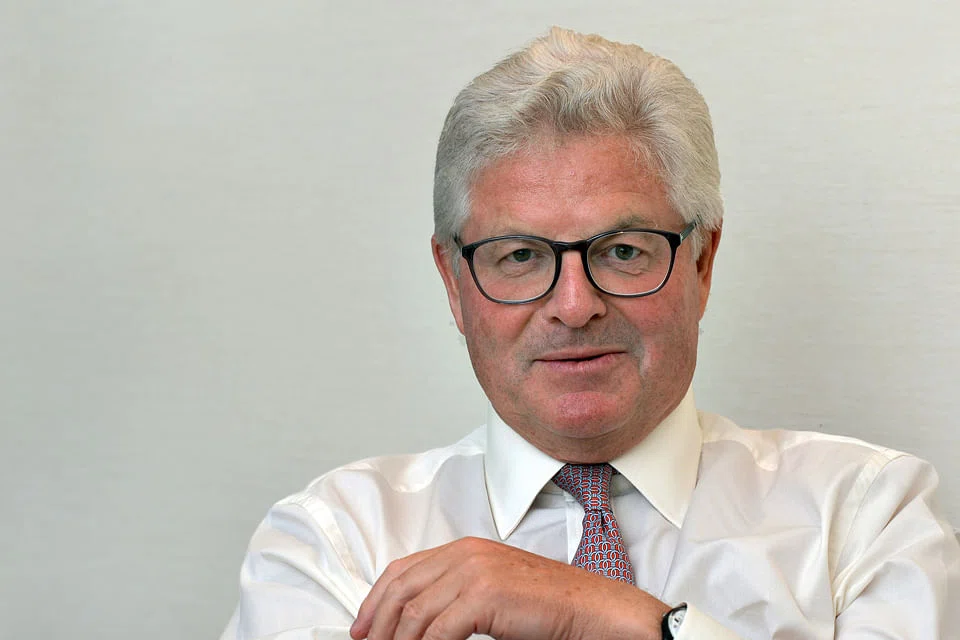
THINK of an item of value or any risk and chances are, you will find a Lloyd's of London syndicate ready to insure it. This runs the gamut of ubiquitous property and casualty cover to more unusual things such as body parts and yes, an actress's smile.
Lloyd's chairman John Nelson is justifiably proud of Lloyd's long history. Founded in 1688, the insurance and reinsurance marketplace is 326 years old this year. From its roots as a maritime insurer, its tentacles today extend into virtually all areas of business, pushing into new frontiers such as cyber risk and space tourism.
Through the centuries it has endured the worst weather catastrophes, world wars and terrorist attacks. Today, it continues to attract huge amounts of capital, which is testament to the confidence investors have in its longevity.
Mr Nelson, a veteran banker who became Lloyd's chairman in 2011, says the group's adaptability is key to its sustainability. "Let's be frank," he says. "Lloyd's has had some major problems in the not-too-distant past. At the tail end of the 20th century, we had two to three significant crises but we recovered. We survive because we adapt. We succeeded in adapting to our market, to changes in society and business practices.
"If you look at the risks to start with, they were marine. Then we moved into all sorts of things - the first cars, aviation... We tend to go the way business is going. And then we go to emerging risks."
Lloyd's website is chock-full of interesting milestones. There are events and risks that today seem quaint as the technology has faded into obscurity, or humdrum as the risks have become part of the fibre of daily living. In their time, however, the events and risks pushed boundaries. There were the first airships during World War I, for instance; the storied Titanic and more recently the infamous Exxon Valdez oil spill and more.
Yet another key to its longevity is the marketplace's underwriters, says Mr Nelson, who have leeway to exercise entrepreneurial skills. "We're a market, a honeypot of underwriting skills. Underwriters perform well when they're in company. When they're in a market, it's not just one man sitting in an office with his door shut, thinking - should I underwrite this? In a market, you get a much better feel for what is proven and right and where the opportunities are. People are entrepreneurial. They think very hard about where they can get business, where new business is likely to be and how profitable it can be.''
To start with, Lloyd's is not a company. It is a marketplace where members band together to form syndicates to insure risks. The Lloyd's network is replete with its own jargon. Risks are placed by brokers who must meet Lloyd's eligibility criteria. Syndicates write the insurance risks. Managing agents are companies set up to manage one or more syndicates. The managing agent runs a syndicate's infrastructure and operations on a day-to-day basis. Members provide capital. This group includes some of the world's major insurance groups and companies, as well as individuals.
Finally, there is the Corporation of Lloyd's which determines how much capital members must provide to support their underwriting. Among other functions, the Corporation also undertakes financial and regulatory reporting for the Lloyd's market, manages the Lloyd's brand and network of licences.
But what arguably makes Lloyd's unique is its covenant - the much vaunted chain of security. There are three links in the chain - assets at the syndicate level; members' funds at Lloyd's and central assets.
At the first level, all premiums received by a syndicate are held in premium trust funds and serve as the first resource to pay claims from that syndicate. On the second level, each member has to provide capital to support the underwriting. The capital is held in trust and can be used to meet any Lloyd's insurance liabilities of that member, but not the liabilities of other members.
Sizeable central fund
The third link is the Corporation's central assets, which are available to meet any valid claim that cannot be met by the resources of any member.
"If you're a syndicate, you have your own capital, a goodly chunk of which you deposit with me to provide security. On top of that over the years, we've built up a sizeable central fund, a fund of last resort. So if anyone gets into difficulty, we stand behind them. It's that chain which gives us our rating. That's attractive. It's also efficient because we have a pooled capital. If each individual syndicate had to operate outside Lloyd's, it would not nearly be as efficient."
Today the Lloyd's market comprises some 57 managing agents and 94 syndicates. Gross written premiums exceeded £26 billion (S$53.3 billion) in the fiscal year 2013. It has operations in more than 200 countries.
"Over the past 10 years, we've been profitable, with good returns. But when we get a big catastrophe year - in 2011 we saw Thai floods, tsunami in Japan, windstorms in the US, earthquake in New Zealand - they all come together. We get hit and profits fall. But because of the strength of Lloyd's - that was (the industry's) second worst catastrophe year - we find our capital unimpaired. We bring a covenant that's very strong.''
Here is a snapshot of Lloyd's resilience: 2011 was a poor year with the highest ever in catastrophe claims for Lloyd's and the second highest for the industry as a whole. The annual report cites the "frequency and severity of natural catastrophes throughout the year'' and the low interest rate environment. The group incurred a loss before tax of £516 million, compared to a profit of £2.19 billion in the previous year. Yet capital, reserves and other securities, and central assets were not impacted.
Since then, based on the interim results for June 2014, pretax profits have improved by 20 per cent to £1.66 billion, from £1.38 billion in June 2013. The current fiscal year has been a relatively benign year in terms of natural catastrophies, marred however by aviation losses. Lloyd's financial strength was upgraded by Fitch to AA- (very strong). To be sure, there are challenges. One is to expand its business in emerging regions which are vastly under-insured, says Mr Nelson. "We're an enabler. As the demography of the world changes, we need to expand our footprint." He cites India as a desirable market. At the moment, India is proscribed because of its foreign direct investment rules, some of which require joint ventures. "We're a market; we can't have joint ventures. But there is a bill in Parliament to allow Lloyd's in India. That's something we hope will happen in the foreseeable future.''
Singapore, he says, is Lloyd's largest platform outside London. It has also established a presence in Shanghai and Beijing. At the moment, the Asia-Pacific (including Australia and New Zealand) accounts for 12 per cent of Lloyd's business. "If you look at under-insurance in those (emerging) countries, it's very, very substantial. We published a report on this two years ago, and it's pretty much the same today, particularly in Asia. As the market internationalises, insurance penetration increases. You would expect the specialist sector to grow at a rate higher than GDP as penetration improves.
"In developed markets we expect the business to grow in line with GDP. In these other countries we expect it to grow more quickly. We think our addressable market is going to treble in 15 to 20 years; that gives you a scale of the opportunity."
Expansion in emerging markets is at the heart of its multi-year strategy, spelt out in Vision 2025. In a recent strategy update, it reports that it is on track. This year, it worked with the Turkish and Indonesian governments to secure legislative changes to enable trading licences. It is also conducting feasibility studies for a presence in Indonesia, Malaysia and South Korea. Surely one positive backdrop is the availability of capital. That, however, raises its own set of risks, says Mr Nelson.
"At the moment there is no shortage of capital. Driven by very low rates, institutions are looking for good returns. The great thing about insurance is that it tends not to be correlated with other investments, so you get a bit of a spread in the way it behaves. I think there are signs that insurance is being looked at by sophisticated, long-term institutions as an asset class, just like property. The industry will need capital to be around. At the moment we have a surfeit of capital, driving premium rates down and making life more difficult for underwriters. But in the mid to long term, that should even out.''
Business plan
He says there is always a risk that risk itself is underpriced. "In any market you never have perfect equilibrium. There are always lines that are underpriced and gradually people realise that and it recovers. The insurance industry is designed to pay claims so there will be times there is a loss.
"But at Lloyd's, we regulate our own underwriting. In practice, every syndicate has to have its business plan reviewed every year, and we monitor the plan against performance. We might ask the syndicate to adjust the business plan or add more capital. Or, if they want to change strategy as conditions are not particularly favourable, we'd allow them to adjust it. This system has worked very well for Lloyd's. That's why Lloyd's has outperformed its peers.''
Emerging risks are yet another challenge due to the dearth of experience and data. "There are major new risks. The first is what I call old risks in new geographies. As countries like China, Vietnam, Malaysia and Indonesia industrialise and commercialise, you create big volumes of additional risks and lines . . . Cyber risk is very crucial. And there are some intangible risks like reputational risk which increasingly causes problems. There is also supply chain risk. As supply chains get more crucial to business, if you have one thing go wrong, it ricochets across the whole logistics." Climate change is yet another example. "There is no question that it's with us. Again, that has gotten to the point where we can begin to model it. . . Climate change is very important. We're going to be increasingly vigilant to make sure that the models of underwriters have climate change in them."
Cyber crime is also a growing threat, and the rate of data breaches - at least those that make headlines - suggests that few systems are impervious to data hacks. Earlier this year, JP Morgan Chase said 76 million US households and seven million small businesses were impacted in a data breach in June and July. In Singapore, hackers targeted 19 government websites. A 2013 Norton Report found that Singapore victims were the biggest losers to cyber crime globally. The average cost per victim here rose 75 per cent to US$1,158, four times the global average cost per victim of US$298.
Says Mr Nelson: "Cyber risk is a very difficult subject. Good underwriting is built on data. But up until recently, the insureds kept all their cyber breaches secret. They didn't want people to know. What is now quite clear is that the insureds can significantly reduce risk by comparing data and being much more transparent. That has definitely made an impact.
"The second thing is, there is only a certain amount of data for cyber risk because it is so new. Then there is the question of how do you define loss. But products are being developed and Lloyd's is certainly at the vanguard in doing this. The underwriters . . . assess the risk, partly depending on the insureds' capacity to defend themselves. Insurance provides a natural commercial pressure on the insured to improve its defences, through patches and more.''
He adds: "There are breaches every day. Everyone is under attack, any big organisation, all the time. We're all learning. I wouldn't pretend to have all the answers. Generally, when you have an emerging risk - in the old days, it may be an airplane or satellite - pricing starts off reasonably high. As experience and technology improve, accidents reduce and premiums tend to come down.''
Cyber breaches
In Lloyd's Risk Index 2013 survey, cyber risk has moved up in importance from 12th spot (malicious) and 19th (non-malicious) in 2011, to the No 3 risk overall. The cost of cyber breaches is also growing. Lloyd's cites a 2012 study by the Ponemon Institute which found that the average annualised cost for 56 benchmarked organisations was US$8.9 million a year, up from US$8.4 million in 2011. Costs ranged between US$1.4 million and a staggering US$46 million per year per company.
Interestingly, companies in the Risk Index 2013 survey believed they were "slightly more able" to deal with the risk, which may well reflect complacency. The survey said: "It appears that businesses across the world have encountered a partial reality check about the degree of cyber risk. Their sense of preparedness to deal with the level of risk still appears remarkably complacent."
Meanwhile, Mr Nelson, who declines questions of a personal nature, says the insurance industry - and not just Lloyd's - has proven itself resilient through the 2008 financial crisis. "I think that's because the industry is very prudential. It assesses risk very carefully; it's well capitalised. Comparisons are odious, but it's not like the banking sector. The insurer is there for the long term. He wants to produce a sustainable service in terms of capacity. He wants to be there year after year. . . He isn't there to get a spread out of the client this month. He is trying to create a relationship that will endure and that's very important.''
The insurance industry has certainly not provoked the degree of ire that the banking industry had. Remuneration is likely a factor. In the years leading to the crisis, bankers paid themselves excessively while offloading risky assets to unsuspecting investors. But pay in the insurance industry has remained relatively moderate.
"Insurers didn't get paid as much as bankers. I think there is a question of cultural philosophy here. If you put capital at risk, it should be rewarded. Part of the issue with bankers is that they didn't put capital at risk themselves, yet they are rewarded with capitalist returns, in excessive bonuses. If you look at total remuneration in all its forms, it has a significant impact on shareholders who have capital at risk. I have no doubt that bankers should be well paid if they do a really good job, but not in some cases to the extent that they have been paid. Some packages are hard to explain and justify.''
Of his career, he says he has been "lucky enough'' in banking, and in recent years in real estate and telecommunications. Insurance proffers a degree of satisfaction. "Insurance. . . operates a business on an entirely socially useful basis. Everything we do is to protect business, mitigate and transfer risk, and put people and communities and businesses in a position to get back on their feet after a catastrophe. The contribution we made in Christchurch, in the Thai floods and (Hurricane) Sandy is very important. It's good to be in a business where you feel you are really doing some good."
JOHN NELSON
Chairman, Lloyd's of London
Born: 1947
1970 Qualified as chartered accountant
1971-1986 Kleinwort Benson
Started in firm's Corporate Finance Division in London. Rose to become Director in 1980
1986-1998 Lazard Brothers
Managing Director with overall responsibility for corporate finance in 1986. Became Vice-Chairman of Lazard Brothers in 1990.
Also Chairman of Lazard SpA, Italy and Vice-Chairman of Lazard GmbH, Germany
1999 Chairman of Credit Suisse First Boston (Europe)
Other appointments (Not exhaustive):
1998-2000 Non-Executive Director of Woolwich plc (acquired by Barclays)
2001-2002 Chairman of LIBA (London Investment Banking Association)
2002-2011 Deputy Chairman of Kingfisher plc
2002-2008 Non-Executive Director of British Telecom Group plc
2002-2010 Board Member of English National Opera (Chairman, Development Board 2002-2006)
2002-2012 Member of Chairman's Advisory Group, KPMG
2004-2013 Chairman of Hammerson plc
2010 Trustee of Chichester Harbour Trust, appointed Chairman 2013
2010 Trustee of National Gallery and Chair of Development Committee
2011 Chairman of Lloyd's of London
TRENDING NOW
Can a first-time homebuyer couple earning S$18,000 a month afford a new EC unit?

He built the Vingroup empire. Now South-east Asia’s richest man is handing some key roles to his sons
Asia needs new energy security architecture

Chagee, Mixue and Luckin won the market. Sustaining their edge is the harder part

