

Psyched for success: Sagi Karni, Israel's ambassador to Singapore
Sagi Karni, Israel's ambassador to Singapore, talks about his startup nation, its risk-taking culture, and the agritech partnerships between the two countries.

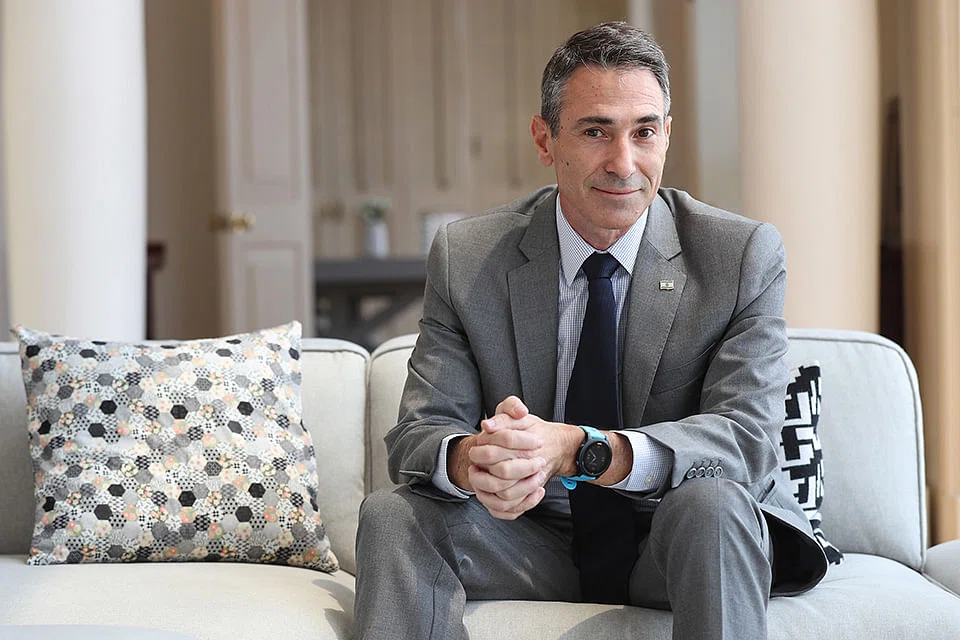
ISRAEL today is nicknamed the "startup nation" for good reason. With a population of about nine million, the country houses the largest number of startups per capita in the world. But its entrepreneurial culture dates back to centuries ago, before the state was established, when the land it sat on was known for establishing farming collectives called "kibbutz".
Profits from farming are reinvested into the collective after providing for members. Over the years, kibbutz farmers made barren lands bloom with field crops, poultry, dairy and fish farms, which, to date remain mainstays of the economy.
Israel's startup story is reminiscent of its agriculture history, one of triumph in the face of challenges, from political upheavals to an arid farming environment. Recent years have seen the themes of innovation and agriculture overlap, with several hundreds of agritech firms springing up across the country.
Sagi Karni, Israel's ambassador to Singapore, has made it his mandate to foster agritech partnerships with the city-state. After all, the two countries share several similarities, including a relatively small size and dependence on imported food supplies.
"When I came here, I found out that the government of Singapore is interested in this issue, and has set up a '30 by 30'," says the 53-year-old, referring to Singapore's target to produce 30 per cent of its food needs locally by 2030, up from the current 10 per cent.
"And the reasoning is very simple, it falls under the headline of food security, for obvious reasons. So we started to discuss the possibilities," says Mr Karni, who was appointed to his role in August 2019. "It is clear that Singapore is not going to develop large fields of corn or rice.
"So we had to find out what's realistic and we identified three main tracks: protein substitutes, urban farming and aquafarming."
In May this year, chickpea-based protein developer ChickP, which owns a patented technology developed at the Hebrew University of Jerusalem, announced its expansion into the AsiaPacific with the launch of a new office in Singapore.
Israelis have consumed protein substitutes for many years, Mr Karni says, citing the country's corn schnitzel speciality, often found on the kids' menu.
"Looking forward, I'm personally convinced that protein substitutes are a big part of the solution - not only for Singapore, but for the world.
"We will not be able to produce enough protein in the conventional ways, especially when countries are more committed to the environment and the conservation of resources. With growing populations around the world, the standard of living is growing and demand for good food is also growing. The current trajectory is not sustainable. So I think protein substitutes will be a very big deal," Mr Karni says, speaking to The Business Times in an interview in late May.
In terms of the countries' collaborations in urban farming, the ambassador points to Netatech, sole distributor of a pioneer drip irrigation technology by Israel's Netafim, a company that started in 1965 on a kibbutz in the country's Negev Desert.
Apart from drip irrigation, Netatech offers a myriad of other sustainable urban solutions dealing with rainwater harvesting, storm control, environmental monitoring, and skyrise greenery, among others.
Mr Karni acknowledges the challenges with urban farming, which Israel does not have as much of a need for because of its larger land area.
"Urban farming is more tricky because of space issues. It's a lot of hassle for small yields. But if the stakeholders are able to get the price right, and get all the different agencies working together and supporting it, the local entrepreneurs believe that it's commercially and economically viable," he says.
The aquafarming space in Singapore has not seen much Israeli activity but there is "very good potential" for working together, he says.
Fuelling innovation
Comparing his startup nation with Singapore's push for entrepreneurship over the years, Mr Karni points to some distinct cultural differences between the two nations.
"My friends here in Singapore taught me that kiasu-ism is very strong," he says, using the Hokkien dialect term which translates to a fear of losing out.
This may be why some Singaporeans may hold back when it comes to new, riskier ventures. Israelis, on the other hand, have no qualms about starting something new even if it turns out to be unsuccessful, he says.
"It's not considered to be a shame if a group of friends start something, raise some funds from a venture capital fund and then after a year or two or three, it doesn't work. No one will say that they are failures in life. There is no stigma in that sense.
"In fact, I think that they will be considered as brave and courageous for starting something new even though the outcome was a failure. So this is part of our culture," he says.
Despite the coronavirus pandemic, the value of Israeli high-tech exits jumped 55 per cent to a record US$15.4 billion in 2020. Data compiled by Israeli non-profit Start-Up Nation Central showed the country's innovation technology sector smashing a new capital funding record in the first five months of this year, topping US$10.5 billion.
Now-ubiquitous innovations that originated in Israel include the USB flash drive, invented by Dov Moran, and Google Suggest, the search engine's autocomplete search tool.
"When we put government money into startups, we know in advance that we are taking a very high risk. So we're not going to impose regular, commercial KPIs (key performance indicators) on such investments because it is by definition, venture capital," Mr Karni says.
"We are very happy if 10 per cent of these ventures succeed, because we consider it a good rate of success. Now, this is not the thinking of a banker, right? But if you want to encourage technological entrepreneurship, there's no other way. You have to take risks."
The ambassador adds that the Israeli government has been active in setting up and funding incubators to drive entrepreneurship in the early days, but homegrown startups are now attracting an increasing number of investors from across the globe, decreasing the need for domestic investment in startups.
And failures have often created new opportunities for entrepreneurship, Mr Karni points out.
"So whenever I have the chance to talk to young or potential entrepreneurs, usually students, I always tell them not to worry or be ashamed. Just give whatever you want, everything you can, but try to spend some other people's money and not your own," he quips.
Speedy inoculation campaign
In recent times, Israel has also been recognised for its quick rollout of the Covid-19 vaccine. As at end-July, close to 60 per cent of its population has been fully vaccinated. Singapore's figure is about 55 per cent.
For Israel, the feat was achieved with quick and early acquisition of vaccines, as well as a healthcare system that combines competition with tax-funded universal coverage, Mr Karni says.
"It took a lot of foresight and stamina to really, really work very hard to get the vaccine on time because it's a very nasty competition out there," he says.
The country's four health management organisations had residents' contact information at their fingertips, enabling them to quickly contact those eligible for the vaccine via text messages, e-mails and phone calls.
The third element critical to its successful inoculation campaign is flexibility, the ambassador says.
"For example, if you come by late in the evening and there are vaccines left over, and if we can get you in, we will get you in (to get vaccinated). That's it. And people were really, really eager to get vaccinated."
However, like elsewhere in the world, Covid infections in Israel have been climbing of late due to the Delta variant of the virus. But while there has been a resurgence - there are now over 1,000 cases reported daily - they are just over 10 per cent of the peak in January.
"And this is all due to a very successful vaccination campaign, not due to good behaviour of the population, because the population did not behave very well. Israelis are a little bit wild. But the vaccination campaign was very, very successful because people believed and understood this is important. So they rushed to get vaccinated," Mr Karni says.
Although the country had also implemented unpopular lockdowns earlier in its battle against the virus, the authorities recognised that tough curbs are not sustainable, he adds.
"Eventually, we've seen that if you want to get back to normal life and to allow people to travel and to revive the economy, it seems like only vaccines will help. There is no other way. A small country like Israel cannot close our borders, make them watertight, and not allow people in and out altogether. It's impossible for the long run," he says.
While the country has reinstated some restrictions - such as the mandatory wearing of face masks indoors and quarantine for all people arriving in Israel - due to a recent surge in cases due to the more infectious Delta strain, the government has said it wants Israelis to learn to live with the virus and avoid another national lockdown that could do major harm to the economy.
Cross-border conflict
On the periodic escalation of cross-border hostilities with Palestine, most recently in May, Mr Karni is of the view that the conflict warrants a political solution, not a religious one.
"Look, this is a political conflict between two national movements. Let's try and find a political solution for political conflict because if you try to turn it into a religious conflict, then it becomes very much more difficult to solve. So, when people from certain quarters are trying to emphasise the religious aspect of it, they're not helping. They are actually spilling oil on the fire, and this is very dangerous," he says.
The rise of social media has also resulted in "horrible incitement from some sectors" and could be an obstacle to Israel's quest in establishing good relationships with countries in South-east Asia, home to a significant Muslim community, Mr Karni says.
Keeping fit
While most of his stint in Singapore thus far has been amid a pandemic, the ambassador - a keen athlete - says it has given him an opportunity to explore the city-state while keeping fit.
"I have to tell you that I cycle more miles in Singapore than I drove in Singapore," says Mr Karni, an avid triathlete who usually rides with a group of local cyclists.
"For running, I think the best place is MacRitchie. It's a beautiful place to run, and for cycling there are many other places. I usually try to get as far away from what's considered the city. So I go to Woodlands, Kranji, those areas are nice, and along the East Coast, there are also very nice places to go around," he says.
He also enjoys checking out eateries around the island and has a soft spot for hawker centres. "In the hawker centres, you see the real people. And it's a nice thing to have a variety of ethnic groups and different foods. I think going to the hawker centres lets you get to know the place better. So it is great fun," he says.
Still, he looks forward to the day when border restrictions are lifted.
"Not being able to travel has impacted everybody, but I think in this aspect, Singaporeans are suffering more than others. Israel is also a small country, so there's a limit of how much you travel.
But still, you can get into the car and drive for three hours and get a change of scenery. There's more variety. This is something I miss," he says.
SAGI KARNI
Ambassador of Israel to Singapore
1967: Born in Kibbutz Dan, Israel
EDUCATION
1994: BSc (Biology and Philosophy), Hebrew University of Jerusalem, Israel
2005: Master in Public Policy, Tel Aviv University, Israel
CAREER HIGHLIGHTS
2000-2002: Deputy Chief of Mission in Oslo
2005-2008: Member of Israeli delegation to the European Union
2008-2010: Ambassador to Angola and non-resident Ambassador to Mozambique and Sao Tome
2010-2013: Foreign Affairs Advisor to Minister of Energy and Water Resources
2013-2017: Consul General to Hong Kong and Macau
2017-2019: Acting Head of Strategic Planning and Assessment Unit, Israel Ministry of Foreign Affairs
Since August 2019: Ambassador of Israel to Singapore
TRENDING NOW

First Resources blames El Nino, outside fires for Kalimantan hotspots amid haze scrutiny

High Court rules against Julius Baer’s Singapore trust arm in US$50 million family trust dispute

Singapore key exports jump by higher-than-expected 68.4% in September, led by non-electronics

MSCI proposes downgrading Indonesia to standalone market status

