Purpose-driven branding
Winning customers in today's age of 'woke' advertising calls for more than a great product or service. More than ever now, brands need to have authentic stories with a social impact, says Nirvik Singh, Singapore-based global COO of Grey Group.

Sharon See
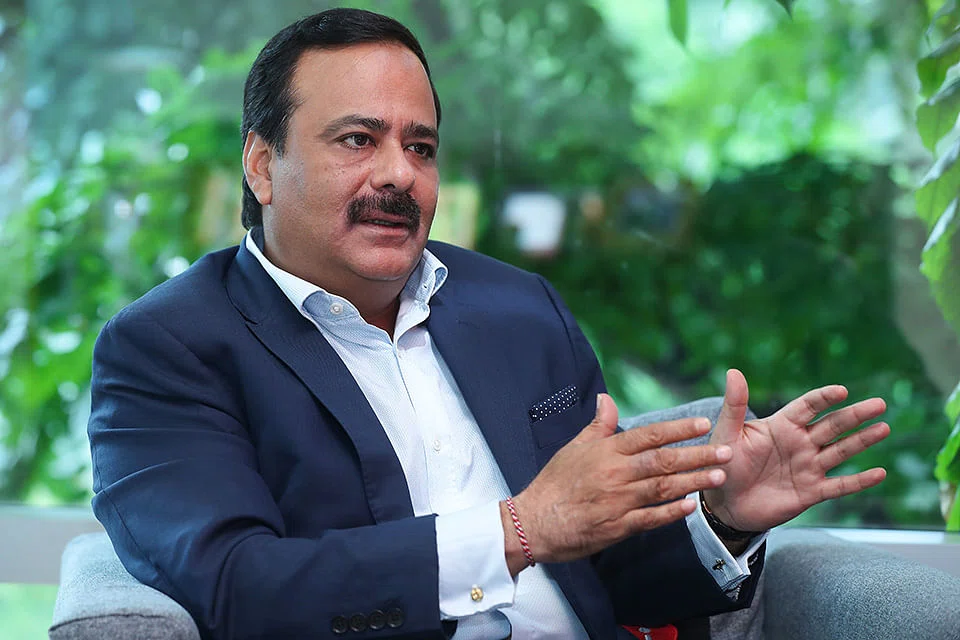
WHEN the Covid-19 pandemic finally comes to an end, whenever that may be, the world would want to be a kinder place, says veteran adman Nirvik Singh.
Much has been said in the past months about how the novel coronavirus has exposed the crippling flaws of our capitalist economy, but history has also shown that pandemics have an epochal ability to reshape our society for the better.
After all, the Black Death in the 14th century, said to have decimated a fifth of the world population then, was what precipitated the decline of serfdom in Europe in its wake. Some historians have argued that it was also the radical disruption that ushered in the Renaissance period.
"I think people will want a kinder world, people will want to be more connected," says Mr Singh, who is global chief operating officer of New York-headquartered advertising agency Grey Group, part of the WPP conglomerate.
"There'll be a much larger conversation on fake news because in this trying time, you don't know which messages you're receiving are true or not true, and I think that will lead to a much more robust conversation about maybe regulations across the world," he continues.
And beyond that, Mr Singh believes people will change how they'll shop and what they'll eat; they would want to know where that food is coming from and whether it's safe.
These changes would have profound implications on not just the advertising industry, but the economy at large, in a post-Covid-19 world.
"People will go back to consuming. However, at that point, brands that are authentic and honest and kind are the kind of brands that will win," Mr Singh says.
In a way, the pandemic is merely accelerating an emerging trend. Just before the coronavirus wreaked havoc across the world, climate activism was the movement finally gaining momentum after decades of unheeded warnings from scientists.
And already, brands that are associated with a "higher purpose", such as sustainability goals, are the brands that millennials have been gravitating towards, Mr Singh notes.
This need for purpose will simply become increasingly important.
All this underscores the importance of having authentic stories with a social impact, where the ad industry is concerned, or what has been termed "woke" advertising. (Woke is a slang term used to describe awareness and consciousness of certain facts and issues, particularly social matters.)
Grey has done quite a few of such ads in recent years, including one for razor giant Gillette to highlight toxic masculinity amid the #MeToo movement.
Mr Singh fondly recalls one of his favourite projects, which involved the World Wide Fund for Nature (WWF) in 2019. The client's objective was to highlight the problem of plastic in oceans; it's hardly a new message anymore, but an extremely important one that bears repeating nonetheless.
"Everyone's been talking about plastic. We defined it by saying, you're actually consuming a credit card every week," Mr Singh says.
The campaign, based on WWF's study, pointed out that people could be ingesting some five grams of plastic a week, the equivalent of a credit card.
Its end goal was to get people to sign a pledge to help convince governments to take stronger measures to end plastic pollution.
The thought-provoking parallel appears to have struck a chord with people because it has since garnered over 1.6 million signatures, and some 40 governments have publicly pledged to come up with a new plastic policy, according to Mr Singh.
"That to me is great because we're making societal changes, and it's about how we apply our creativity," he says.
Creativity, he adds, is what permeates his firm's culture. It's a fairly abstract description, so how does one institute a culture of creativity?
Mr Singh says it comes down to encouraging people to be brave and challenging them to come up with unusual solutions.
For example, over a third of Bangladesh's population had no bank accounts, and most of the people were poor farmers with no savings. So the Grey team there designed an initiative that brought the United Commercial Bank (UCB) and local retail giant Shwapno into a collaboration.
The idea was that if the farmers sold their produce to the retailer, the proceeds would then be deposited into their UCB accounts. This was tested in the village of Barinagar, and more than 200 farmers signed up in just a day, according to Grey.
Given the diversity of the projects Grey handles, what helps is having a network of people with varying skills that the group can draw on.
To that end, the company built an app that catalogues the over-6,000 employees it has worldwide, not just in terms of their resume and expertise, but also where their passions lie, Mr Singh says.
The app also offers communication tools and can be used for training.
"We were working on a gaming project, and we found, the best gamer was somebody in our office in Bogota," Mr Singh says of the app.
"We had 440 experts with a gaming background; we could pick and choose and build the best talent pool to service that client."
As it turns out, this platform is now proving its worth in the midst of a global pandemic.
"In a situation like this, where people are under lockdown, it's probably the best thing to do because you may not be allowed to shoot a TV commercial right now in the UK, but maybe you are allowed to shoot one in South Africa," Mr Singh points out, adding: "So by just connecting our people virtually, we're making sure that businesses continue to run and continue to do well."
For a company that was founded 103 years ago in New York City, business continuity should be a familiar concept.
The Singapore office wants to take this a step further through a programme called Grey Adventures that mentors selected startups for free.
A batch of 18 to 25 startups at any one time occupy a corner of the Singapore office along Scotts Road at no cost.
"We don't fund them. So what we do in exchange for the free space and love that we give them, we ask for 10 hours of their time every month," Mr Singh says.
"They can just come and speak to our people, they can come and train our people, or we take them to our clients, so they actually come and say, let's work on this project together."
It's a mutually beneficial arrangement, Mr Singh notes, allowing Grey Singapore to tap on these startups' expertise.
Easy connections
Mr Singh's career with Grey spans some 30 years, and last September, he was promoted to his current role.
Born in 1963 in Kolkata, India, the business graduate decided to move to Singapore in 2010 after being appointed chairman and chief executive of Grey Asia Pacific, and also because one of his sons got accepted to a boarding school here.
In fact, Mr Singh was first offered a position in Singapore a few years earlier, sometime between 2007 and 2008, he says, which he turned down.
"Now in hindsight, foolishly, I didn't move to Singapore, I should have," Mr Singh, now a permanent resident, says with a laugh.
He explains: "I love Singapore. I think it's the easiest city to live in. If you have a travelling job, it's easy connections. But I also think the growth going forward in the world will come from this part of the world."
It's why he has chosen to remain in Singapore even though his recent promotion was to a global role.
Mr Singh wasn't always an adman.
While in college, he worked part-time for a tea company before joining Lipton India upon graduation.
This independent streak actually stems from a family feud in his younger years, after he lost both his parents at the age of 17.
"Our family is a family that runs various businesses. But for various reasons, my uncles decided not to get fair," he shares.
"And I think therefore, learning to stand on my two feet earlier in life has shaped my worldview."
Principle of fairness
Mr Singh counts his close colleagues as family, and one of the greatest influences in his life was one of his former bosses in India, who also became a father figure to him.
Through him, Mr Singh picked up the principle of fairness and the importance of having a passion for the business.
But there is another surprising influence Mr Singh gives credit to: sports.
He began playing tennis and cricket competitively when he was about 10, but these days, he prefers a game of golf.
"I think sports tells you a lot about your own character and somebody else's character," he says.
"How competitive you are, are you going to do silly things to win at all costs, are you going to be fair, are you a bad loser, are you a gracious winner... I've often used my learnings on the sports field as a corollary to what I do at work," he explains.
"You have to just come on every day and try to do your best. There are days you lose, but if you do it every day, you'll probably win more often than lose. And if you lose, it's fine. Be gracious," he says.
This attitude is also reflected in how he views leadership.
"You have to set the tone at the top, and I think your behaviour defines your organisation's behaviour," Mr Singh says.
"And number two, you can never look not 100 per cent excited. People read body language, people look at you for visual cues and takeaways. And if you look down and out, then the entire organisation will be down and out."
But this enthusiasm is not something that can be faked.
"If there's a hard message to be delivered, you've got to be honest to deliver the hard message," Mr Singh notes. "I think if people trust you, then they will realise that that message is not coming out of some strange place, but it's being done for the good of the organisation and the people."
The secret to being genuinely enthused is to like what you do and be curious about everything, he declares.
"If you are curious, you will just be enthused about life in general."
NIRVIK SINGH
Global chief operating officer Grey Group
1963 Born in Kolkata, India
EDUCATION
1985: Bachelor of Commerce, St Xavier's College, Kolkata
1987 Executive Development Programme, Harvard Business School
CAREER
1985-1987: Lipton India
1987-1989: JWT India
1990-1995: General manager, Trikaya Grey
1995-1997: COO, Trikaya Grey
1997-2004: CEO, Grey South Asia
2004-2009: CEO, Grey South East Asia
2010-2016: Chairman and CEO, Grey Asia Pacific
2016-2018: Chairman and CEO, Grey Asia Pacific and Middle East
Since 2019: Global COO, Grey Group
Decoding Asia newsletter: your guide to navigating Asia in a new global order. Sign up here to get Decoding Asia newsletter. Delivered to your inbox. Free.
Copyright SPH Media. All rights reserved.