Recapturing Ericsson's mojo
CEO Börje Ekholm is looking to reinvent the company to ensure it remains a frontrunner in telecom technology.
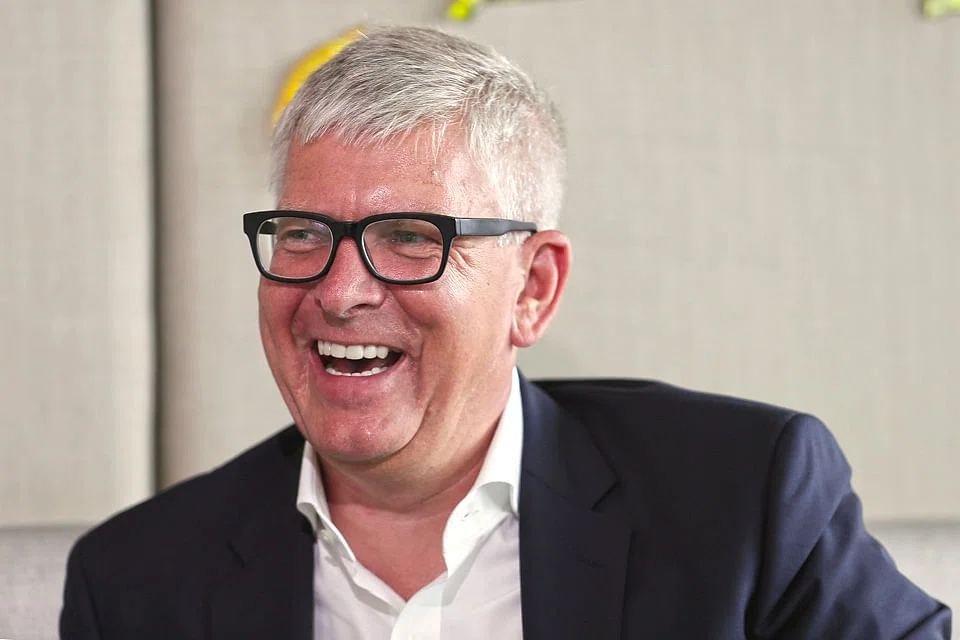
CRAFTING a turnaround in a 140-year-old company which practically set the standards for the telecommunications equipment market is no easy task. This is something that Börje Ekholm, president and CEO of Ericsson Group, readily acknowledges. Mr Ekholm came out of semi-retirement in January to lead the embattled Swedish giant as it fights off the challenge posed by Chinese telecom equipment makers such as Huawei and ZTE and also a rejuvenated Nokia.
Technology breakthroughs which have resulted in the commoditisation of network equipment has allowed the challengers from China to break into what used to be an old boys' club of companies from Europe and North America which dominated this space.
These companies set many of the standards on which the telecommunications equipment industry runs and which allow users to, for example, take their phone to another country and log on to a local telecom network seamlessly.
The Chinese challenge over the past decade and a half has resulted in a dramatic upheaval and consolidation in the industry and, of the old guard, only Ericsson and Nokia survive in any meaningful manner.
Mr Ekholm candidly admits that Ericsson's turnaround would take quite some time to materialise. "We said very early on that we are not targeting to see the full benefits until beyond 2019, and so we have some time ahead of us in which to put our sales on a different footing."
In its third quarter 2017 results posted in October, Ericsson announced its fourth consecutive money-losing quarter, with an operating loss of 4.8 billion Swedish krona (S$774 million) that was 37 per cent worse than the average loss estimated by analysts.
Sales of 47.8 billion krona were down 3 per cent in constant currencies and the company warned its usual year-end sales bounce would not be as big as in previous years.
Emphasis on R&D
While Ericsson cut 3,000 jobs during the third quarter, it added 1,100 recruits in its R&D (research and development) organisation.
Mr Ekholm is looking to take costs out by reducing overheads and letting go of parts of its service delivery business. At the same time, he is pumping more money into R&D to keep Ericsson's technology lead intact. "We are currently investing about 15 per cent of our revenue in R&D. We are looking to increase that number.
"In order to succeed going forward we need to secure our technology lead by investing in R&D. We have to do that in order to help our customers be successful because ultimately our success is tied to our customer's success," the CEO says.
He adds that with a lead in technology, the company can bring down cost as well. "The reality is that traffic is growing exponentially and our customers have more flattish revenues so we need to help them to be more efficient - not only spectrum-efficient but also in their operations. We can only do that by being technology leaders."
The Ericsson boss is making a big bet on the new technology disruption that is about to hit the industry - fifth generation mobile telephony or 5G. He wants to be prepared to ride this new wave.
"We are investing heavily in 5G but we are also investing in 4G because it is going to be a long-lasting technology. We are also spending a lot in our core OSS and BSS services because we think that it is important for our customers to digitalise and transform their business and we have strong product offerings there."
OSS refers to operation support systems which are applications and hardware that support back-office activities which operate the telco's network, provision and maintain customer services. BSS refers to business support systems which are software applications that support customer-facing activities such as billing, order management, call centre automation and CRM (customer relationship management).
Ericsson is also investing in managed services focused on automation which allows the use of market intelligence and machine learning to become more efficient in managed services. "That is where we see the market in future," Mr Ekholm adds.
He admits that in the near term Ericsson is "challenged" in IT and cloud today because "we have to work through a number of projects that we are challenged in. We need to stabilise our product portfolio".
According to market reports, Ericsson is renegotiating or exiting unprofitable service contracts in its networks unit as it aims to double its operating margin to 12 per cent after 2018. It has exited or renegotiated 13 out of 42 contracts it considers problematic, improving profits.
Company insider
While Mr Ekholm has his task cut out for him, to his advantage, he has in-depth knowledge about the company, having served on the Ericsson board for more than 10 years. As a result, Mr Ekholm witnessed first-hand the damage wrought to the company as the Chinese equipment makers first started competing on price to capture market share, particularly in the Asia-Pacific region, and then increasingly compete on both price and technology.
Ericsson's problems have been long in building up. In July of 2016 Ericsson's former CEO, Hans Vestberg, was fired and there were market expectations that an outsider would be brought in to steer the Swedish company in a new direction. After a wait of a few months, which added to uncertainty in Ericsson, Mr Ekholm, who was then leading a semi-retired life in Colorado - his current home - was called in to run the company.
Apart from his obvious abilities as a go-getter and an insider, to understand why the task fell on him, one needs to go into a bit of background.
The major stakeholder in Ericsson is Investor AB, an investment company owned by the Wallenberg family of Sweden. For generations, the Wallenbergs have controlled many of Sweden's big companies. Some reports have called Wallenberg the most powerful family in Sweden.
Mr Ekholm was CEO of Investor for more than 10 years before he retired and was, before his current appointment, head of Patricia Industries, Investor's portfolio of unlisted companies. In other words, he is a trusted employee of a major shareholder in the company.
Mr Ekholm notes that the nature of communications is changing and moving away from voice to becoming data driven. Thus companies including Ericsson have to adjust.
"So far the word communication has been about human-to-human communication. Now if you think about the next layer it's actually systems using the benefit of machine-to-machine communication.
"So I think there is a whole new market opportunity coming up with IoT (Internet of Things) devices and 5G networks."
Mr Ekholm agrees that the generally accepted targeted date for roll-out of 5G networks is on or after 2020. "It will probably become mainstream by that date but you will be seeing earlier roll-outs in some countries."
He makes an interesting point about 5G. "Of course we will see much higher bandwidth as compared to 4G networks and we are talking about speeds in the region of one gigabit per second.
"However, the real interesting thing is, when you combine that with extremely low latency that the network will have, you can think about a whole new set of very interesting types of applications."
Network latency refers to how much time it takes for a packet of data to get from one designated point to another. The lower the latency the less chance of packets of data getting lost and the end result is extremely stable connectivity.
"When you have low latency combined with bandwidth, you can think of new types of games and gaming devices," says Mr Ekholm. "New games can be created where you look out and see your surrounding environment and that becomes your gaming environment. I am sure they will come out with games that I can't even think about."
The other major area that will benefit is augmented reality where a subject matter expert can wear a device and see in real time what is happening and provide feedback from a remote location, he adds. "You could see that being applied to remote surgery. That's going to take a while but the reality is it can all of a sudden happen. I think the latency aspect is more important than the bandwidth with 5G networks."
Another big area is autonomous vehicles. "Think about a vehicle knowing where all other vehicles are and not only that, it also knows the exact position of pedestrians. You could remove almost all road accidents. This is only possible with low latency networks where the signal drop is virtually non-existent," the Ericsson CEO adds.
Smart cities
New 5G networks will also have a dramatic impact on smart cities, thanks to their low latency. "We are going to see a lot of different applications and I couldn't tell you which one will be the big one. What is certain, however, is that there will be a big change ushered by 5G."
Mr Ekholm agrees that eventually, even in 5G there will be inevitable commoditisation of the core technology. "But we also see product advantages coming through and giving benefits in the marketplace. For example, our products are software-driven upgrades for narrow band IoT. You can use the upgrade to create a lot of differentiation. And networks behave differently so I think there are still opportunities to create value."
The Swedish company has an agreement with Singapore Telecommunications to help the telco with its narrowband IoT platform.
Mr Ekholm notes that the Asia-Pacific market is very important for Ericsson. "This is an important region for us, a big part of the world, and the growing part. We have to strengthen our presence here and so one of the things we are trying to do is increase our footprint.
"We are pretty much in all the countries in the region but we still need to strengthen our presence and that can happen when we have products that are competitive in the market and I think we have that."
The Ericsson CEO, who lives in Colorado but has his office in Stockholm, feels the next one-and-a-half years will be crucial. "We need to re-establish our profitability and that will help us to take the next step.
"At the same time, even though I look at it as a turnaround, we need to put our bets around a long-term future. We need to take the cost out even as we invest more in R&D. That's the way forward for us."
That's quite a lot on the plate of a man who thought he would spend time, after semi-retirement, pursuing his twin passions of fishing and skiing.
BÖRJE EKHOLM
President and CEO of Ericsson Group
1963 Born in Edsbruk, a municipality in southern Sweden
1984-1988 MSc in Electrical Engineering from KTH Royal Institute of Technology, Stockholm, Sweden
1989-1990 MBA from INSEAD, France
1988 Associate at McKinsey & Company
1992 Analyst at Investor AB
1995 President of Novare Kapital AB
1998 Head of New Investments and President, Investor Growth Capital
2005 President and CEO at Investor AB
2006 Elected as board member of Ericsson
2015 CEO of Patricia Industries, a division within Investor AB
2015 Joined board of Alibaba Inc
2017 President and CEO of the Ericsson Group