

Robot at your service: Singapore companies ride global wave to build next-gen robots
Singapore companies are building robots that clean, deliver food and guard buildings. The journey is tougher than it looks.

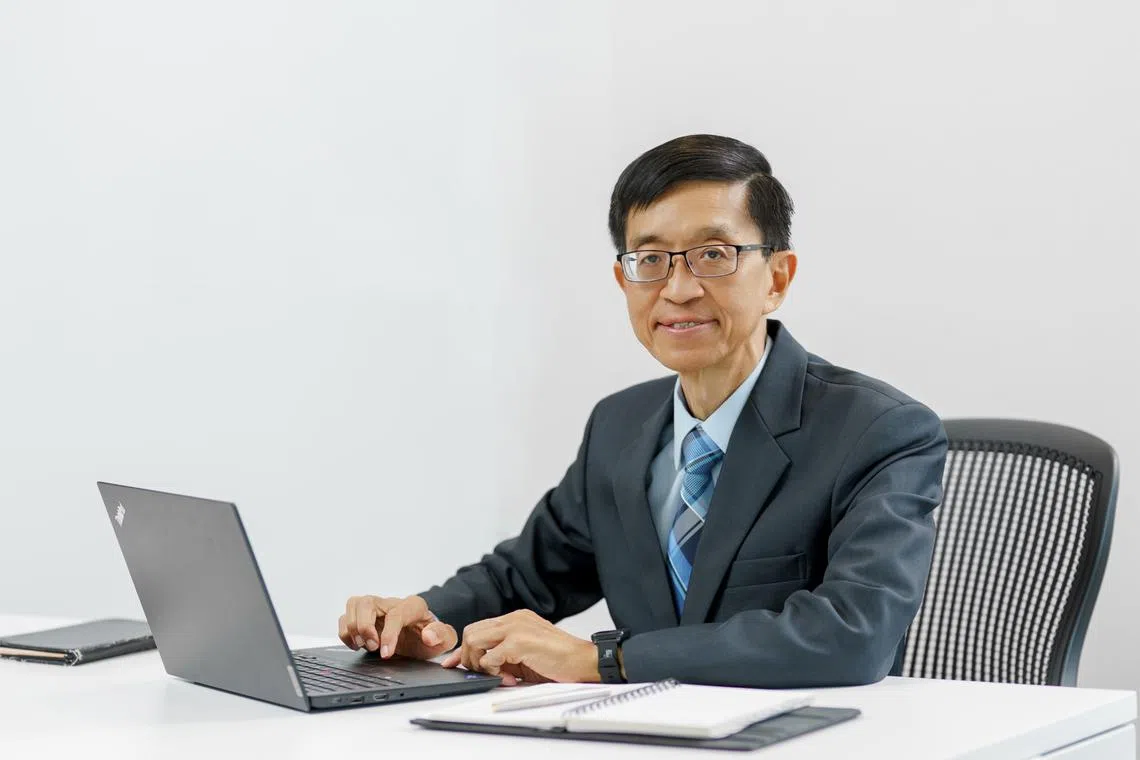
THE world was in the thick of a pandemic when Kelvin Wee, chief executive of Taiwan-listed Patec Precision Industry, received an enquiry from security organisation Certis Cisco.
Certis was trying to build a security robot, but things were not working out with its vendors. They struggled to find the sweet spot where performance, reliability and pricing met. Could Patec help?
The opportunity was intriguing for Wee, who spent most of his life working for the Singapore-based precision-engineering company founded by his father. Building robots was not in the ordinary course of business, but Certis’ interest in deploying the technology gave him an inkling that this industry might eventually be critical.
Wee turned out to be right. In the years since, Singapore’s blue-collar workforce has suffered from more manpower shortages and rising labour costs.
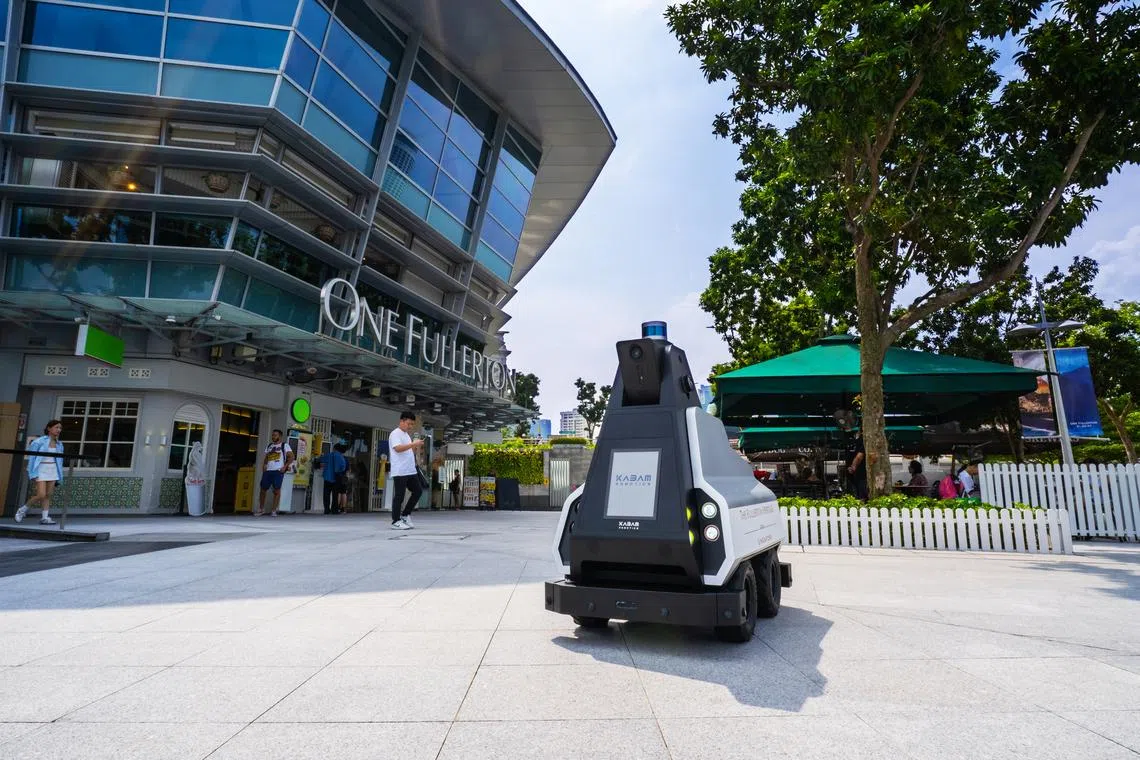
Companies are turning to automation. Certis now offers its clients smart security services, including those delivered by two robots designed by Patec’s spin-off company Kabam Robotics. These patrolling robots can detect incidents and feed information back to a virtual platform called the Smart Command Operations Centre.
To build them, Wee sought the help of an old friend working on software development. Together, the team did a series of demos that impressed Certis stakeholders and the board. In December 2020, Certis awarded Patec a purchase order for 45 robots worth about S$4 million.
Wee said: “That was the day we realised that there was probably a business in this.” Kabam Robotics was founded shortly after. In 2022, it merged with Cognicept Systems, the startup built by Michael Sayre, Wee’s software business partner.
For decades, the rise of automation has favoured industrial robots, commonly found on the factory floor. These robots operate in an environment where conditions are fixed and controlled.
Service robots, on the other hand, are found in free environments with variable conditions and human behaviour. A cleaning robot, for example, must know how to navigate through changing crowd conditions in a shopping mall.
The variability makes it tricky to build a robot that is always effective. But developments in technology, such as sensors and vision systems, have helped these machines adapt better to human environments.
Singapore excels at industrial automation, but needs to carve a niche for itself in the field of service robotics.
The country had the second-highest industrial robot density in the world in 2022, research from the International Federation of Robotics shows. It had 730 robots for every 10,000 employees, largely deployed in the manufacturing sector.
But now, Singapore wants to shape the next wave of service robots that augment humans’ work.
National dream
Singapore launched a National Robotics Programme (NRP) in 2016, with more than S$450 million in funding. NRP, funded by the National Research Foundation, identifies key priorities in robotics and supports participants collaborating across public agencies, research institutes and the private sector.
The programme has invested in over 40 robotics projects involving more than 650 researchers, engineers and scientists, noted Prof Quek Tong Boon, NRP’s chief executive.
Last month, the government announced about S$60 million in new funding for NRP. The money will go into driving robotics development in sectors such as manufacturing and logistics, facilities management and healthcare.
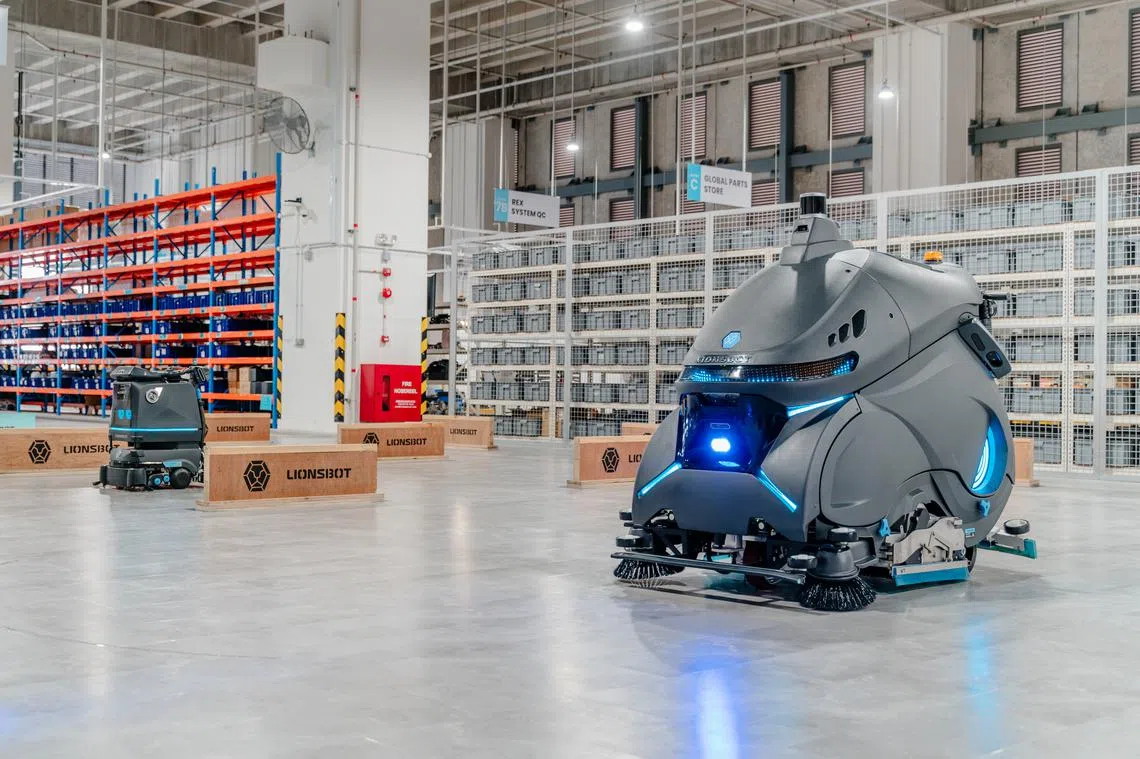
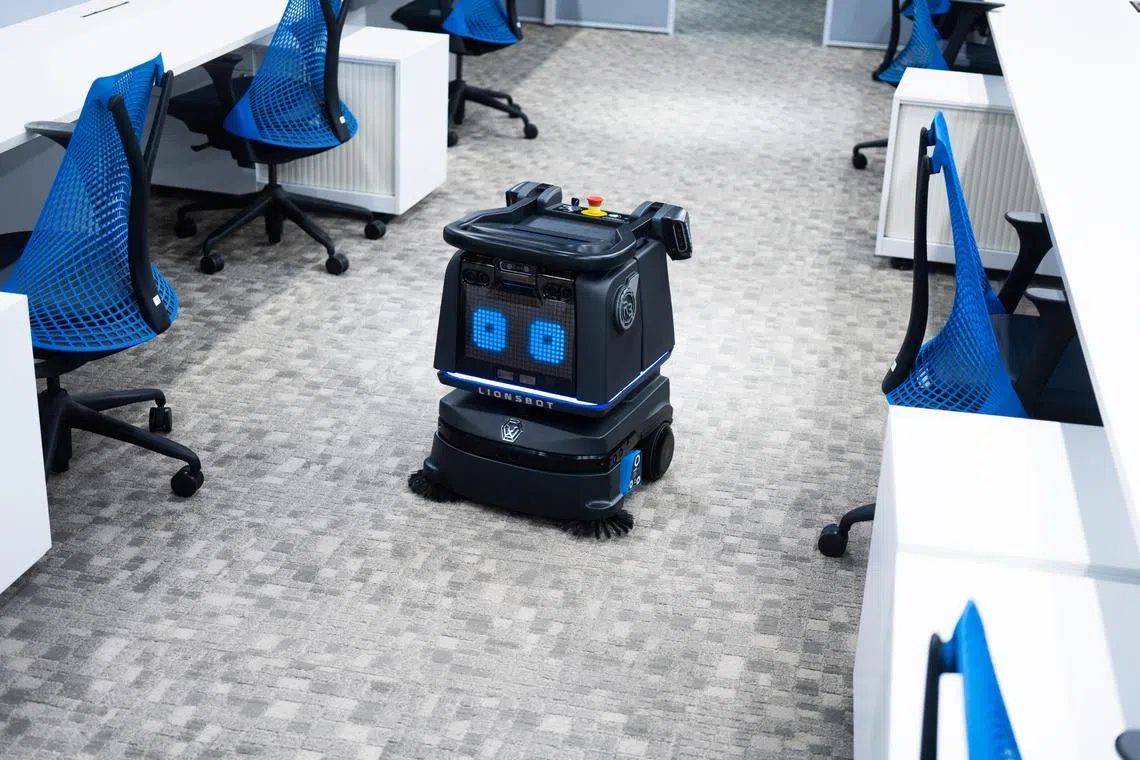
Since NRP started, local companies like LionsBot and Hope Technik have made a name for themselves on the international stage.
LionsBot, founded in 2018, has sold over 2,500 of its made-in-Singapore professional cleaning robots to buyers in 30 countries. On Thursday (Apr 18), it launched its 4,908-square-metre factory in Singapore’s Kranji area, with an investment of S$12 million.
The new factory has five times the manufacturing capacity of its previous one in Changi. The expansion to Kranji has bumped up LionsBot’s manufacturing output to up to 4,000 robots annually. Its chief executive Dylan Ng said that with further automation in the future, the new facility will be able to produce up to 20,000 robots.
NRP’s Prof Quek said: “We never expected that, by the time the first phase of our programme ended, we would see robots catalysed by us in the midst of the environment in Singapore.
“Given our labour crunch, it was inevitable that we would be a user of robots. So we asked ourselves: ‘Can we go beyond just being a user? Can we try to influence this development? Can we make money out of it?’”
Today, robots are being tested across Singapore. In a trial that ended in February, one called “Aiden” navigated narrow pathways and lifts to deliver meals to frail seniors living in rental flats in Queenstown.
At Gardens by the Bay, drones built by the Singapore University of Technology and Design hose down the Supertrees with water – a safer and faster way to clean these high structures without endangering human workers.
The local industry is benefiting from the global adoption of service robots. Worldwide sales of such robots grew by 48 per cent in 2022, when nearly 158,000 units were sold, research from the International Federation of Robotics shows.
The entire robotics industry, including industrial robots, is projected to be worth US$65.6 billion by 2028, according to a report from Statista. Service robots are expected to dominate market volume, growing about 11 per cent annually from 2024 to 2028.
Twists and turns
Robot fever has caught on in the public markets. South Korea’s biggest initial public offering (IPO) in 2023 came from Doosan Robotics, whose robots serve beer, prepare coffee and deep-fry chicken. Shares of the company were up 63.4 per cent from their IPO price on Wednesday, closing at 71,100 won.
UBTech Robotics, China’s biggest manufacturer of educational and humanoid robots, debuted on the Hong Kong Stock Exchange in December. Its shares have nearly doubled from their IPO price of HK$90, giving the company a market value of around HK$69 billion (S$12 billion).
But not everyone is getting their moment in the sun. The shares of Roomba-maker iRobot have plunged more than 80 per cent this year, after a US$1.4 billion buyout by Amazon failed to get past EU regulators.
The deal’s demise left iRobot tackling plunging revenue, soaring losses and a heavy debt pile. The company laid off 31 per cent of staff shortly after.
Most robotics companies fail to even make it to the public markets.
Lyon Poh, technology consulting partner at KPMG in Singapore, said: “Achieving financial sustainability requires a multifaceted approach.
“It means optimising costs through streamlined production processes and operational efficiency, while diversifying revenue streams with different pricing models and fostering long-term partnerships for recurring revenue.”
Securing funding is a challenge for robotics startups as well. Venture capitalists have mostly preferred software startups for their scalability and ability to pivot quickly. Robotics outfits, on the other hand, need a heavier investment in assets and a longer runway to mass commercialisation.
This makes it difficult to invest using a typical seven-year horizon, said Goh Chew Lam, director at Blue InCube Ventures. He and his partners invest out of a personal pool of capital – unlike VC funds with a fund life.
Some investors have unrealistic expectations of returns, he said, which puts founders under pressure to deliver those kinds of returns by chasing aggressive strategies.
In China, some startups ended up overvalued. “It forces startups to try to grow into the valuation,” Goh said.
Instead, companies should focus on providing value to their customers and finding real problems to solve. Goh cited the example of the tray-return robot deployed across Singapore food centres in 2021, in line with a campaign by the National Environment Agency.
“That was a good attempt – but a wrong problem. Once the fine for encouraging people to return their tray came in, there was no need for those robots.”
Staying the course
Robot-makers’ headaches extend beyond capital constraints. Despite efforts to get robots to adapt, the effectiveness of service robots still depends on their physical environment and willingness of companies to adopt the technology.
Among 100 restaurants evaluating the use of robots, 10 would think these machines suitable, based on the layout of the place, said William Dai, founder of robot-distributor Ourglass Robotics.
“Five of the 10 are probably willing to pay for it; three to four out of the five would have issues related to workflow, grants, internal resistance, or other priorities.
“In the end, only one or two will purchase a robot, out of 100 restaurants,” he said.
But Dai remains optimistic about the industry. Sales of Ourglass’ food-delivery robots spiked during the pandemic; today, the company has nearly 300 robots serving customers in Singapore, including those in the Din Tai Fung restaurant chain.
Enquiries have fallen about 80 per cent from two years ago, but he still sees room for growth. Ourglass plans to expand into healthcare, security and data centres with new robots.
Ling Ting Ming, chief executive of robotics company Otsaw, believes organisations are becoming more receptive of robots. Armed with data gathered from tracking a robot’s work in a typical 800-bedder hospital, he visited several facilities in Germany, one of the top markets for robotics.
“When I talk to C-level executives in the hospitals, I say: ‘Do you know that every day, you are making your staff run six marathons and carry 30 elephants in the hospital?’”
That line often got his customers interested.

Otsaw’s robots, which are used across various industries, are priced from US$20,000 to US$80,000, depending on the project requirements.
“Looking ahead, we’re intensifying our global sales efforts to expand our network of resellers, with a primary objective of capturing a larger market share in both the EU and the US,” said Ling.
Other parts of the robotics supply chain are maturing as well. NRP estimates that there are over 250 companies in the local robotics industry, including systems integrators and charging technology companies.
One of them, a startup called Factorem, helps robot-makers overcome the issue of needing high-quality, affordable parts in low quantities to build prototypes. Factorem co-founder Alexandra Zhang said robotics startups often have trouble finding a reliable supplier, or getting their requests prioritised.
Low-volume prototyping and production often takes two to three months, she noted. Factorem uses artificial intelligence (AI) to provide market prices, and matches order requests to the best supplier who can take the job, reducing fulfilment times.
“It enables efficient transactions, even for a single piece part. It is a seamless way to order custom-manufactured parts in seconds, and get them on-demand in days,” she said.
AI-deas for the future?
Increasing adoption of robots has prompted the industry to think deeper about the intersection between real-world environments, hardware and software. For instance, a robot transporting a sick patient meets a robot carrying linens – who gets priority to pass?
And if each robot is from a different manufacturer, how do they communicate with each other? Or with building facilities?
Singapore has been developing the Robotics Middleware Framework, a software layer that enables different robot types to coordinate their actions. This framework helped strengthen Kabam Robotics’ management platform SMART+, which facilitates seamless communication between robots, building infrastructure and backend systems.
Recent leaps in AI have sparked interest in how the technology could be used in robotics. Last month, Nvidia announced Project GR00T, a general-purpose foundation model for humanoid robots. The AI model helps robots understand natural language and emulate movements by observing human actions.
Industry players in Singapore are exploring the use of AI, though real efficiency may still be years away.
Sharon Ng, a Nanyang Business School professor who has studied the relationship between humans and robots, said AI could help encourage mass commercialisation of robots.
One barrier to adoption has been a robot’s lack of ability to adapt to situational and individual needs, she said.
Research has shown that patients are reluctant to be operated on by robot surgeons because they do not think that these machines can understand their individual uniqueness, she added.
“I think the day when the robots can adapt to idiosyncratic needs will be the day we see greater adoption.”
TRENDING NOW

Things to know about DBS’ incoming chairman Anthony Lim

DBS eyes prime brokerage business as Q3 profit falls 5% on weaker trading income

Royal Group and Sunset Hospitality abandon plans to open Casa Mett hotel off Orchard Road

George Yeo adds 100,000 Wilmar shares at S$2.97 apiece, taking stake to over 1 million shares

