See you in the metaverse: How VR and NFTs could transform commerce

FOR fans of the rapper Snoop Dogg, a Hong Kong company wants to offer an opportunity to visit his mansion - not here in our physical reality, but in a 3D video game. In this virtual world, dubbed "The Sandbox", players can head to a digital recreation of the Dogg mansion, enjoy virtual concerts and collect "Dogg style" digital assets. Snoop Dogg described the game - which is set to launch an initial version on Nov 29 - as "the future of virtual hangouts". Other brands have hopped on board. Gaming giant Atari is set to have a virtual theme park in The Sandbox, showcasing its classic games. IMPS, the licensor of the Smurfs, will feature a Smurf village that gamers can explore. The South China Morning Post will create immersive cultural experiences. Adidas namedropped The Sandbox on social media, tweeting: "adiVerse, anyone?" It almost sounds like The Sandbox could be a digital mall or amusement park. But to Sebastien Borget, the game's co-founder, it feeds into a bigger idea: The metaverse, a virtual world where people can socialise, consume goods and entertainment and even own assets like virtual land - just as they could in the real world. "We think that the future of commerce is not just transactional, buying a product on a 2D page, like Amazon. We feel that the future of commerce is really how communities connect to creators," says Borget. Projects like The Sandbox have shot into the spotlight, as the idea of the metaverse explodes globally. Big money is flowing in. Borget's venture, for instance, has clinched US$93 million in a fundraise led by the SoftBank Vision Fund 2. Its in-game token, SAND, has risen close to 10 times in value in a month. Is this all brilliant or bananas? That is the big question on the minds of entrepreneurs and investors, as they contend with how the metaverse could transform retail - or not. Many who spoke to The Business Times see immense potential, but are also wary of the legal and regulatory minefield ahead.
Meta-what?
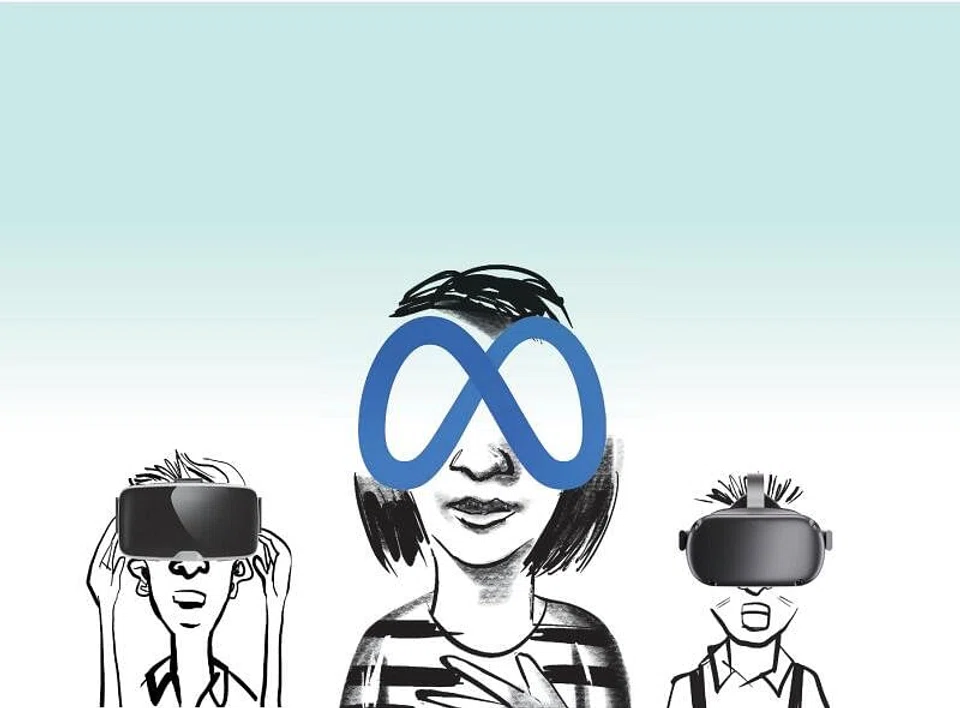
The concept of the metaverse comes from the science-fiction novel Snow Crash, which envisioned a virtual reality (VR) based world that people escaped to, away from the failed real world. But now, the term is being used to denote what could be the next wave of the internet. The floodgates opened on Oct 28, when Facebook creator Mark Zuckerberg unveiled his grand vision to help build the metaverse, or what he described as "an embodied internet where you're in the experience, not just looking at it". In line with this vision, Facebook has rebranded itself "Meta".
The company acknowledged that the metaverse won't be built overnight or by a single company, and that many products would only be realised in the next 10 to 15 years. Nevertheless, brands are already buzzing. Chinese tech juggernauts Alibaba and Tencent have reportedly applied to register their own metaverse-related trademarks. Nike is said to be staffing up on virtual designers, which could indicate plans to sell virtual sneakers. Dyson has built a VR showroom for customers to preview its electronics. So-called "metaverse e-commerce" is unlikely to become mainstream anytime soon, notes Wang Xiaofeng, principal analyst at research firm Forrester. "But there will be experimentation and pilot campaigns emerging, more likely in the US with vendors like Roblox, and probably in China where domestic vendors usually move fast in applying emerging tech," she says. Roblox, an online platform where users can make their own games, is seen as a frontrunner in building the metaverse, alongside other tech giants like Epic Games and Nvidia. The race to advance immersive tech like VR could move retail towards an age of "hyper-personalisation". "This means that every object, every conversation, image or any point of interaction in the digital environment, serves to exist as additional data points for retailers to use," says Ivan Zhou, Asia-Pacific general manager at Techsun, a China-based marketing tech company. This could also mark a shift in the nature of consumption itself, notes Jefferson Chen, co-founder and chief executive of Advance Intelligence Group, the AI company behind buy now pay later service Atome. "It's more than just an immersive VR experience; people are willing to pay, own, and transact for products that are entirely digital and not physical," says Chen, pointing to how sales of art, in the form of non-fungible tokens (NFTs), have soared. His company is in the early stage of exploring what role it can play in the metaverse. Vinnie Lauria, founding partner at Golden Gate Ventures, thinks that this could be the start of "e-commerce 3.0". " In Southeast Asia, Singapore would be the first-mover market," he says. Derek Wang, Singapore general manager at Alibaba Cloud Intelligence, is likewise optimistic that such metaverse e-commerce could take off in Singapore and Thailand. "With cloud as the infrastructure of the metaverse, and technologies like data analytics and AI, remote rendering, and IoT... we are moving closer to a future of metaverse e-commerce."
Don't funge with me
But while retail could take off in the metaverse, this would necessitate a rethink of how payments are made. In the case where the goods being sold are virtual, such as a piece of digital art, there is also the issue of how to prove ownership. This is where many are betting on NFTs - which are essentially units of data stored on the blockchain with a unique signature. NFTs can take the form of any digital asset - a meme, a GIF or even this very article (unless you're reading it in print). NFTs have already exploded in popularity with some transactions bordering on ridiculous - a GIF of the flying Nyan Cat sold for almost US$600,000, while Twitter founder Jack Dorsey's first tweet went for US$2.9 million. Axie Infinity, an NFT-based game, reportedly sold a plot of virtual land for US$2.3 million, while the online world Decentraland sold a patch for US$2.4 million. What seems like a senseless bubble now could get a more solid use case in the metaverse, some reckon. NFTs could become the primary way to facilitate commerce in the metaverse, or even across the physical-digital realm, says Jothi Menon, co-founder and chief executive of RtistiQ, an online art marketplace leveraging blockchain.
Projects like The Sandbox are centred on NFTs. Players themselves can create their own digital assets in the game - such as costumes and weapons for their avatar - as an NFT. Their ownership is recorded on the blockchain. They can also trade these assets on The Sandbox's marketplace, earning from their creations. Upon purchase, the new ownership of the asset is recorded on the blockchain. Players can likewise own virtual "land" in The Sandbox's universe, similarly in the form of NFTs, as with the case of Snoop Dogg. The land units are represented in a map that forms The Sandbox metaverse. "The Sandbox is positioning itself as an open, decentralised metaverse where users can make their own assets and they can make their own experience... We want users to be self-sovereign, to truly own their assets," says Borget. Kelly Choo, partner at True Global Ventures, explains why he thinks that NFTs will be a cornerstone of the metaverse. In a traditional video game universe, everything you see there belongs to the game publisher - the buildings, roads, character avatars, says Choo, whose firm is invested in The Sandbox. But being able to create your own digital asset - say, a teddy bear made out of pixels, as an NFT means that you could lay claim to it and even sell it. Or if your ambitions are grander: you could purchase virtual real estate within the gaming universe and build your own teddy bear amusement park within it, that other gamers can visit. Says Choo: "You want these bears to be owned by you as the user, not the company. The moment these bears are owned by the company, if that (universe) shuts down, you will lose the bears. If you buy a shirt and the shop closes down, does your shirt disappear? It doesn't." "So when buying in the metaverse, we believe that it should be open and should be (in the form of) an NFT... and you can take the bears and move them anywhere else in the metaverse . We think that this concept is very important, because if the ownership is based on the platform, then everyone is just renting, not buying."
Regulatory nightmare?
Even as there is potential, the dystopian possibilities are aplenty. Data collection in the metaverse, especially where VR headsets are involved, could be much more intrusive, notes Paul Tan, partner and head of litigation for South-east Asia at Clifford Chance Asia. "Users participating in the metaverse will likely be 'logged in'' for extended amounts of time. This will mean that patterns of behaviour will be continually monitored. Will we be able to switch off tracking?" he questions. There is also the issue of which data privacy laws will apply, given the cross-border nature of e-commerce, or whether a uniform standard of law could be applied to the metaverse. The same concern applies to protecting intellectual property and disputes. "What happens if a consumer has a dispute with a merchant on the metaverse? What would be the applicable consumer protection laws in that context? Again, will such merchants have any 'nationality' as we understand it today?" Tan adds. Antitrust concerns could be another thorny issue - if the metaverse is dominated by larger players who innovate rapidly, this could marginalise smaller local players, says Roshan Raj, partner at research firm RedSeer Consulting. "Hence, public opinion and regulations will likely seek checks and balances to ensure that local players remain relevant in the metaverse domain and that relevant laws are created to limit abuse of dominant position," he says. Then there is the spectre of wider social inequality, points out Chen of Advance Intelligence Group. "The gap between the haves and have-nots will widen further, such that half the world may live and benefit from the metaverse while the other half may struggle with getting basic access," Chen says. He adds: "Who will be controlling these metaverses and gateways? Having too-dominant players is not good because of the control and influence they exert." Where NFTs are involved, regulations are even trickier, as legal test cases are only starting to emerge. "For NFTs, it remains unclear precisely what legal rights the purchaser has bought - there's no physical copy, only a digital copy - does the purchaser own some contractual rights vis-a-vis the collector to use the physical copy he has bought? Is this a license? Do we need a new category of legal rights?" points out Tan. Despite the litany of issues to be ironed out, Tan still sees the metaverse as an exciting and intellectually stimulating prospect. "As with most things, human ingenuity and tech will lead the way; the law will have to catch up," he muses. "The law isn't going to be able to stop any of these issues or problems from arising but we will need it to try and tackle them, if at all possible."
Lower-hanging fruit
As many questions hang in the balance, where do retailers go from here? Observers think that the hype over the metaverse will at least push more brands to innovate on shopping experiences. Immersive tech has already been gaining traction in certain retail segments, such as fashion and furniture, where augmented reality and VR are used to engage customers in try-ons. Jeff Lim, general manager at Shopline Singapore, reckons that there is an opportunity for the perfect blend of physical and online shopping experiences. "Even though it's still in its early days, we can definitely see more businesses adopting VR in the next few years," he says. That said, it is still a niche market, says Jan Ondrus, associate professor of information systems at ESSEC Business School Asia-Pacific. "VR experiences might not be enough to convince e-commerce buyers to ditch the good old websites or mobile apps... Innovative, immersive e-commerce experiences can unnecessarily complicate the act of purchase, which in turn would significantly decrease sales.," he says. There are oppotunities for content publishers as well. Karl Mak, founder and chief executive of Hepmil Media Group, which owns content platform SGAG, is excited on what the future holds. NFTs, for instance, could change the way that content creators distribute and monetise their work. "We are not hurrying to say we must jump on now, but we are aware of what's happening and we are studying it deeply," he says. Choo of True Global Ventures is optimistic that Singapore, which has been very forward-looking on blockchain, will lead the way on metaverse projects. "Maybe in five to ten years, 'metaverse' becomes so ingrained into our culture, as a part of everyday life; it's just like how people say 'Xerox' for photocopying."
He quips: "They could even just be like, hey, see you in the metaverse."
TRENDING NOW
He built the Vingroup empire. Now South-east Asia’s richest man is handing some key roles to his sons
Can CDL become a powerhouse in fund management?
Canada is upping oil flows to Asia, but South-east Asia’s refineries aren’t ready to handle them yet
Data centre energy demand from Asean telcos not a ‘big risk’, says industry group