Singapore e-waste recyclers all charged up to sate appetite abroad
With its still-fledgling local market, Singapore’s used-battery processors must look abroad to sate their appetites
Chong Xin Wei
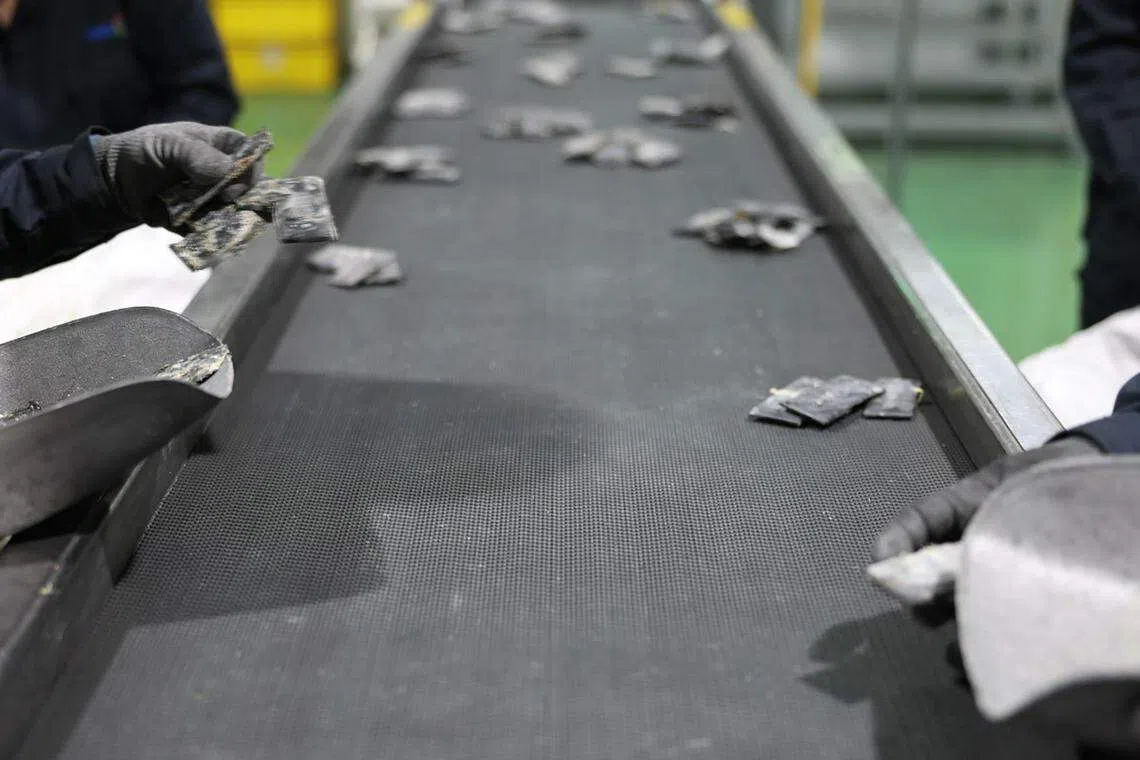
IN ONE year, the TES B battery recycling facility in Tuas can recycle about 5,000 tonnes of lithium-ion batteries. That works out to about 14 tonnes per day, the equivalent of about 280,000 smartphone batteries.
Yet, at the moment, TES B is only processing up to 70 per cent of its designed capacity, says Alfred Hee, head of battery solutions for the Asia-Pacific region at TES-AMM, the home-grown electronic waste (e-waste) recycler that owns TES B.
“As we are dealing with scraps, which include spent batteries, the frequency and volume is not constant, unlike in a manufacturing plant. In certain months, we have healthy volumes, and then there’s the lull period,” he says.
Of the feedstock that TES acquires for its plant, only about 30 per cent of batteries from communications devices and 20 per cent of electric vehicle batteries come from Singapore sources. The rest are imported.
“While Singaporeans are known to own several electronic gadgets, the volume of e-waste is still considered low, considering Singapore’s population size,” says Hee.
Like TES, many other players in Singapore’s nascent e-waste recycling industry have substantially more capacity than the local market requires. But while growth and scale still lie abroad for the sector, there is guarded optimism that Singapore’s e-waste recycling scene could yet blossom on the back of a greening economy.
Singapore generates about 60,000 tonnes of e-waste per year, says the National Environment Agency (NEA). It does not maintain publicly available statistics on e-waste recycling, but a study conducted between 2016 and 2017 found that only 6 per cent of e-waste in Singapore was sent to be recycled. The rest was mainly passed to delivery persons, thrown away, traded in or resold.
In July 2021, Singapore launched its first extended producer responsibility (EPR) scheme, to place the onus of collecting and treating end-of-life e-waste on producers. More than 10,000 tonnes of e-waste has been collected and recycled under the scheme.
Hee says the lack of awareness about e-waste recycling here may result in people selling their electronic devices for secondary use, either locally or overseas. That reduces the number of batteries available for recycling, he says.
He adds that Singapore’s smaller population – relative to that in Malaysia and Indonesia, for example – means the total number of electronic devices owned here is also lower than in other countries.
“In countries with bigger population sizes, the number of electronic items that people own could be double or triple that of Singapore’s. Therefore, there are fewer batteries for recycling here,” Hee says.
Feeding abroad
But TES may not need feedstock from Singapore to survive. Indeed, Hee says that overseas business has all along been a part of the company’s plan. After all, TES charges e-waste producers a recycling or recovery fee, so importing feedstock generates revenue for the business as well. TES imports spent batteries from markets such as China, Thailand, Malaysia and Indonesia.
Hee also notes that importing spent batteries can contribute to the company’s bottom line, as more battery elements can then be extracted and resold to battery manufacturers.
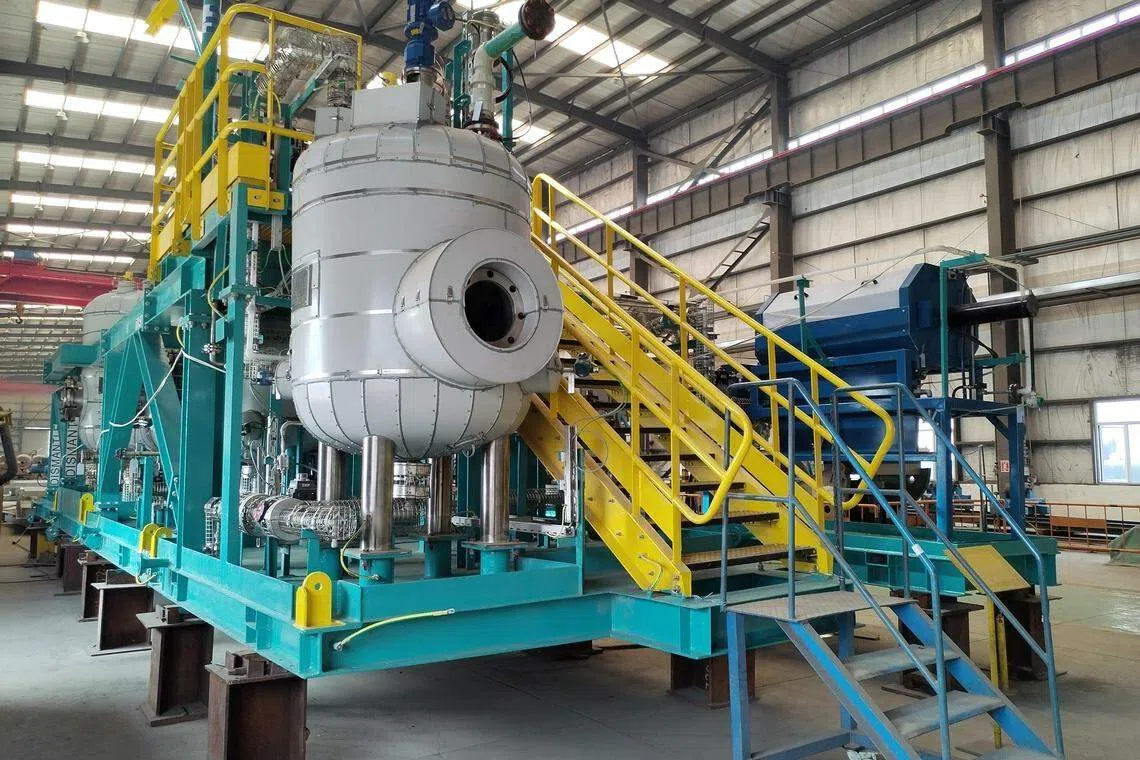
Singapore-based recycling company Green Li-ion makes the equipment that battery recyclers use to process their feedstock. As at last June, the company had sold eight of its proprietary machines. Only one of those machines was sold here in Singapore – to TES. The majority of the company’s clients are overseas, including the US, Australia and Germany.
Green Li-ion chief executive Leon Farrant says: “This is because Singapore doesn’t do a lot of large-volume recycling, compared to Europe and the US.”
He adds that limited battery recycling activities here may result in recyclers struggling to make enough money. Those hoping to survive might have to look elsewhere.
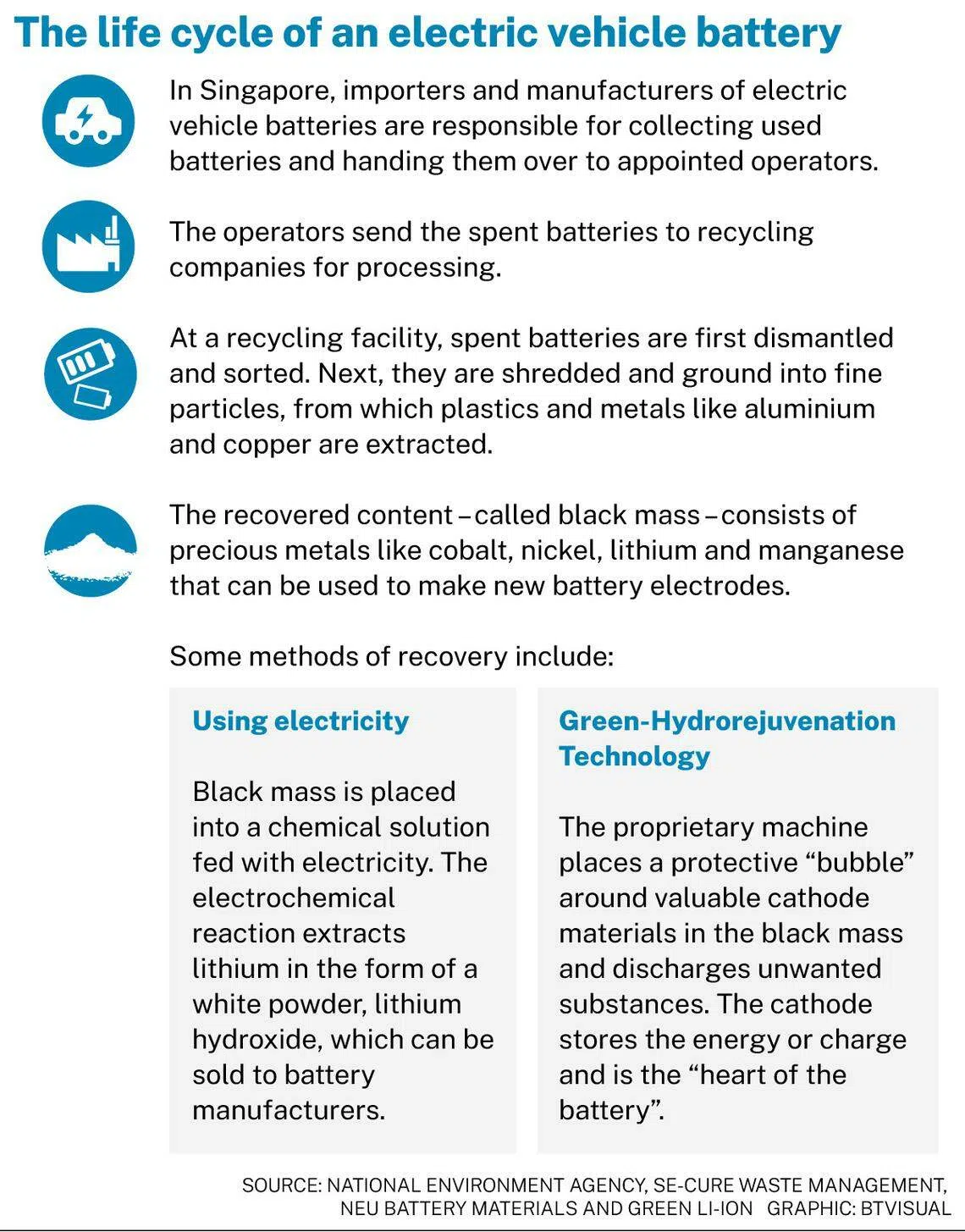
“This may lead them to supply their technology to battery recyclers that have the largest volumes of black mass globally, which, unfortunately, has resulted in them trading outside of Singapore,” he says. Black mass refers to the content recovered from crushing and grinding batteries.
But looking elsewhere isn’t always optimal. Another local battery recycling company, Se-cure Waste Management (SWM), says its current facility can process about 250 tonnes of lithium batteries and materials a month, equivalent to more than a million mobile phones and about 500 electric vehicles.
But only about 15 per cent of its capacity uses local feedstock. The rest is imported from overseas, says managing director Vince Goh.
Noting that Singapore has a limited supply of feedstock, he says the company has to import e-waste to meet a “minimum operational threshold”.
Without disclosing the startup’s margins, Goh notes that some collection agreements come at a cost to SWM.
“When we talk about recycling, it is not just about the recovery standards; we also need to consider whether it will be sustainable financially for the company, and whether we have enough profits and revenue to undertake research and development,” he says.
Home prospects
Still, the Singapore market could yet expand. As the Republic electrifies to reduce peak land transport emissions by 80 per cent by or around 2050, the volume of e-waste here is expected to grow.
To boost e-waste recycling rates, NEA says it is working to step up outreach and engagement efforts, to raise public awareness of the importance of e-waste recycling and of the various e-waste collection points.
The agency will also expand the collection infrastructure and avenues for material drop-offs to make e-waste recycling more convenient and accessible to the public.
“As more members of the public become familiar with the (EPR) scheme and adopt the practice of disposing of e-waste properly through the various avenues, we expect collection volumes to increase over time,” the agency says.
SWM plans to expand its facility in Singapore in anticipation of such increased feedstock. The new facility, equipped with new technology and automation systems, is expected to process up to 24,000 tonnes of lithium-ion batteries per year, Goh says.
As transport operators green their fleets and carmakers produce electric vehicles, Goh hopes to remain at the forefront of the recycling industry. “We are pushing ourselves to be ready for the surge in spent batteries here,” he adds.
Singapore startup NEU Battery Materials buys black mass from SWM, and sells the recovered metals to battery manufacturers.
Bryan Oh, NEU’s co-founder, says the company plans to increase the size of its pilot plant, which currently occupies 100 square metres at SWM’s facility.
As electric vehicles gain traction here, he hopes to scale fast enough to support the incoming feedstock.
Although Oh does not know the extent to which the volume of local e-waste will grow, he expects more people to adopt electric vehicles, as Singapore plans to electrify half of its vehicles by 2030. He also reckons that the increasing demand for electronic gadgets, energy storage systems and electric vehicles will fuel feedstock here.
Grass still green on other side
Nevertheless, Oh isn’t losing sight of the global market. He plans to take NEU abroad, including to Europe, the US, India and Indonesia.
“Singapore is still quite in the early stages of electric vehicle adoption, compared to other regions, which have been using electric cars for decades,” he says.
“Our plan is to build a full-fledged recycling hub to service the end-of-life management and supply recycled and precious metals back to individual countries.”
TES’ Hee does not expect the volume of feedstock from Singapore’s consumer sector to grow significantly, with the Republic’s small population being a limiting factor.
He adds that TES will continue to source spent batteries from overseas, on top of increasing its local intake.
“The volume and frequency of battery scraps are neither uniform nor periodic. We thus need to supplement (our feedstock) from various overseas sources,” he says. “Also, as a business, we need various sources of spent batteries; we are competing with other recyclers for these materials.”
While local growth will be positive, Hee is realistic about the economic realities of a small market.
“We are always looking for ways to increase our local feedstock, but we aren’t the only battery recycler in Singapore, and it is a competitive market,” he notes.
Emerald Technology Ventures’ investment manager Graham Carey says he prefers to invest in companies that offer “enabling technologies” to recycling players, which insulate these businesses from the supply-and-demand challenge.
“A business model that leverages the growing demand for lithium-ion batteries and sells its technology to local and international recycling companies has a much greater chance of success,” he says.