

Sweet on agility
Ehab Abou-Oaf, regional president of the world's biggest confectionery company, Mars Wrigley, believes in empowering employees to be nimble - and defies the anti-sugar movement.

Vivien Ang
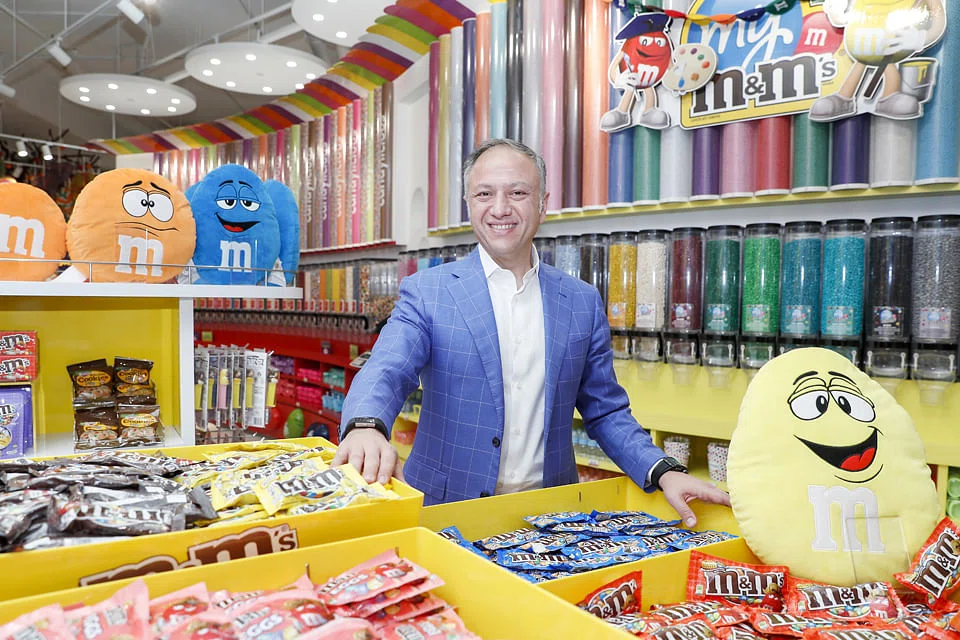
SITTING across the table at St Marc's cafe and enjoying a chocolate croissant, Ehab Abou-Oaf, regional president of Mars Wrigley Confectionery, laughs and says: "I like to say I eat 50kg of chocolate every year." This reporter pauses and considers, but somehow, the figure seems believable coming from the self-confessed diehard chocoholic. "When you are with Mars, chocolate is your bread and butter," he quips as he sits back and dusts the pastry flakes off his hands. Mention Mars Inc and chances are, the eponymous chocolate bars automatically come to mind. However, this privately owned company - which made almost US$35 billion in net sales in 2017 - is as diverse as the number of chocolate brands under it, which include Twix, M&Ms, and Snickers, just to name a few.
Indeed, Mars Inc has its fingers in many pies, one of which includes petcare. The firm boasts brands such as Whiskas and Pedigree; and Mars Petcare, together with Mars Wrigley Confectionery, account for more than 90 per cent of sales.
And Mars Inc has been in the petcare business for more than 75 years, says Mr Abou-Oaf, who has joint Egyptian-Belgian citizenship. The firm started out with pet food brands but has since expanded further into veterinary care and diagnostics.
"The acquisition of VCA last year, one of the largest networks of veterinary hospitals in the US, has made Mars Inc the world's largest employer of veterinary professionals. This is just one example of the portfolio shifts we are making to our business as it grows.
"A lot of people don't know that these brands are under the big umbrella of Mars Inc. The company has always been under the radar but that is changing. We believe that consumers want to know about the company behind the brand and what I would like for people to know is that Mars Inc is very principles-based - operating on the five principles of quality, responsibility, mutuality, efficiency and freedom."
What makes the family business of over 100 years special, he adds, is that the company values relationships and thinks of its employees as associates who are members of the family. The less hierarchical practice of Mars Inc translates to faster decision-making, which makes the company both an efficient and a special place to work in.
Although the firm has a presence in more than 80 countries, "it is interesting how people in the various countries that Mars Inc operates in think that it is a local company".
Mr Abou-Oaf, who is based in Singapore, believes that it is partly due to the decentralised approach that Mars Inc adopts. "We focus on the local consumer and doing what's right for them. We have customers in different parts of the world with different needs. Hence, the decentralised approach allows us to take the path that is closest to satisfying the customers and consumers."
Moreover, Mars Inc is "complex", he says, with brands, businesses, and operations around the world. "How could we continue to thrive if every decision was made centrally? For this reason, we give all associates freedom to act with full responsibility for doing their assigned jobs."
Hence, Mars Inc and its products are very much integrated into the local environment, he says. The company believes in a decentralised business model where decisions are made as close to the market as possible, and its associates are empowered to act as they see fit. This enables the company to respond more quickly to changing market dynamics and consumer trends, as well as create products that are relevant for local consumers.
For example, the firm - which has more than 20 brands of sweets and chocolates under its name - established a production facility in India in 2016 to produce eggless Snickers for its Indian consumers who are largely vegetarian, and temperature-tolerant Galaxy bars that better withstand India's searingly hot climate. Galaxy bars in India are also packaged in re-sealable wrappers as most Indians like to consume chocolates over long intervals.
Principle of mutuality
In Singapore, the company brings in limited-edition packaging for their chocolates for festive occasions such as Chinese New Year.
Asked how the company maintains a seamless process - from the procurement of cocoa beans to manufacturing and distrbution - such that consumers get to have their chocolate fix daily, Mr Abou-Oaf credits it to the mutuality principle.
"A mutual benefit is a shared benefit which we believe is more enduring. We believe that the standard by which our business relationships should be measured is the degree to which mutual benefits are created. These benefits can take many different forms, and need not be strictly financial in nature."
Mr Abou-Oaf explains that Mars Inc relies on its partners - from the manufacturers and suppliers down to the distributors - to get the products on the shelves. It is a partnership across the supply chain starting from the supply of raw materials.
Moreover, as it is not publicly listed, Mars Inc is uniquely poised to be more agile and adaptable, he says. "Being privately held allows us to make long-term decisions that are embedded in not just our principles but also in creating long-term value for the supply chain that we are a part of. We are not under the quarterly pressure of Wall Street and we are only looking after the sustainability of our business and success of the principles. We do not have to pay dividends and the profits are mostly reinvested."
A good example is Mars Inc's acquisition of Wrigley in 2008 for about US$23 billion jointly with financier Warren Buffett.
By 2016, Mars Inc cashed out Mr Buffett and took full control of Wrigley, formally putting M&Ms and Altoids mints in the same division.
"It was always the agreement that we were going to consider fully acquiring the Wrigley business. Due to the freedom principle, Mars Inc always had a healthy financial balance sheet, which allows us to make acquisitions. It doesn't mean we don't borrow money; we borrow, but we are able to pay it back in a relatively short period of time. Like what we did with Wrigley. The acquisition enabled us to create the largest confectionery company in the world."
As boss of a confectionery giant, who also happens to be president of Food Industry Asia, Mr Abou-Oaf certainly has his own take on the anti-sugar crusade, as well as the idea of a sugar tax to curb the sweet tooth.
"We believe in a strategy of choice. We like to be transparent about what is in our products so we have labellings. We follow the WHO (World Health Organisation) sugar intake recommendation and we believe our products are treats. Because I exercise, I eat right, I am able to enjoy the goodness of chocolates."
The regional president, who is in his early 50s, adds that he is happy with the approach Mars Inc is taking and believes that the issue of whether a single ingredient risks the health and lives of people is a contested provocation - "research and science will tell us that different people react differently to different things and it is a combination of ingredients that make up how our body reacts", he says. "Ultimately, a balanced diet is the answer."
Mr Abou-Oaf adds that he does not believe a sugar tax is the answer to deter consumers from indulging in sweet delights. "Experience has shown that tax is not the best form of swaying consumer consumption. We have a common objective - the government, us and consumers - and that is the health of consumers. And that is not achieved through tax. It is achieved through being transparent, working with industries to evolve and ensuring that consumers are making informed choices with the products."
What about the controversy surrounding the colourful button-shaped chocolates called M&Ms (there were rumours that the dye used to coat M&Ms was cancer-causing) ? Mr Abou-Oaf was quick to rebut: "M&Ms have been around for years and have been approved by all the FDAs globally. There is no shadow of a doubt that it is safe for consumption."
Mr Abou-Oaf adds that Mars Inc- which is ranked among the Fortune 100 best companies to work for - has committed to move from artificial colours to natural colours.
"But it takes time because we want to do it responsibly and natural colours come from natural sources, so by definition it has an impact on the planet. So we want to be a responsible company that makes use of resources sustainably and responsibly."
Hence, with ingredients such as palm oil, the company continues to source 100 per cent Roundtable on Sustainable Palm Oil ( mass-balance certified palm oil which is part of the firm's Sustainable In A Generation plan "to transform our extended value chain".
"We use our resources to the fullest and waste nothing. Mars Inc has a different business philosophy from other corporations and this is a key reason for our success. Our approach singles out Return on Total Assets not only as the prime financial measure but as a driver of growth. By minimising our assets, we give our consumers excellent value for money while delivering healthy returns at lower levels of profit than our competitors."
With climate change affecting the production of cocoa and rising prices, the company is also doing its part to protect and ensure the continuity of the main ingredient in its products.
The firm is pledging US$1billion over the next five years to help with cocoa sustainability and its approach starts with helping the more than five million farmers in West Africa, South-east Asia and the Americas who are responsible for growing most of the world's cacao.
Part of its Sustainable In A Generation plan, the firm's Sustainable Cocoa Initiative works across three areas to put farmers first.
"First, we are reaching as many farmers as possible by certifying our entire cocoa supply and encouraging others in the industry to commit to certification. Mars is currently the only major manufacturer to work with all three major certification organisations - UTZ, the Rainforest Alliance and Fairtrade International. Second, to improving cocoa breeding. Farming methods and protection against pests and disease by investing heavily in and conducting breakthrough research like mapping the cocoa genome. We released these results into the public domain so they can be used by everyone to develop better breeding practices and lead to healthier, more productive trees for farmers."
Production boost
In fact, last year, Mars Inc also invested US$4 million in opening a cocoa research facility in Pangkep, Indonesia, in a bid to boost advanced production methodologies and better farmer practices. This is apart from the company's existing cocoa research centre in Tarengge, South Sulawesi.
"Lastly, we give farmers the knowledge and technology they need to triple their yields by investing in critical cocoa-sourcing regions. An example is the Cocoa Doctors programme in Indonesia, through which the firm teaches farmers modern production techniques and best practices. This enables cocoa farmers to have bigger yields and profits, and these farmers go on to provide coaching to numerous other farmers in their respective villages."
"Just this year alone, we have invested in new or expansion of our manufacturing capabilities across our segments, in markets such as Egypt and India (chocolate) and Kenya (gum and mints). Equally important is that we are not just manufacturing, but also innovating and investing in R&D to create products relevant for consumers from the diverse markets in the AMEA (Asia-Australia, Middle East and Africa) region."
As the interview winds to a close, it seems an opportune moment to finally pop the question: What is his favourite chocolate?
He chortles and says: "Well, there is a chocolate for different times of the day. I love a Twix in the morning as it is a combination of chocolate and biscuits. M&Ms in the early afternoon as it is a snack I like. For a treat at the end of the day I have a Dove bar. Weekends when I exercise, I have a Snickers bar. So different days of the week, different times of the day - I love having different types of chocolates."
EHAB ABOU-OAF
Regional President, Mars Wrigley Confectionery
1966 Born in Egypt
EDUCATION
1982 - 1984: United World College of Lester Pearson - International Baccalaureate Diploma
1984 - 1989: The American University in Cairo - BSc with Honours, Mechanical Engineering
CAREER
1990-1993: Technical Brand Manager, Jeddah Governorate, Saudi Arabia, Procter & Gamble
1993 - 1997: Group Head R&D, Brussels, Procter & Gamble
1997 - 1999: Section head R&D, Japan, Procter & Gamble
1999 - 2000: Associate Director R&D, Brussels Area, Belgium, Procter & Gamble
2000 - 2003: General Manager, Egypt and North Africa, One Mars
2004 - 2007: General Manager, Egypt, North Africa & East Mediterranean, One Mars
2007 - 2010: President, China, Mars Chocolate & Petcare
2011 - 2015: President, Asia Pacific, Mars Wrigley Confectionery
2016 - 2017: President, Asia Pacific, Middle East and Northern Africa, Mars Wrigley Confectionery
Since 2017: President, Asia-Australia, Middle East & Africa, Mars Wrigley Confectionery
OTHER APPOINTMENTS
Since 2016: President, Food Industry Asia
June 2017: Chairman of the Board of Governors, Singapore American School
TRENDING NOW

He built the Vingroup empire. Now South-east Asia’s richest man is handing some key roles to his sons

China’s Pinglu Canal likely to benefit Singapore, other South-east Asia ports in the long term

Suntec Reit to increase Singapore focus, sell three Australia properties
Despite the de-dollarisation debate, demand for dollar liquidity in Asia is growing

