Team player to the core

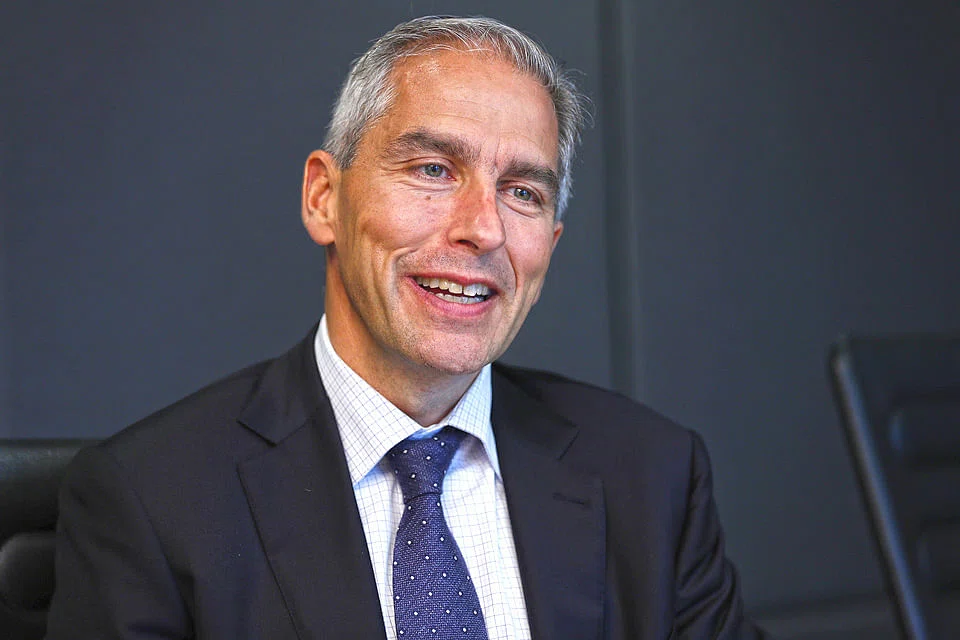
Aon co-president Michael O'Connor talks about the professional services firm's "Aon United" philosophy which emphasises collaboration across different business areas and geographies.
Janice Heng
Janice Heng

Published Fri, Jun 28, 2019 · 09:50 PM

    TO the uninitiated, distance running may not seem like a team sport. But in the university context, say, the seemingly solitary pursuit can be fuelled by camaraderie, says Michael O'Connor, co-president of global professional services firm Aon plc and college-era track star.

    "In my former life I was a two-time All-American in track," he shares, referring to the distinction conferred to amateur student athletes who are among the top in their event.

    Yes, some of that involved focusing on individual excellence, he grants. "But I think for myself, in my college days, it really was the success of the team that got me most excited."


    Back when he was at the University of Notre Dame, its athletics programme was ranked third in the country. "(It) opened my eyes to the opportunities of being part of a team, being a contributor to try and actually accomplish something," he sums up. "To me it was about: 'How can I be the best player that I can be?' And then: 'How can I be the best teammate?'"

    That spirit has carried on to his career at Aon, where he has both individual and collective responsibilities as one of its two co-presidents.

    "As a professional services firm, a competitive priority, an imperative for us, is how do we actually connect our team better," he says. The firm's "Aon United" philosophy emphasises collaboration across different business areas and geographies. It's no small task, given that the firm has been built up through some 450 acquisitions over the last few decades, with 50,000 people across 120 countries.

    Asean Intelligence

    Get insights into businesses across South-east Asia

    Get the free report

    Yet Aon's identity is far from fragmented. In the past year, Aon has moved to a single brand for all its offerings, in a decision that was "hard to believe" in their industry, says Mr O'Connor. The company also moved to a single profit-and-loss statement and a global operating committee.

    Then there is the co-president arrangement, in place since May 2018. "Eric and I embody the spirit of Aon United," says Mr O'Connor, referring to fellow co-president Eric Andersen. Mr O'Connor focuses on the markets of North America and Asia-Pacific, as well as the business areas of commercial risk, health, and data and analytic services. Mr Andersen handles the geographies of Europe, Middle East and Africa, and Latin America, and the solution areas of retirement and reinsurance.

    Despite this split in portfolios, the co-presidents "operate as truly a partnership", says Mr O'Connor. "In some small way, hopefully our colleagues see that as the way we expect all our colleagues to work across the world. Which is: true partnership."

    Having an impact

    Mr O'Connor was born in 1968 on Long Island, New York, to parents who were "great believers in education". After graduating from the University of Notre Dame with a degree in accountancy, he joined former Big Five accounting firm Arthur Andersen in 1991. The firm met a sticky end about a decade later, due to its involvement in the 2001 Enron scandal. But its significance for Mr O'Connor is a happier one: it was there that he met his future wife.

    After some three-odd years in Arthur Andersen, Mr O'Connor decided to "go back to school" - specifically, law school. Yet along the way, as he studied corporate law and worked at law firms during his degree at the University of Chicago, he realised his true interests lay elsewhere. "Ultimately for me, what really was interesting was the underlying business," he says. So instead of going into legal practice after obtaining his law degree, he joined management consulting giant McKinsey & Company in 1997. "It was a great training ground," he remembers; a place to "see how great businesses worked".

    There, once more, a theme from his past was underscored: "One of the things that became apparent was largely it came down to how the team operated. ...One of the things that was true in every one of the high-performing organisations I saw is that they had fantastic teams."

    One organisation that he noticed was Aon, when he was serving it in his McKinsey role from 2006 to 2008 and thus "got to have an inside look at how Aon was developing as a firm".

    "For me, I was very fortunate to be able to get connected with Aon, be able to actually work with some of the team as an adviser from the outside, and then ultimately get the opportunity to join the firm."

    "So it was a two- or three-year job interview," he sums up with a laugh.

    Besides gaining insight into the firm's workings, he saw "enormous potential to be able to have more impact with clients", he adds. "That's what got me excited about joining Aon."

    Having unity, he adds, is for the sake of "a single cause": serving clients. Though Aon is able to transact solutions for its clients, the role it plays is still largely that of an adviser, helping clients to identify and understand the risks they are facing, assess and quantify the impact of such risks on their businesses, and take action to transfer or mitigate them. "There's more risk today than there ever has been." Traditional risks persist while new risks are emerging, from pandemics and cyber attacks to intellectual property (IP) issues.

    And while the layman might assume that growing longevity and medical advances are positive developments, these trends do mean that companies face increasing risks in the area of health. As workers live and work for longer, the incidence of sickness rises, Mr O'Connor points out. Healthcare costs are also rising in tandem with medical improvements.

    In areas such as healthcare and retirement, Aon advises its clients on the appropriate benefits and plans to offer employees, "both to make sure that they're doing the right thing by their employees but also (so) that they have a highly-engaged, productive workforce".

    Caring for one's employees is part of caring for the company's own health, after all. Aon's solutions are not just about helping companies operate, but also "win in the war for talent", he adds.

    In the 2019 edition of its annual global risk management survey, Aon found that many top risks remain uninsurable. These include increasing competition and economic slowdown, ranked among the top five worldwide, and named the top and fourth risks respectively by respondents in Asia.

    But for other big risks - such as cyber attacks or data breaches, ranked seventh in Asia and sixth worldwide - Aon has stepped up to serve.

    To provide truly effective service, however, has required the acquisition of new capabilities.

    Take cyber risks, for instance. "A few years ago we looked and said, we had great brokerage capability, great risk capabilities around it, but the reality is we didn't have enough technical capability," explains Mr O'Connor.

    Aon found the answer in Stroz Friedberg, an expert provider of cybersecurity solutions, incident response and recovery, and acquired the firm in 2016. The combination of Stroz Friedberg's technical capabilities and Aon's risk management capabilities would make the overall team more effective in both serving clients and working with insurance companies, explains Mr O'Connor.

    It was a similar story in the area of IP, where the risks and issues have changed greatly in recent times. Forty years ago, firms' stock market capitalisation was largely tied to tangible assets such as plant, property, and equipment; today, intangible assets are key, says Mr O'Connor.

    "What we saw over the last few years was that the insurance industry was not doing enough, and we ourselves - as an adviser to clients - were not doing enough.

    "So we stepped back and said: 'What's required here?' Again, our answer to that was that we need more technical capability."

    Last year, Aon IP Solutions was formed, incorporating the acquisition of IP consulting business 601West and appointing the latter's co-founder Lewis Lee as the chief executive officer of the new group. Also joining Aon IP Solutions were Stroz Friedberg's IP team and members of Aon's merger and acquisitions team, who had worked with clients on transactions involving the buying and selling of IP.

    Summing up the significance of Aon IP Solutions' formation, Mr O'Connor says: "We have now the technical capability to truly understand IP, to assess the strength of that IP, to be able to value it, and ultimately be able to work with insurance markets to transfer some of that risk."

    In addition to strengthening its team with regard to specific industry areas, Aon has been building capabilities in the broader field of data analytics, with such skills applicable across its many solution areas.

    "We're a big believer that this industry has to be built on data and analytics. Fact-based insight that leads to action is absolutely what we believe has to be done."

    Aon has been on a data drive for a while, though its efforts have grown more sophisticated as it gains capabilities. Take, first, an example from several years ago, when Aon tapped the historical data of over 6,000 clients to understand that group's collective risks - their collective exposure to natural catastrophes, say. Using those calculations, Aon was able to take the data to insurance companies and ask if they would insure this group.

    More recently, Aon developed an analytical platform for employee health plans. Years of client data were used to build an algorithm that helps clients optimise their self-insured health programmes. "What used to be done through hours and hours and hours in an office is now done in seconds in front of our client on a computer," says Mr O'Connor.

    Furthermore, the algorithm also draws upon an employee perception database. This means that clients are able to not just optimise their health plans around costs, but also see how changes to the programme would affect employees across different socioeconomic factors.

    The platform was developed by Aon's "team in the field" along with their team in its Singapore innovation centre, demonstrating how the latter is not "an island unto itself", says Mr O'Connor.

    Aon has about 850 people in Singapore, including more than 100 in the global innovation centre, which focuses on data and analytics.

    The firm's global presence is one strength which it taps in its own efforts to attract and retain talent. "We want to create an environment where people feel developed and challenged," says Mr O'Connor, adding that Aon has the ability to "create tremendous opportunities for people to learn": both by learning from the clients they serve, and by working in different locations across the world.

    Busy schedule

    He himself, of course, does his fair share of jetting about. His travel schedule has been about the same for the last decade, he reckons: spending three out of every four weeks away from home.

    His family is based in Chicago, where his wife is now a full-time mum - "She's now got the much-tougher job" - to their 12-year-old daughter and 10-year-old son.

    "I try to do everything I can to optimise time at home. So I count nights at home as one of my objective functions, which is how can I actually maximise nights at home," he says - an objective function being a mathematical expression of a business target.

    But his busy schedule is a necessary part of his role in Aon: "We have the belief that as a leadership team we have to be in front of our colleagues, in front of our clients, and in front of our partners.

    "If you look at the businesses we're in, in a professional services environment where we're actually providing advice, counsel and solutions to clients, you need to spend time face to face," he points out.

    "What I do or what Eric does or Greg (Case, Aon chief executive officer) does is interesting; what's most important is what our colleagues are doing every day with clients."

    His visits to Aon's various offices - including its Singapore one, where our interview is taking place - help him "basically figure out what (he) can do to make the environment more effective, the team stronger".

    It comes back, as always, to the Aon United concept and the centrality of the team: "I look at my role and responsibility as to make sure that we're as supportive as we can be to our team, to allow them to be as effective as they can be with clients.

    "So my job is, how can I make the team be more successful."

    MICHAEL J O'CONNOR

    Co-president Aon plc

    Born in Long Island, US in 1968

    EDUCATION

    Bachelor's in Accountancy from Mendoza College of Business, University of Notre Dame

    MBA from Mendoza College of Business, University of Notre Dame

    Doctor of Jurisprudence from University of Chicago

    CAREER HIGHLIGHTS

    1991 Joined Arthur Andersen

    1997 Joined McKinsey & Company

    2008 Joined Aon as Chief Operating Officer of Aon Risk Solutions

    2013-2018 Chief Executive Officer of Aon Risk Solutions

    Since 2018 Co-President of Aon

    Copyright SPH Media. All rights reserved.