
The Fed is as clueless as markets

When the stewards of monetary policy are so uncertain, the best course of action is to do nothing
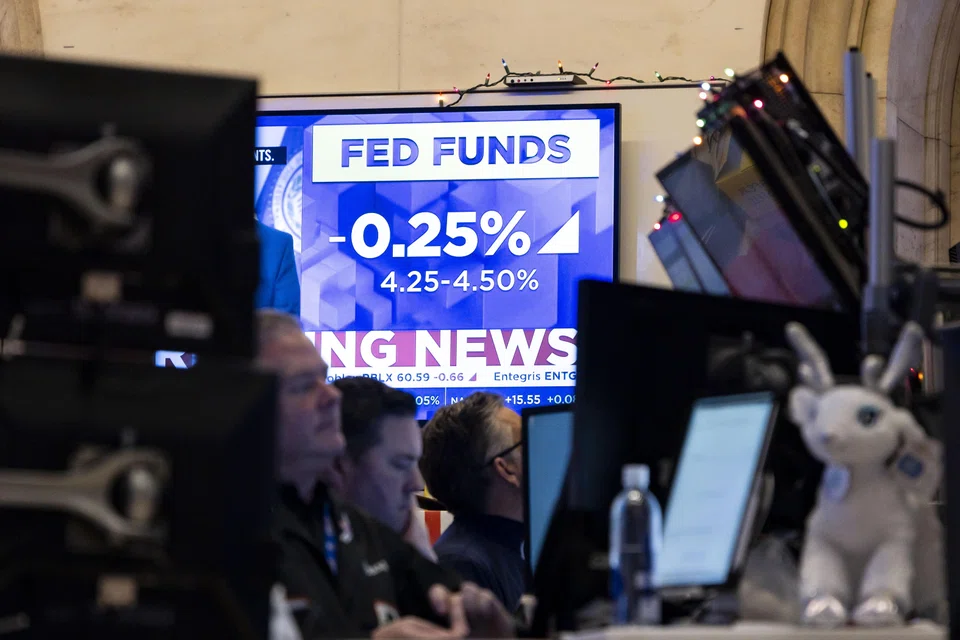
    • With its decision on Dec 18, the Fed has now cut rates by 100 basis points to 4.25 to 4.5 per cent, appropriate adjustments given the meaningful moderation in inflation from the peaks of 2022.
    • With its decision on Dec 18, the Fed has now cut rates by 100 basis points to 4.25 to 4.5 per cent, appropriate adjustments given the meaningful moderation in inflation from the peaks of 2022. PHOTO: EPA-EFE
    Published Thu, Dec 19, 2024 · 05:20 PM

    IN NORMAL times, the conduct of monetary policy is a lot like driving a car through a thick fog of uncertainty. You have a general idea of where you are going, but you want to move slowly to avoid accidents. At the moment, it is more like driving while double blindfolded – in a car with malfunctioning brakes. The most prudent move is to stop.

    With its decision on Wednesday (Dec 18), the US Federal Reserve has now cut rates by 100 basis points to 4.25 to 4.5 per cent, appropriate adjustments given the meaningful moderation in inflation from the peaks of 2022. But nobody knows what comes next – and I mean nobody.

    The key feature of the Fed’s latest economic projections was the uncertainty surrounding them. The median forecaster on the Fed’s rate-setting committee now projects that inflation progress will slow meaningfully in 2025, and that the central bank will cut rates just two more times by next December.


    But among the 19 Fed board members and Federal Reserve Bank presidents, 15 now say that the risks to their forecasts for core personal consumption expenditures (PCE) inflation data are weighted to the upside, the most since 2022. Fourteen said that their uncertainty about core PCE, the Fed’s favoured inflation gauge, had increased since they last filled out the survey in September.

    Why is everyone so uncertain all of a sudden?

    First, there is president-elect Donald Trump. Though Fed chair Jerome Powell has be careful about opining on politics, Trump’s agenda introduces a raft of two-sided risks, especially his threat to place sweeping tariffs on America’s trading partners.

    Such a move could mechanically increase price levels. Yet during his first presidency, the Trump trade war actually prompted the Fed to cut rates, reacting to an upheaval in financial conditions and the prospect of reduced business investment.

    Powell brought to Wednesday’s press conference details from 2018 Fed research that suggested looking through tariff-induced inflation. Yet, this environment is clearly different in a variety of ways, with inflation expectations already shaken by the past four years.

    Trump has also promised to extend tax cuts enacted in 2017 and maybe add new ones, which could have the effect of further juicing economic growth and inflation – especially if they are deficit-funded. And he has threatened mass deportations of undocumented immigrants that could cut into labour supply.

    Second, there is the wobbly nature of the inflation data itself – a risk that Powell played up. Asked if the uncertainty among officials was all about Trump, he reminded reporters that the latest inflation readings had been far from pristine.

    The core PCE deflator rose by a too-high 0.3 per cent in September and in October. Though the pace is likely to have cooled in November, the upshot is that realised inflation will almost certainly exceed the Fed’s earlier 2024 projections. And, recent experience suggests that upside inflation surprises tend to be concentrated in the first quarter, despite attempts to compensate for such trends through seasonal adjustment.

    Overall, I suspect that Powell emphasised these bumps and wiggles in the data partially to avoid too many Trump questions, but he is right that the data has been frustrating.

    Third, there is the uncertainty about how the interest rate backdrop is actually affecting the economy. Some members of the Fed’s rate-setting committee have argued that the world has fundamentally changed in recent years, and that policy rates as they stand today may actually be close to the “neutral” rate – the setting that is neither stimulative nor restrictive, but just right.

    As Powell said Wednesday, “we’re significantly closer to neutral” but also “still meaningfully restrictive” – whatever that word salad means.

    Others think we might already be pulling into the neutral station. Federal Reserve Bank of Cleveland president Beth Hammack, who registered the lone dissent against Wednesday’s rate cut, said this month that “we may not be too far from a neutral setting today”. And Fed governor Michelle Bowman said in November that “we may be closer to a neutral policy stance than we currently think”.

    The upshot of all of this is that the Fed’s best option is to put the car in park, and they have left the door open to doing just that. In his remarks on Wednesday, Powell said that the central bank is “at or near a point at which it will be appropriate to slow the pace of further adjustments”.

    I do not think that all of this necessarily means that rates will be suspended here indefinitely. Remember: there’s a scenario in which the Trump agenda could ultimately precipitate an economic slowdown and rate cuts. It all depends on which campaign promises he keeps.

    All we know is that we do not know enough, and Powell himself is as clueless as many in the markets. BLOOMBERG


