From field to fork: Net zero starts in our food chain
AS EARTH Day (Apr 22) approaches, more than ever, climate change will be at every corner we turn. And for good reason. From Instagram to LinkedIn, we’ll be met with a flurry of updates on what individuals and organisations are doing to help save the world.
While I applaud these efforts, it’s simply not enough. Tackling climate change isn’t just for the month of April; it needs to be on the agenda year-round. The ambitious net-zero targets set by governments and organisations alike are all well and good. Indeed, the public and private sectors must lead the way in reducing global greenhouse gas emissions, but consumers can absolutely play their part by making environmentally friendly lifestyle choices.
Food and climate change are inextricably linked. Although we must switch to renewable energy to meet climate targets, this can address only 55 per cent of emissions. To reach net zero, we need to change the way we make and use things, and that includes taking a good hard look at the food we eat.
It is estimated that our food chain is responsible for a shocking one-third of anthropogenic greenhouse gas emissions. When you take a closer look at how our food ecosystem functions, it’s easy to see how broken it’s become.
Before we flocked to supermarkets, wet markets were the go-to destination for the weekly food shopping. Sadly, this trend is on a downward trajectory. A 2018 survey conducted by Singapore’s National Environment Agency found a decreasing penchant for wet markets. Some 39 per cent of respondents said that they had not visited wet markets in the past year. In the same survey in 2016 and 2014, the corresponding figures were 33 per cent and 23 per cent respectively.
Wet markets allow for seasonal and local produce to reach our kitchen tables instead of food that has travelled miles across the globe.
Now, our supermarket shelves are bursting at the seams with produce from China, Africa, Europe, and the United States as we chase profit over quality and the environment. While I know Singapore has limited space for agriculture, as consumers we all need to understand and be more conscious of the food miles our produce has travelled and the impact that has.
Furthermore, these globally sourced ingredients require extensive packaging in single-use plastic, and more often than not, preservatives and additives to extend their shelf-life. What we receive at the other end may look the part, but its history tells a different story.
Simply put, choosing foods with fewer food miles helps reduce pollution and protect our planet.
From food source to food waste
If food loss and waste were a country, it would be the third-highest greenhouse gas-emitting nation behind the US and China.
Recently, chef Massimo Bottura laid the statistics chillingly bare. “We are eight billion people on earth. We produce enough food for 12 billion people. Yet, 820 million people don’t have anything to eat. It’s criminal,” he said.
We need to do all we can to target food waste. Buy only what you need. If you have surplus, get creative with what’s left in the crisper drawer. And remember, the freezer is your friend.
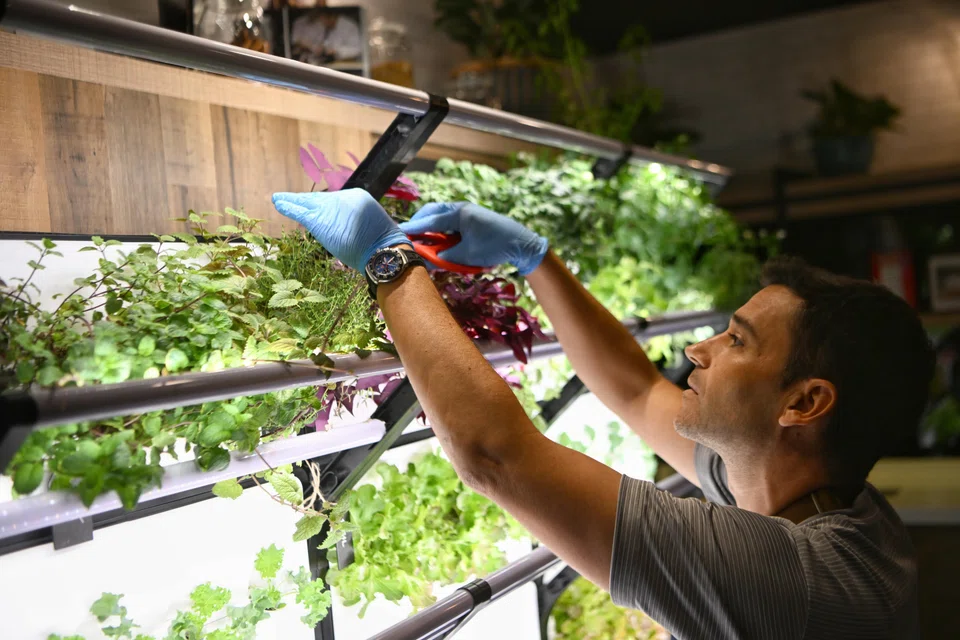
Better yet, grow your own. Full disclosure, I own a company that builds edible green walls for homes and offices. But, if you can get the right infrastructure in place, you can grow a surprising amount of produce, reducing your reliance on shop-bought. Zero preservatives, zero packaging, zero food miles.
The responsibility for tackling climate change needn’t fall solely on the shoulders of consumers. It needs to come from the top down. If private industry, NGOs and governments can come together to educate and empower their communities, we can bring about genuine change. One such example is Enterprise Singapore, which I’ve worked closely with to scale my business from Singapore to Malaysia and the US. Its support and insights have been truly valuable.
Although the climate outlook may seem grim, I firmly believe that a small shift in behaviour by each and every one of us can bring about genuine change.
If we can work together to build more sustainable food systems, we have some hope in reaching net zero.
The writer is founder of Grobrix, the world’s first patented modular edible green wall