Ford is as American as apple pie. Or is that Honda?
The purity test for what counts as a US manufacturer in Trump’s trade war sets up a spiral towards absurdity in the auto sector
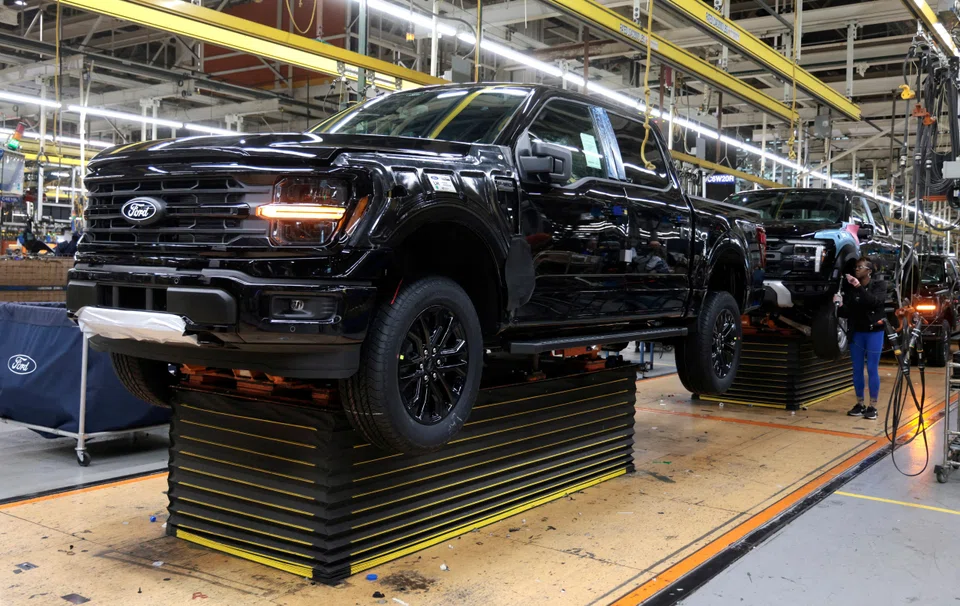
AMERICANS buying cars will very soon be liberated from even more of their money than usual. President Donald Trump’s incoming 25 per cent auto tariffs, timed to roughly coincide with his “Liberation Day” announcement of so-called reciprocal tariffs, are expected to add several thousand dollars to the average price of a vehicle in the US (not cheap as it is).
Besides the dollars involved, there is the unsettling, extreme rationale behind these tariffs with which to contend. Peter Navarro, Trump’s uber-hawk trade adviser, was asked recently about manufacturers potentially cutting jobs to deal with the costs of tariffs. His response to CNN’s Kasie Hunt was astonishing: “So the first thing it’s really important to understand, is that the ‘Big Three’ so-called American companies – GM (General Motors), Ford, Stellantis – they’re not really American companies.”
Let us concede that Stellantis, headquartered in the Netherlands, is not an American company. On the other hand, it was formed largely through Fiat’s rescue of Chrysler out of bankruptcy, and employed more than 50,000 people in the US at the end of 2023.
As for GM and Ford Motor – both still receiving mail in the Detroit area I believe – the former is forecast to sell more vehicles in the US than any other company, and the latter makes the F-150 pickup, which is like apple pie with a chrome grille. Between them, they employ almost 180,000 people in the US.
So whatever could Navarro mean? About half the new passenger vehicles sold each year in the US are imported, with Canada and Mexico accounting for about 40 per cent of those. The Trump administration finds this intolerable.
Navarro, ridiculously overstating his case, was going further, making a point about how much domestic content there is in the vehicles made by the Big Three. Trump’s auto tariffs do not merely target where vehicles are assembled, but also the provenance of their parts.
Even for vehicles that qualify as being compliant with the US-Mexico-Canada trade agreement, manufacturers will have to identify those parts “wholly obtained, produced entirely, or substantially transformed” in the US, with a tariff charged on the rest.
Navarro went on to say about the Big Three that “they have less American content in their cars than some of the other companies that are operating in America, like Honda”.
On that, he has a point – if only up to a point. “Made in the USA” is a nuanced term, given the intricate cross-border auto supply chain established under three decades of North American free trade as well as wider globalisation. GM and Ford unquestionably lead when it comes to the number of vehicles they sell in the US that are assembled there, according to CreditSights, as well as the proportion of their global sales that this represents (Stellantis’ more global footprint dilutes this).
Content is a different matter, though. Professor Frank DuBois of American University’s Kogod School of Business helpfully uses figures reported to the Department of Transportation, among other data points, to compile an index of models and manufacturers, the Kogod Made in America Auto Index. On that basis, Honda does beat out Detroit, though not Tesla.
As gotchas go, however, Navarro’s comes with some major problems.
First, consider the fact that the federal government’s own classification system lumps Canadian and US parts together rather than separating them. That rather underlines the complex, intertwined nature of the industry’s supply chain, and complicates efforts to neatly delineate what is American-made.
Trump’s tariff proclamation hinted at this by saying that the Commerce Department would be given time to figure out how to establish the value of non-US-made parts. “It’s going to be a compliance nightmare for auto manufacturers and customs,” said Prof DuBois. Presumably, the vaunted cost cutters at the Department of Government Efficiency – headed de facto by the conflicted figure of Elon Musk – will OK the expense of a vast new vehicle content inspection operation.
The Kogod index of individual models addresses the limitations of the content data by broadening to include other criteria, such as where the manufacturer’s headquarters are located, and where the engine and transmission are built.
On that basis, Tesla vehicles, with high domestic content and the company based in Texas, score the highest. But so do several Ford Mustang GTs, two variants of Stellantis’ Jeep Wranglers, and several Chevrolet and GMC trucks by GM. Honda’s Passport sport utility vehicle is also up there in the top 20.
The point here is that Navarro’s domestic purity test sets up a spiral towards absurdity. Honda may score higher on Canadian and US parts, a flawed measure in itself, but it employs only around one-third the number of US employees as GM.
Moreover, 84 per cent of GM’s shareholder base – where the profits go – is in the US, Sixty per cent of Honda’s is in Japan, according to figures compiled by Bloomberg. But there is no need to stop there. Manufacturing of vehicles is, after all, increasingly automated, so perhaps we should ask where the robots come from? Japanese and European companies, mostly. Seems problematic.
Efforts to repatriate some manufacturing capabilities in a fragmenting world can be sensibly contemplated. But a policy geared towards ensuring every nut and bolt be made on US soil is a recipe for pricing cars beyond consumers’ reach – which is presumably why Trump has reportedly tried to strong-arm manufacturers into eating the cost themselves.
It also speaks to outdated thinking. An increasing proportion of vehicles’ value relates to software and services, such as advanced driver assistance features and, eventually, self-driving and robotaxis. Will customs officers inspect code?
Similarly, electrification has offered a powerful spur to investment in auto supply chain manufacturing around the world, including in the US. Yet the Trump administration is hostile to that trend, and poised to remove subsidies. Instead, it is seemingly focused on pursuing something like autarky in the internal combustion technologies of the last century.
By the time Detroit meets the new threshold of being American, whatever that means, it will have accelerated its retreat from a rapidly shifting global stage. BLOOMBERG