Fortune may favour the bold in Jurong Lake District mega site tender

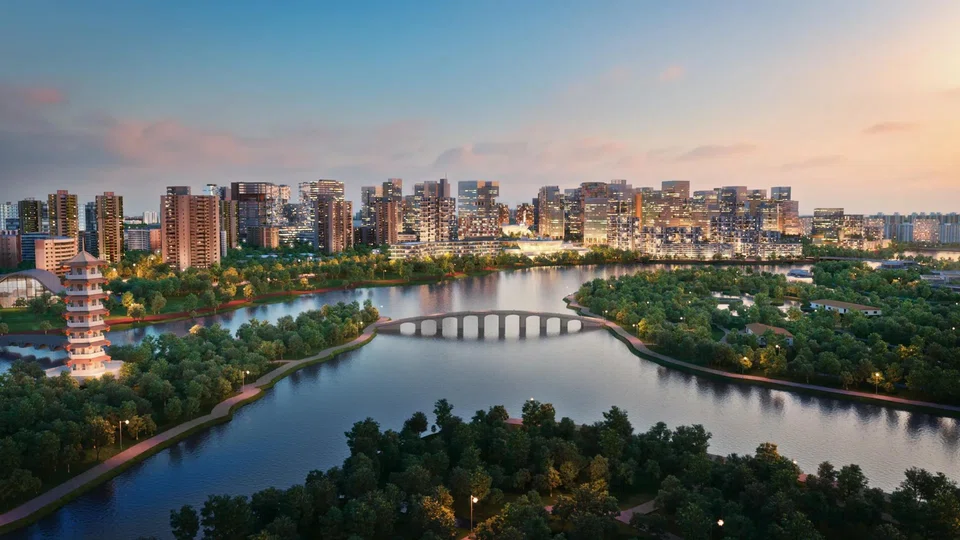
CAPITAL is expensive, and the capital commitment will be huge, but leading developers should seriously consider taking on the 6.5 hectare white site in the Jurong Lake District, which was recently launched for tender by the Urban Redevelopment Authority (URA).
As part of URA’s decentralisation strategy, Jurong Lake District will be developed into Singapore’s largest business district outside the city centre to cater to varied business needs.
The 99-year leasehold site up for tender comprises three plots of land between Jurong East MRT interchange station and the future Jurong Lake District station.
Maximum gross floor area (GFA) of the mixed use development is 365,000 square metres (sq m) or over 3.9 million square feet. At least 146,000 sq m of GFA is for office use, while a maximum of 166,000 sq m of GFA is for residential use. The remaining GFA can be for complementary uses, such as retail. An estimated 1,700 private homes could be built on the site.
The proposed development will be progressively completed over the next 10 to 15 years. Under Phase 1, at least 70,000 sq m GFA of office space and around 600 homes are to be built.
Tenderers will submit their concept proposals and tender prices separately for the tender, which closes at 12 noon on Mar 26, 2024.
Compelling concept proposals featuring a distinctive, highly sustainable mixed-use development with well-designed people-friendly public spaces and amenities to serve the needs of the business and local communities, will be shortlisted to proceed to the second stage of evaluation, which will be based on price only.
The master developer for the Jurong Lake District site pays upfront for the land required to be developed in Phase 1.
Under the option scheme, the master developer pays a fee of 10 per cent to 13 per cent of land price of remaining GFA for an option period of five to eight years to complete the purchase of the remaining land.
The option fee is non-refundable. If the master developer completes the development of the entire precinct, part of the option fee percentage paid can be used to offset some of the land price of the last phase.
Gross development cost for the integrated development at Jurong Lake District could total around S$8 billion.
Sure, some local and foreign groups that are active here have deep pockets plus expertise in executing large scale projects. Also, parties can find partners, thereby sharing risks.
Higher financing costs
Nonetheless, higher financing costs may weigh heavily on the appetite of developers for mega development sites.
For every S$1 billion of loan drawn down, annual interest costs rise from S$20 million to S$50 million, based on assumed annual interest rates of 2 per cent and 5 per cent respectively. Servicing a S$1 billion loan over seven years could cost S$210 million more in interest expenses when the annual interest rate is 5 per cent versus 2 per cent.
Higher financing costs on property development projects hit non-residential components harder.
With homes, developers can start selling units, say around 15 months after buying a site, and receive payments based on project construction milestones. This reduces the loan drawdown for projects which lock in strong sales early on.
On the other hand, a developer of an office building, who seeks to hold the building post-completion, sees no cash inflow until tenants move in.
With the Jurong Lake District site, selling around 1,700 homes should be manageable, given strong demand for homes in the city fringe and suburbs. Normanton Park, located near Kent Ridge Park, sold all its 1,862 homes within about 18 months of its official launch. Given great transport connectivity, homebuyers could snap up homes at the Jurong Lake District site.
However, developers may be put off by the large office component of the Jurong Lake District site.
Many businesses are reducing their physical office footprint, as employees embrace working remotely and technology enables workers to work productively off-site.
Some technology groups, which grew their office footprint aggressively in recent years, are giving up space as they cut headcount and pause expansion plans. Also, if economies grow sluggishly, businesses will be cautious with their real estate needs.
CBD versus decentralised locations
Having great physical offices can help businesses attract and retain talent. A great office space can boost corporate branding and aid in building corporate culture.
Amid flight to quality among space users, might top grade office spaces in the Central Business District (CBD) thrive and offices in decentralised locations flounder?
While transport connectivity is good for many locations in Singapore, the CBD can be more convenient for people living across different parts of the island.
Businesses may choose a CBD address because of the clustering effect. As many businesses operate out of the CBD, being in the CBD helps in networking with business associates, bankers and professional services firms.
Having a CBD office address may also confer prestige. Moreover, knowledge workers could be more motivated to commute to the office because of the buzz of working in the CBD and the ease of meeting friends after work at the drinking holes that dot the CBD.
Certainly, the risks are high for whoever lands the Jurong Lake District site.
But, profit margins can be higher for more complex development projects than plain vanilla ones. With a large project, there is room for economies of scale to achieve costs savings. Also, some developers may prefer to focus on a single mega-scale project versus working on multiple smaller scale projects.
Crucially, the Jurong Lake District site offers scale for place making efforts that can draw office space users and help improve financial returns. Perhaps, the developer of the Jurong Lake District site will deliver exciting office spaces that are well-supported by lifestyle amenities, lodging for overseas visitors, and event and public spaces.
Execute well, and the recurring income as well as capital value of the non-residential components of the development could grow strongly over time. Moreover, the developer of the Jurong Lake District integrated development can create a differentiated new landmark development to burnish its corporate branding and enhance its ability to secure development projects globally.
A Singapore where there are more knowledge workers, businesses want to grow their presence and connectivity island-wide is great can accommodate a buzzing CBD plus exciting decentralised locations. Jurong Lake District may become a coveted destination for businesses, as it can have a critical mass of office space and great amenities.