

G20 gyrations threaten multilateral forum’s future
At play too are much wider questions about US international economic and political leadership in the Trump era
FORMER French president Nicolas Sarkozy once claimed that “the G20 foreshadows the planetary governance of the 21st century”. Yet, this assertion has not worn well more than a decade and a half after the group was upgraded from a finance minister body to one where heads of state now meet too.
As South Africa prepares the more than 1.5 billion population of the African continent to host the G20 for the first time, including a key foreign minister meeting on Thursday (Feb 20) and Friday, the omens are not good for a successful year of diplomacy. The chief concern for the hosts is the stance of the United States under the Trump presidency, which is opposing key planks of the 2025 G20 agenda. This continues a pattern, since the Ukraine war began, of the G20 having much diminished effectiveness in the face of growing global geopolitical divisions.
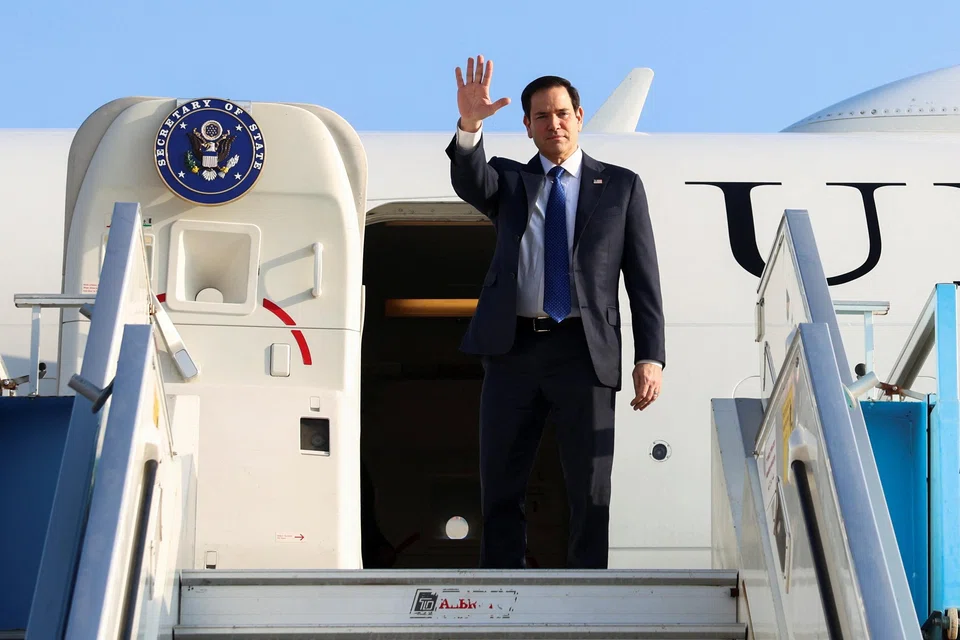
The latest salvo began when new US Secretary of State Marco Rubio declared that “South Africa is doing very bad things. Expropriating private property. Using G20 to promote solidarity, equality, and sustainability. In other words: DEI (diversity, equity and inclusion) and climate change. My job is to advance America’s national interests, not waste taxpayer money or coddle anti-Americanism”.
Rubio subsequently declined to attend this week’s G20 foreign minister meeting, which Chinese Foreign Minister Wang Yi and Russian counterpart Sergei Lavrov will be at. Moreover, it is not yet clear whether US Treasury Secretary Scott Bessent will join the G20 finance minister meeting later this month.
The latter possibility is made less likely by US President Donald Trump also weighing in on these issues. He declared that “South Africa is confiscating land, and treating certain classes of people VERY BADLY. The United States won’t stand for it, we will act. Also, I will be cutting off all future funding to South Africa until a full investigation of the situation has been completed!”
Trump went on to sign an executive order on Feb 7 which claimed that an expropriation law, passed in December, enables “the government of South Africa to seize ethnic minority Afrikaners’ agricultural property without compensation. This Act follows countless government policies designed to dismantle equal opportunity in employment, education and business, and hateful rhetoric and government actions fuelling disproportionate violence against racially disfavoured landowners”. Washington donated some US$440 million in aid to South Africa in 2023, of which the majority was for HIV-Aids programmes.
What Trump and Rubio refer to in their denunciation is the 2024 South Africa Expropriation Act, which aims to resolve ownership inequality issues created by the pre-1994 apartheid system of white minority rule. The controversial law has drawn criticism for potentially disregarding private property rights, particularly those of the white minority, as it potentially permits state land seizures without compensation. To date, no land has yet been expropriated.
Add to this too Trump’s broadsides against the Brics club in recent times, of which South Africa is a longstanding member. The US president has repeatedly warned Brics members against trying to replace the US dollar as a reserve currency, threatening a 100 per cent tariffs measure in response.
The hostility of the Trump team to South Africa is only the latest example of growing geopolitical divisions impacting the G20. Tensions have long been high too between China and the West, and recent summits have seen significant tensions over Moscow’s invasion of Ukraine, causing much diplomatic fireworks.
In 2022, 2023 and 2024, G20 ministers regularly clashed diplomatically, with Russia’s Sergei Lavrov walking out of some meetings. Moreover, the usual customary group pictures of the so-called “G20 family” have become rarer.
In this context, there are significant challenges to constructive discussion taking place at the 2025 G20. This despite the strong support that South Africa has received from other powers, including the European Union (EU). For instance, European Council president Antonio Costa has highlighted with President Cyril Ramaphosa “the EU’s commitment to deepen ties with South Africa, as a reliable and predictable partner”. He added that the EU has lent “full support to South Africa’s leadership of G20 and its ambition to strengthen multilateral cooperation and the Pact for the Future to address the most pressing global issues”.
The backing of Brussels for Pretoria reflects not just its partnership with the country and wider continent, but also the concern that Washington’s absence from the G20 will only benefit Moscow and China. Key officials in Joe Biden’s former team, including former White House senior deputy press secretary Andrew Bates, have made this point too, saying “this show of (US) weakness hurts our national security and economy while benefiting China”.
Yet, even if some governments, like the Trump team, have some disagreements with parts of President Ramaphosa’s G20 agenda to address climate change and fairer finance for poorer nations, there are other items for constructive engagement. Take the example of the future of the energy agenda in Africa, which the United States has a huge stake in.
For instance, the US Export-Import Bank alongside other bodies such as the UK Export Finance, China Development Bank and Japan Bank for International Cooperation, have a key role in financing the large US$20 billion Mozambique LNG project led by TotalEnergies.
The United States and wider West can play a key role in driving such projects. Other examples include ExxonMobil’s potential Rovuma LNG project in Mozambique, ENI’s LNG facilities in the Republic of Congo, BP’s operations in Senegal and Mauritania, plus the LNG project of Equinor and Shell in Tanzania.
The danger if the United States does not engage on these agendas is that it will lose a critical mass of its economic foothold in South Africa and much of the rest of the continent. China has long been South Africa’s largest trading partner, with bilateral commerce estimated at US$52.4 billion in 2024, around double the total with the United States.
This position may be eroded if Trump pushes for South Africa to lose duty-free access to US markets for many products under the African Growth and Opportunity Act. This is a US law whose scope includes many other African nations too.
All of this highlights why 2025 will be perhaps the most unpredictable G20 year ever. Not only may Trump not attend the final leadership summit, there is also a possibility the summitry process could collapse into rancour.
Amid the uncertainty, however, what is at stake is more than the future of the multilateral forum. At play too are much wider questions about US international economic and political leadership in the Trump era.
The writer is an associate at LSE IDEAS at the London School of Economics
TRENDING NOW
Simba admits exceeding spectrum limits amid failed M1 deal; full-year profits surge 277%

Temasek’s Wan Chee Foong to helm PIL, Lars Kastrup to be board adviser

He built the Vingroup empire. Now South-east Asia’s richest man is handing some key roles to his sons
One-third of Singapore-listed firms at risk in severe AI downturn: MAS

