

G7 summit success shows West can still lead
This is significant, given the paralysis of the G20 right now over differences with Russia, China and their allies
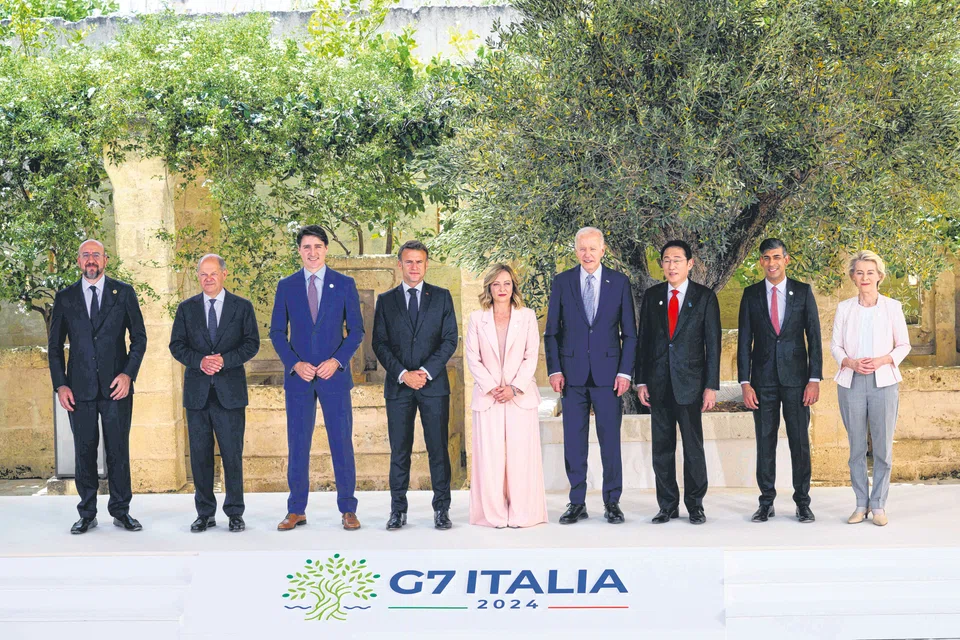
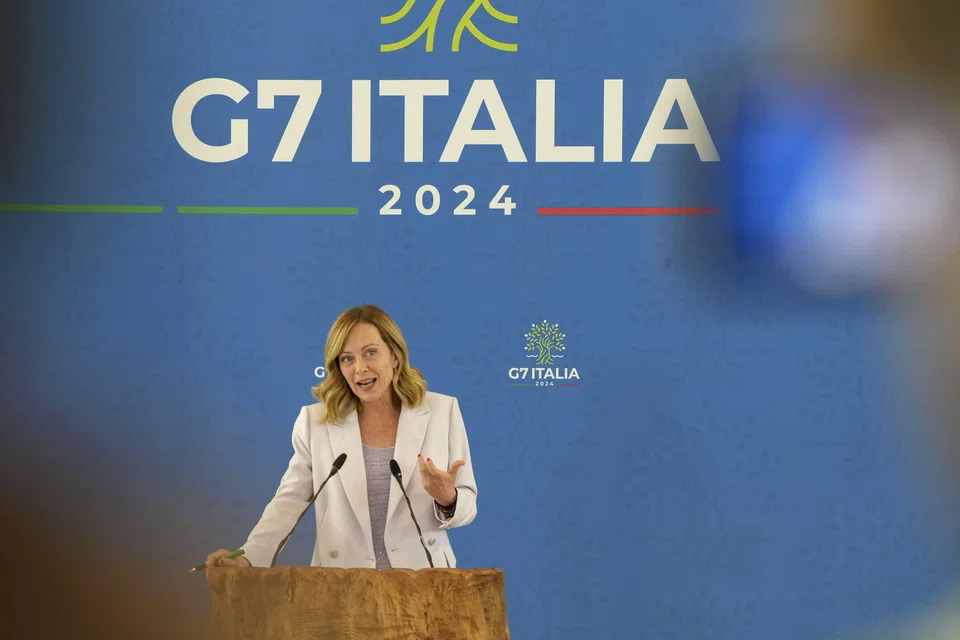
THE G7, widely written off as an anachronism in the 2020s, was created in the instability of the 1970s to monitor developments in the world economy. Yet at the Italy-hosted leadership summit which finished at the weekend (Jun 15), Western leaders delivered a series of big geopolitical wins that shows the body can still deliver.
At the top of the agenda was Ukraine where the most eye-catching announcement was a US$50 billion G7 loan to Ukraine. This uses profits from US$300 billion in frozen Russian assets in the West to boost funding for Kyiv, a move that Moscow has condemned.
A number of other security deals were made with Kyiv, the standout of which is a 10-year bilateral agreement with the United States – seen in the West as a potential transition point for Ukraine on the road to joining Nato. This includes commitments for prolonged aid encompassing areas such as military training, the sharing of intelligence, and economic assistance.
There were also broader efforts at the summit to woo the Global South regarding Ukraine. Italian Prime Minister Giorgia Meloni invited a range of key emerging market leaders, including Argentina President Javier Milei, Brazil President Luiz Inacio Lula da Silva, Turkish President Recep Tayyip Erdogan, UAE President Mohamed bin Zayed Al Nahyan, Indian Prime Minister Narendra Modi and South Africa President Cyril Ramaphosa.
Outside of Ukraine, there was significant focus on Israel too, with the G7 giving strong public backing to the US ceasefire deal outlined by US President Joe Biden, and calls on Hamas to accept it. This looks for an immediate ceasefire in Gaza, the release of all hostages, plus a significant and sustained increase in humanitarian assistance for distribution throughout Gaza.
China was in the spotlight too with the G7 issuing its starkest-ever warning yet to Beijing over its support for Russia, and threatening more sanctions if Beijing keeps transferring defence-related material. The communique states that “we call on China to cease the transfer of dual-use materials, including weapons components and equipment, that are inputs for Russia’s defence sector”.
The United States pushed too, in the words of US Treasury Secretary Janet Yellen, for a “strategic and united” response to China’s overinvestment in electric vehicles (EVs), solar products, semiconductors, steel and other key sectors, to keep Western firms economically viable in these areas. The goal in Yellen’s assertion is “building a wall of opposition to the strategy that they (China) are pursuing”.
This US call for G7 unity on China comes in the wake of the Biden team’s announcement of new tariffs on Chinese EVs, batteries, solar panels and other products; some of these measures will kick in on Aug 1. In recent days, the European Union also added counterpart measures against Chinese EVs.
On the broader agenda to diversify Western economies from China, there was also a big G7 discussion on critical minerals. Here, it was agreed to continue driving work through the International Energy Agency, the Minerals Security Partnership, the Sustainable Critical Minerals Alliance, and also implement the Five-Point Plan for Critical Minerals Security agreed at Japan’s G7 meeting last year.
There was also significant pushback against Beijing’s trillion-dollar Belt and Road infrastructure scheme. The G7’s alternative Partnership for Global Infrastructure and Investment scheme was reaffirmed.
The Western-backed schemes in this plan include support for the Lobito Corridor in Africa (which stretches from the Democratic Republic of the Congo and Zambia to the Atlantic Ocean via Angola’s port of Lobito); the Luzon Economic Corridor in Asia (connecting Subic Bay, Clark, Manila, and Batangas in the Philippines; an initiative that is strongly supported by Japan); and the India-Middle East-Europe Economic Corridor.
Meloni also put a special focus on Africa at the event to promote European energy security. The goal is to turn Italy into a major hub distributing energy from Africa to Europe.
On energy, the G7 was nevertheless a disappointment for many climate-change activists. In part, this is because of the emphasis Western leaders placed on liquefied natural gas, which is seen as a transition fuel. They stressed “the important role that increased deliveries can play” and acknowledged that investment in the sector can be appropriate in response to the current (Ukraine) crisis.
While there was scepticism around the Italian G7 producing any meaningful outcomes, the agreements reached – including on Ukraine – may prove significant. This should not be hugely surprising as the Western club has previously been at its best in times of crisis, tackling the big issues of the day.
The grouping was founded in 1975 in the aftermath of geopolitical and economic shocks when Washington pulled out of the gold standard. This underlines that it is fit for purpose for turbulent times like today. Back then, US president Richard Nixon had resigned and there was a clear and imminent danger of currency wars. The G7 stepped up to the plate, however, playing a key role in the management of the most important exchange rates. It also brought Japan into the Western policy-making community – and a similar far-sighted approach is needed today to try to get greater alignment with leaders of the Global South.
So the body has a proven record of delivering, and it can potentially play a significant role again now. This is especially urgent given the paralysis of the G20 right now, with splits between the West and Russia, China and their allies.
The Italian summit may also be noteworthy as it is potentially the last of Biden’s presidency. At the back of the leaders’ mind has been the jarring possibility that next year’s event could see the return of former US president Donald Trump.
From 2017 to 2021, Trump’s presence prompted the worst divisions ever within the G7. This reached its nadir in 2018 at the Canadian summit which saw an unprecedented failure to agree an end-of-summit communique and remarkable undiplomatic language, including Trump’s characterisation of Canadian Prime Minister Justin Trudeau as “so indignant” while the latter called the US president’s trade tariffs “laughable”.
This personal animosity on display between Trump and other leaders provided political atmospherics for wider policy splits. Trump, for instance, called on the first day of that summit for Russia to be allowed to rejoin the group (as the G8), as was the case from 1997 to 2013. Yet, other G7 leaders dismissed this and instead called for a “rapid and unified” response to Moscow’s malign international interference.
Taken together, the Italian summit provided a key moment for Western leaders to double down on the big strategic questions facing the world. At a time when the G20 has become less effective, the G7 has assumed new relevance and has greater potential to set the global agenda again.
The writer is an associate at LSE IDEAS at the London School of Economics






