G7’s 50th birthday year sees Trump as party pooper
Summarise
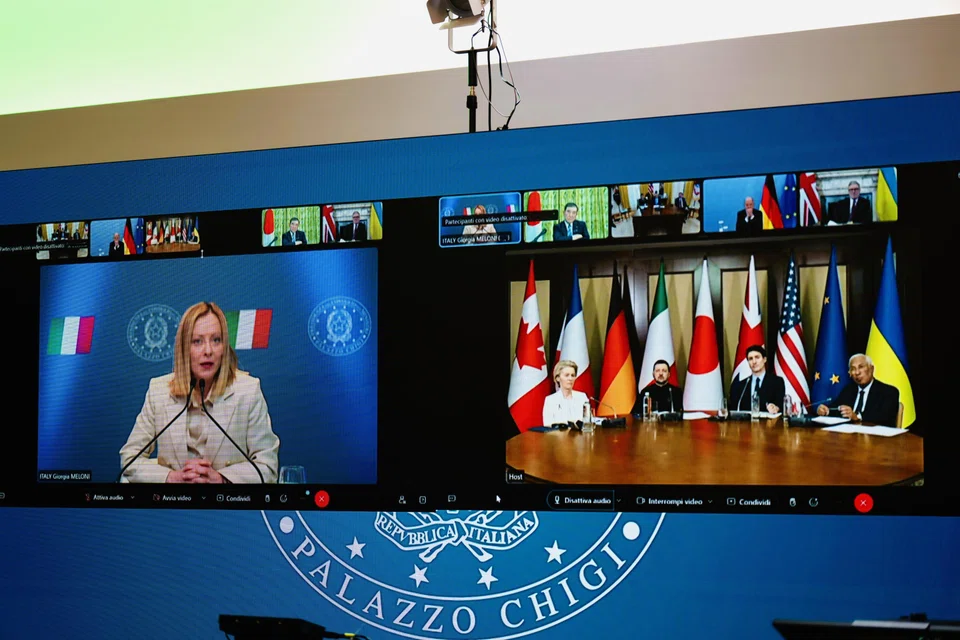
    • G7 leaders attending an emergency meeting on Ukraine on Feb 24, 2025. On a range of issues from trade to climate change and the Ukraine war, the US appears to be splitting from key Western partners at a time of significant geopolitical and international economic turbulence, giving rise to talk of a “G6 plus 1”.
    • G7 leaders attending an emergency meeting on Ukraine on Feb 24, 2025. On a range of issues from trade to climate change and the Ukraine war, the US appears to be splitting from key Western partners at a time of significant geopolitical and international economic turbulence, giving rise to talk of a “G6 plus 1”. PHOTO: EPA-EFE
    Published Tue, Mar 11, 2025 · 05:00 AM

    [LONDON] In 2018, Canada hosted what may have been the most challenging year ever of G7 diplomacy during Donald Trump’s first presidency. Yet, even that may be tame compared to the Canadian-led G7 this year, which coincides with the start of Trump’s second term and the 50th anniversary of the club’s first summit in 1975.

    In June 2018, Trump remarkably refused to endorse the end-of-summit G7 communique and called for Russia’s re-entry into the club of advanced industrial democracies. Moreover, he criticised other G7 leaders, including host Canadian Prime Minister Justin Trudeau, as having “acted so meek and mild” but “very dishonest and weak” in an extraordinary outburst.

    Moreover, upon leaving the Canadian event, Trump went on to heap praise on North Korean dictator Kim Jong Un, who he met soon afterwards at the Singapore summit. This positive feedback came despite little, if any, new concessions coming from Pyongyang at the time over its nuclear programme in talks with Trump, in a process that ultimately collapsed a year later in 2019 in Vietnam.

    This year’s Canadian-led G7 summitry kicks off in earnest on Wednesday (Mar 12) with a first face-to-face foreign minister meeting of 2025. It may prove the group’s most challenging annual cycle of diplomacy ever. Not only has Trump levied “on-off” trade sanctions on Canada, he has also taunted the country with jibes of it becoming the 51st US state and calling its prime minister “Governor Trudeau”.

    In addition, Canada is in the middle of a leadership transition with Trudeau stepping down from office. His successor, as both prime minister and Canadian Liberal Party leader, was announced on Sunday as former central banker Mark Carney, who now faces a potential political baptism of fire.

    On a range of issues from trade to climate change and the Ukraine war, the US appears to be splitting from key Western partners at a time of significant geopolitical and international economic turbulence, giving rise to talk of a “G6 plus 1”.

    Take the example of Ukraine where, in the United Nations General Assembly last month, the US joined Russia in voting against a Europe-backed Ukrainian resolution that called out Moscow’s aggression and demanded an immediate withdrawal of Russian troops. The US then abstained from voting on its own competing resolution after Europeans, led by France, amended it to make clear Russia was the aggressor.

    While these fissures within the G7 did not begin with Trump, they have been exacerbated by his presidencies. Since the collapse of the Soviet Union, there have been a series of intra-Western disagreements over issues from the Middle East, including the Iraq War opposed in 2003 by France and Germany, through to the rise of China, with some European powers and the US having disagreements over the best way to engage the rising superpower.

    There have been disagreements over burden-sharing, which has long been a sore spot for the US, given it has paid for around two-thirds of total Nato defence spending. US presidents other than Trump have previously urged all Nato allies to boost military expenditure.

    Yet, despite occasional discord, key Western nations generally continued to agree until the Trump presidency around a broad range of issues. These included international trade under the World Trade Organization’s rules-based system; backing for a Middle Eastern peace process between Israel and the Palestinians along the so-called Oslo Accords from 1993; plus strong support for the international rules-based system and the supranational organisations that made these work.

    Yet today, more of these key principles are being disrupted during Trump’s second-term agenda which, if anything, is more disruptive than his first presidency. Far from serving as an annual affirmation that the G7 club is largely aligned, this year’s diplomacy will probably therefore see very significant splits. This includes trade tariffs where the US is at odds with potentially all of its G7 partners – Canada, the UK, Japan, France, Germany and Italy.

    As in 2018 in Canada, Trump may also call for a return of Russian to the G7, when it was the G8. Yet, other G7 members, with the possible exception of Italy, are opposed to this, and there is little sign that Moscow, which joined the then G8 summits from 1997 to 2014, will be invited back to the club while President Vladimir Putin remains in office.

    This context makes it difficult for the Canadians to frame a “Trump-proof” G7 agenda. However, despite disagreements over Ukraine, Ottawa may seek to highlight consensus at this week’s foreign minister meeting over issues including stability in the Asia-Pacific region; the crises in Haiti and Venezuela; and peace and security opportunities and challenges in Africa.

    Even this agenda carries risks, however, given the Trump team’s berating of the failure of numerous key Nato states to spend more on defence. This list includes Germany, which is not yet meeting the target of 2 per cent of gross domestic product spending on its military, although this could change significantly if the country’s constitutional fiscal restraints, known as the “debt brake”, are lifted, as is proposed by the likely next chancellor, Friedrich Merz.

    Should the Canadian G7 put such emphasis on geopolitical issues, it will underline, yet again, the group’s often under-appreciated importance as an international security lynchpin. This despite the fact that the body was originally conceived in the 1970s to monitor developments in the world economy and assess macroeconomic policies.

    The G7’s involvement in this multitude of geopolitical dialogues is not without controversy, given its original macroeconomic mandate. For instance, Beijing strongly objects to G7 discussion of internal Chinese issues and wider security issues in Asia.

    It is sometimes asserted, especially by non-Western countries, that the G7 lacks the legitimacy of the UN to engage in these international security issues, and/or is a historical artefact given the rise of new powers, including China and India. However, it is not the case that the international security role of the G7 is new.

    An early example of the lynchpin function the body has played here was in the 1970s and 1980s, when it helped coordinate Western strategy towards the then Soviet Union. Moreover, following the September 2001 terrorist attacks, the then G8 (including Russia) assumed a key role in the US-led “campaign against terrorism”.

    Taken together, this year’s G7 could therefore see very significant splits, including on trade, climate and Ukraine. While some of these fissures pre-date Trump, his presidencies have grown these gaps into what have become unprecedented strains in the G7’s 50-year history.

    The writer is an associate at LSE IDEAS at the London School of Economics