

In GE2025, podcasts have emerged as a potent tool for politicians to engage voters
Conversation, rather than one-sided content, is gaining political currency

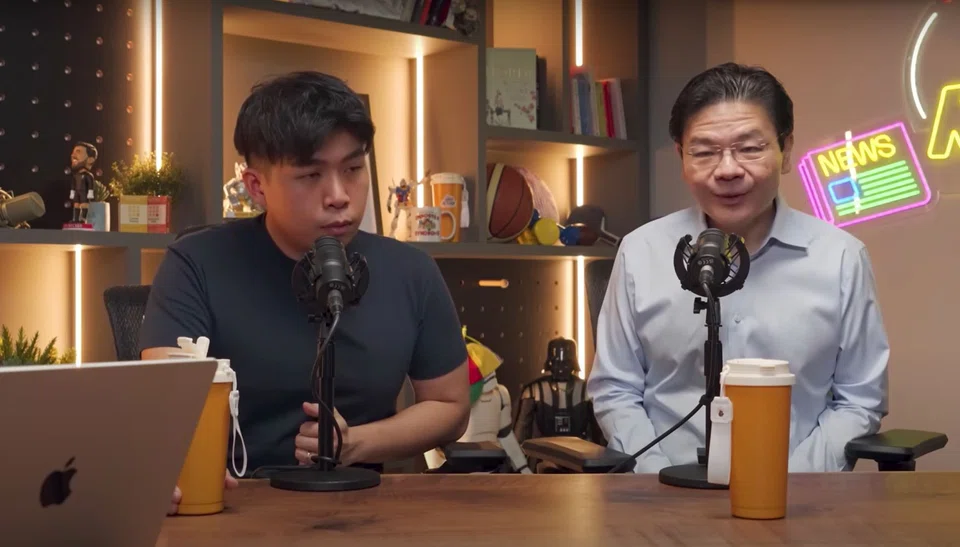
[SINGAPORE] The popularity of video podcasts in this year’s general election suggests a shift in how potential candidates engage with voters – rather than relying on polished images and soundbites, they are playing directly to voters’ desire for longer, more nuanced conversations.
Over the past year, Singapore politicians have made significant appearances on local independent podcasts, such as Yah Lah But, Political Prude and The Daily Ketchup. Prime Minister Lawrence Wong’s interview on the latter has racked up more than 263,000 views on YouTube since its release in January. The top comment, with 980-odd likes, expressed disbelief that the prime minister would ever be on such a medium.
Indeed, the rising use of podcasts for political communication stands in contrast to Singapore’s past generations of leaders – who mainly engaged in the suit-and-tie style of mainstream media interviews.
But PM Wong and his peers have had to adapt to the new digital reality, where even just being on social media is not enough. Young voters don’t just want catchy TikTok videos nor filtered Instagram posts. They want to hear politicians in their own words, with all the stumbles, awkward pauses and colloquialisms.
Podcasts “enable authentic engagement, bridging the gap between political elites and an increasingly critical public”, noted Professor Kenneth Paul Tan of the Hong Kong Baptist University in a recent research paper. They “have emerged as a particularly influential medium in Singapore, combining intimacy, light-heartedness, and accessibility to engage a digitally savvy audience effectively”, he said.
The medium is not just for establishment leaders, but also for opposition figures. For instance, Yah Lah But’s interview with Workers’ Party candidate Harpreet Singh Nehal gained 82,000 YouTube views – widening his reach well beyond traditional news consumers. There is also a growing pool of podcasts that look into wider political issues, such as Teh Tarik with Walid, which has covered a range of topics from public housing to climate advocacy.
Conversation, rather than one-sided content, is gaining political currency. In an interview, American writer Tope Folarin contextualises the rise of podcasts as “a response to our collective dissatisfaction with passivity, which is the primary way that many of us receive information now” – be it Netflix or doomscrolling.
Podcasts are a fresh alternative. “(As) ideas whiz back and forth between the participants, as those participants contradict themselves and double back and occasionally struggle to express themselves… you might feel implicated in the conversation, and you might feel a desire to contend with your own views,” he said.
The strong para-social element of podcasts makes them the perfect tool for political communication. In the 2024 US election, Donald Trump appeared on 14 podcasts, amassing 68.7 million YouTube views. Platforms such as The Joe Rogan Experience allowed him to reach out to his target audience of young, disillusioned voters.
This makes it clear that podcasts have a big pitfall: just because they feel more authentic, doesn’t mean they actually provide better information. Rogan infamously did not challenge Trump’s repeated lies on the show, and arguably deepened the spread of misinformation. The failure to uphold rigorous questioning – even if the format is more candid – can be disastrous.
Unlike the US, the podcasting scene in Singapore is still fairly young, and there is plenty of potential for podcasts to lead the way as a tool for informing the electorate on key policy issues. But listeners will also need a discerning ear.






