THINKING ALOUD

Gearing up for Singapore’s nuclear option

Sharon See
Published Thu, Jun 6, 2024 · 05:00 AM
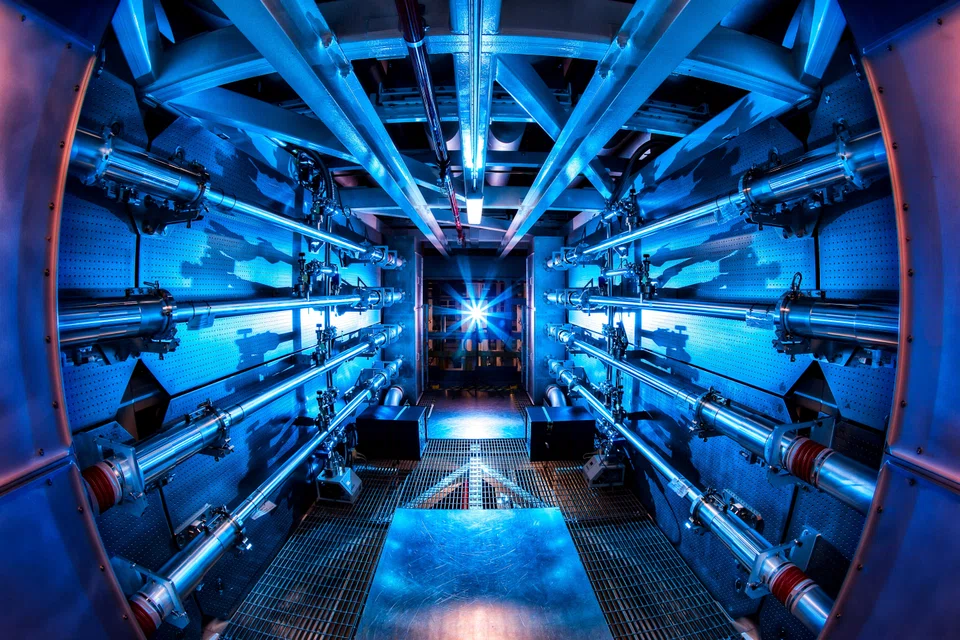
    • US scientists achieved net energy gain in a fusion reaction for the second time in July 2023, producing a higher yield than its initial fusion ignition breakthrough seven months prior at the National Ignition Facility in California.
    • US scientists achieved net energy gain in a fusion reaction for the second time in July 2023, producing a higher yield than its initial fusion ignition breakthrough seven months prior at the National Ignition Facility in California. PHOTO: REUTERS

    UNTIL recently, the idea of harnessing nuclear energy in Singapore would likely have been dismissed out of hand, to no surprise.

    Consider this: Both disaster sites in Fukushima and Chernobyl have exclusion zones that are a few times larger than Singapore’s total land area. Suffice to say, a nuclear accident on a similar scale would be existential for the city-state.

    Yet, the authorities have in fact been leaning into the possibility of adopting nuclear power.

    One hint of the shift in thinking dropped in March 2022, when a report commissioned by the government pointed to the option, a decade after a pre-feasibility study concluded that available technologies were not yet suitable for deployment in Singapore.

    The idea is that Singapore should “pre-position” itself for low-carbon alternatives, the Energy 2050 Committee report said then, particularly as newer nuclear power plant designs are potentially much safer.

    Last month, Manpower Minister Tan See Leng revealed in Parliament that Singapore plans to build a pool of about 100 nuclear energy experts in the medium to long term, ahead of making a decision on introducing nuclear power.

    This comes amid renewed hope that a big breakthrough in nuclear fusion research is within reach. Nuclear fusion produces four times more energy than nuclear fission reactions, and is said to be intrinsically safe without long-lived radioactive waste.

    Currently, all nuclear power plants rely on nuclear fission, where energy is derived from the splitting of atoms.

    In nuclear fusion, two light atoms are combined to form a single particle, releasing massive amounts of energy. Essentially, this is how the sun and other stars generate heat and light energy.

    But recreating nuclear fusion on Earth requires temperatures exceeding 100 million degrees Celsius – several times hotter than the sun. Researchers also have not found a way to generate enough power on an industrial scale and that exceeds the energy input.

    Nonetheless, scientists in recent years have reported promising successes, including a first net energy gain and devices that can withstand the extreme heat. Government labs and at least 30 companies are now in the race to generate power from fusion, according to the World Economic Forum.

    It is likely for these reasons that Singapore authorities can now see the possibility of adding nuclear power to its energy mix.

    But even if nuclear fusion eventually becomes a realistic energy option, it is unlikely to be the panacea the Republic needs to hit its net-zero goals by 2050.

    For one thing, there is no telling when the technology will be mature enough to be scaled. To quote American astrophysicist Paul Sutter, fusion power “has been one of those things that’s been ‘only 20 years away’ for about 50 years now”.

    Notably, both nuclear fission and fusion have been studied since the 1920s, and almost right from the start, scientists had been hopeful that nuclear fusion could eventually become an abundant source of clean energy.

    Still, on a long enough timeline, humanity will probably get there at some point – whether in the second half of this century or the next – and in such a scenario, nuclear power will become an eventuality for Singapore as well.

    The 100 nuclear experts that Singapore aims to train up is testament to its serious intents.

    Whether they eventually get to “ply their trade” in a future fledgling nuclear sector here, they would wear the badge of being one of Singapore’s nuclear pioneers.