As generations cross swords at work, can the divide ever be bridged?
Instances of friction between different generations at work are on the rise, but they can be smoothed over with empathy and communication


WHEN 24-year-old Minh Nguyen worked part-time at a meatpacking factory several years ago, he felt that the strict work hours did not make sense.
He had to come in at 8am together with the rest of his colleagues, even though his role was at the end of the workflow and his actual duties only started later.
Nguyen tried to speak to his much older superiors about his work hours, but was rebuffed as they stated that this was how things were always done. “It was one of those jobs where a guy just says it’s the policy, and then you can’t really negotiate your way around it,” he says.
Their inability to see eye to eye and lack of flexibility led him to quit after just three months.
Intergenerational conflict is nothing new, but there have been growing anecdotal accounts of clashes between young adults entering the workforce and their more senior colleagues. While observers believe such conflict is not an intractable issue, they warn that workplaces need to address it head-on – or face the consequences.
There are no clear numbers on the incidences of intergenerational workplace conflict, but recent surveys indicate that it’s affecting workplaces around the world, especially in the post-Covid era.
In one such study by the National Labour Relations Commission in South Korea, slightly less than half (43.3 per cent) of respondents expressed concerns about escalating conflicts involving millennial and Gen Z employees.
Trevor Yu, associate professor at Nanyang Business School’s Division of Leadership, Management & Organisation, believes such tensions will continue to rise. This is only natural, given increasing intergenerational interactions as older people stay on longer in the workforce, and digital tools such as social media making it easier for workers to express individual opinions and preferences, he points out.

Work shaped by life
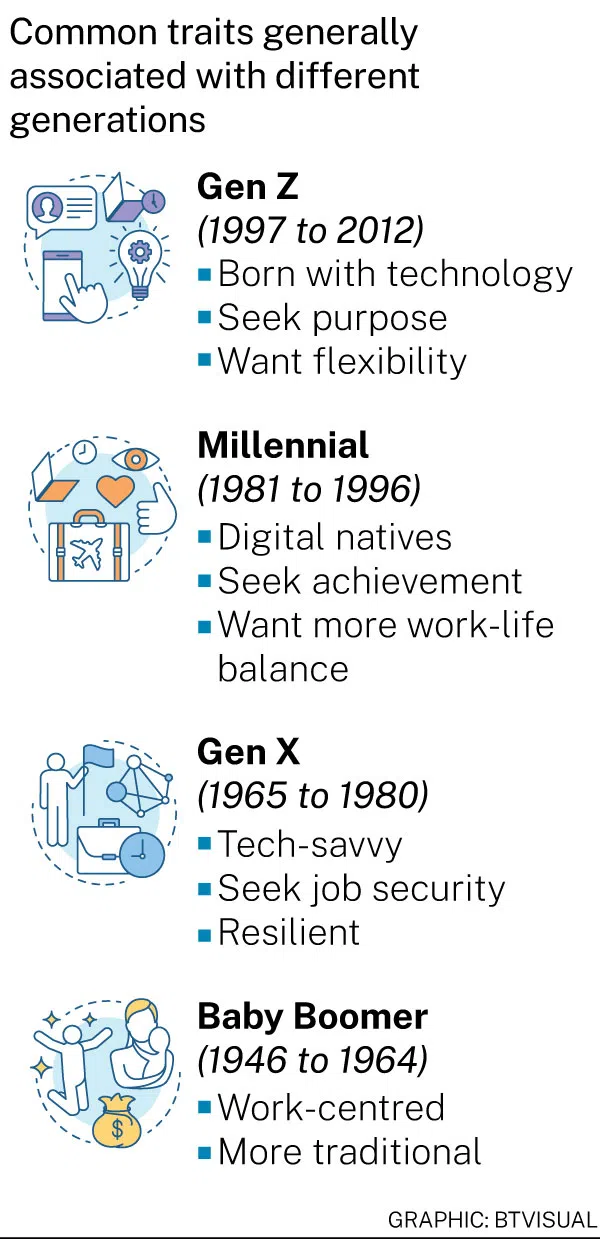
Human resource (HR) professionals say that generational differences in work attitudes and expectations can be partly explained by the different backgrounds and contexts in which they have worked.
Baby boomers likely worked with a “survival” mentality, and thus do “whatever it takes”, says Sze-Yen Chee, executive director and co-founder of Career Agility International, a career strategy consultancy. Meanwhile, Gen X is now sometimes known as the “sandwich generation”, with competing financial responsibilities.
Hard work and job stability are valued, with nine-to-five jobs popular with these groups, notes Sebastian Foo, a HR practitioner in the wholesale trade industry, who is certified by the Institute for Human Resource Professionals (IHRP).
On the other hand, younger workers, comprising millennials and Gen Z, are digital natives who likely had relatively more comfortable economic backgrounds. Millennials may define success through career advancement, rather than pay raises alone, while Gen Z seek purpose.
Such workers tend to prioritise job meaning and purpose, social responsibility, and diversity, equity, and inclusion (DEI) values, says Prof Yu.
While these broad frameworks help to explain generations’ motivations and behaviours at work, HR experts warn that the lines between generations often blur, and these generalisations may not apply to every worker.
The many faces of intergenerational conflict
Intergenerational conflict can manifest in many ways. The differing values of older and younger workers can lead them to adopt unflattering views of each other’s work expectations and ethics.
In the case of Nguyen, the inflexibility of his older superiors pushed him to seek work where younger people’s views were better respected, and that he found personally “meaningful”.
Ho Ghee Gin, HR director at hospitality and food and beverage (F&B) player Katrina Group, similarly recalls one incident when a millennial chef’s urgent leave request to attend his son’s kindergarten graduation was rejected by his executive chef.
To the superior, the request was made for “something so insignificant”. But the younger chef complained that he felt undervalued.
“This younger generation generally values work-life balance and flexible scheduling, and he felt that the older chef was not being understanding of his needs,” says Ho. The disagreement led HR and the operations manager to step in, and the chefs eventually compromised on a half-day off.
On the other hand, older workers often overlook the values and priorities of younger workers, and may perceive them as lacking in drive. Consequently, they struggle to find ways to motivate their younger counterparts.
“(Managers see) being unable to motivate and retain the younger generation as one of the thorniest problems,” says associate professor Emily David from the National University of Singapore Business School.
“Although they themselves were primarily driven by financial incentives and promotions (extrinsic motivators) early in their careers and therefore use these carrots and sticks in their practice, younger generations – who often grew up as single children and therefore have ample resources from their parents and grandparents – don’t respond as much to these incentives and tend to job-hop more frequently.”

Indeed, younger workers’ sense of obligation to their families to become successful, together with the slowing economy, has led to disenchantment and trends such as the “lying flat” movement – doing the bare minimum in rejection of pressures to overwork and overachieve, she says.
At Katrina Group, capable younger workers have joined and left multiple times to earn “pocket money”, says Ho. These disruptions can be frustrating for managers and more senior staff, for whom many years of service is the norm.
Different generations may also have different perspectives of what they “owe” to their employers.
For instance, dry promotions – promotions that come with enhanced responsibilities and titles, not pay raises – are of little interest to younger individuals, says Chee.
“The logic is ‘you’re paying me x dollars to do this job scope’,” she explains. Going beyond this scope is an unappealing prospect to many Gen Zs, as they believe “life is too short to just work”.
In contrast, older executives are more likely to take on more responsibility and a greater workload to progress their careers even without a formal reward, she adds. Again, this dissonance can lead older workers such as managers to view younger workers as unmotivated.
Antonio Law, a 27-year-old engineer, exemplifies the “you get what you pay for” mindset. “If you’re going to pay me what you think I’m worth, then I will only give what I’m worth.”
At his last job, which he left earlier in June, this meant avoiding overtime and non-essential meetings.
“I’m seen as kind of lazy,” he admits, especially by his millennial colleagues, who “feel they should be further along in their careers” and put in “120 per cent” to get promoted.
The need to express
With the greater freedoms of younger people in the workforce comes a stronger ability to express their identity at work, observers say.
At Twitter (now known as X), one workplace policy in the pre-Elon Musk era was for speakers at meetings and town halls to introduce themselves with their names, pronouns and a description of what they were wearing.
This was meant to be inclusive of people with different gender identities and visual impairments, says IHRP-certified Lim Zhi Rong, an HR director at an institute of higher learning who previously worked at the tech company.
This policy, however, split the workforce into two camps: those – usually younger – who were more familiar with these concepts and expected these forms of respect and accommodation; and others who felt that too much time was being spent “patronising this nicety”.
Over at social media influencer marketing company Kobe Global Technologies, founder and CEO Evangeline Leong explicitly encourages staff to “be themselves”. She is a millennial boss to mostly Gen Z employees. But this approach requires careful hiring to find people who are the “right fit”, she says.
Leong recalls an incident where a sales employee who relied on sending e-mails to customers was unable to hit sales targets, but remained unwilling to network on the ground because that was “not (her)”.
The Gen Z identity, especially, is characterised by a more unfiltered and casual personality – something that has caught some older colleagues wrong-footed.
For example, younger workers’ casual tone of voice, or the use of their seniors’ first names instead of honorifics, have been perceived as disrespectful, says Katrina Group’s Ho.
More senior workers were also caught off-guard when their younger colleagues would propose alternative solutions, viewing this as challenging their authority, she adds.
To reduce this friction, HR had to step in to help older workers adapt to how Gen Zs work, and explain that there is no ill intent, while being ready to deal with anyone who was being intentionally disrespectful.
Covid-induced technology gap
Technology itself is another big marker of the divergence between generations, and different tech competencies can give rise to tensions.
Compared to more compliant older workers, who are used to respecting hierarchies and their elders, Erman Tan, CEO of manufacturer Asia Polyurethane Manufacturing notes that his younger workers are often better educated, making them more confident and vocal.
Coupled with technology increasing their access to information, they often believe that they are ready to make independent decisions and handle projects very quickly, he says.
The Covid-19 pandemic, in some ways, worsened intergenerational issues.
Aside from making bonding with co-workers difficult, the pandemic accelerated the adoption of less traditional working styles, particularly working from home (WFH), which has become a point of contention for some.
In Deloitte’s 2023 Gen Z and Millennial Survey, 69 per cent of Gen Zs and 70 per cent of millennials in Singapore said they would consider looking for a new job, if asked to work on-site full-time.
On the other hand, senior workers accustomed to conventional working styles may perceive that anyone working from home may be slacking off. “Older generations are used to going to the office, and ‘what I see is the truth’.” says Career Agility’s Chee.
With increasing WFH arrangements and greater use of technology, work may also become more asynchronous, notes HR professional Lim. While this works well for tasks that require more consideration, other work may be more suited to face-to-face meetings – a preference of the older generation, he says.
Bridging the divide
If intergenerational problems are left unchecked, there will be more polarisation, distrust and lack of knowledge sharing. Prof Yu notes that this could worsen productivity and morale, while heightening stress; and Prof David says it can reduce satisfaction and team performance.
Both agree that such a negative environment may also affect talent retention.
Aside from case-by-case resolutions, HR professionals make a case for bigger-picture solutions to tackle intergenerational friction.
For instance, workplaces should apply workplace policies flexibly to address different groups’ needs, but be fair and transparent, says HR practitioner Foo. This applies to areas such as working from home.
Another important aspect is facilitating communication. Chee trains managers to speak to different people with more sensitivity. Lim hosts internal workshops that help workers to use a common language, and uses HR tools to help them identify each others’ communication styles.
Prof David points out the importance of urging intergenerational collaboration and feeding off each other’s strengths. Besides building a culture of respect and formal training for DEI awareness and conflict management, Prof Yu recommends explicit rewards for collaboration.
Similarly, some workplaces also practise role-switching, allowing younger people to take charge of some projects while older people provide feedback.
Academics have agreed that intergenerational conflict in the workplace is on the rise. But with no easy way to quantify it, it can be difficult to tell if the issue is being blown out of proportion.
With Gen Z becoming more prominent as a demographic due to their social media presence, this could make an “us versus them” divide more visible.
Online platforms also facilitate easier expression on intergenerational conflict, and there may also just be an increased willingness to discuss these sensitive topics.
Regardless, such discussions can be productive, as they will help raise awareness of such issues and what workers are entitled to, says Foo.
But don’t over-focus on the young-versus-old dynamic, cautions Prof David. “Each of us has so many other identities that may be more salient on a given day or in different contextual situations.
“Although learning about averages can be helpful, you absolutely can’t judge any one individual by these generalisations.”
Importantly, conflict is not always a bad thing, says Prof David, noting that different perspectives can be productive. Having the right resources in place can eliminate the negative impacts of age diversity, she adds.