Genting Singapore’s luck may turn in 2025
The renewal of its casino licence for a shorter two-year term adds to the uncertainties at the integrated resort operator, but a turnaround could come

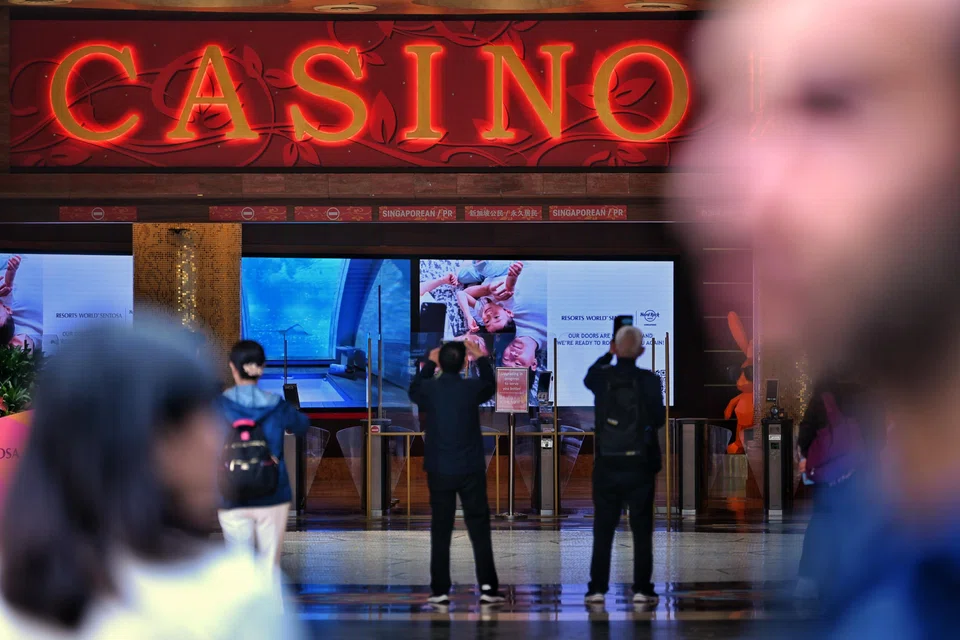
RESORTS World Sentosa (RWS) broke ground on Nov 15 for a major new waterfront development that will include hotels, more retail and dining offerings and even an “immersive, experiential mountain trail”.
The development is the centrepiece of the integrated resort’s (IR) so-called “RWS 2.0” expansion plan, which could drive its growth for the next several years.
Fittingly, just three days after the ground-breaking event, Genting Singapore announced that the Gambling Regulatory Authority (GRA) had renewed RWS’ casino licence for another two years, starting from Feb 6, 2025.
Genting Singapore said that the GRA had granted the licence renewal after taking into account Section 45 of the Casino Control Act – which requires, among other things, that RWS develop, maintain and promote its IR as a compelling tourist destination.
“With its RWS 2.0 expansion plans underway, RWS is dedicated to maintaining its status as the premier lifestyle tourism destination,” Genting Singapore added, in its announcement dated Nov 18.
The stakes are higher than Genting Singapore indicated in its announcement, though.
The GRA said in its own statement on Nov 18 that RWS’ tourism performance had been assessed to be unsatisfactory, and that there were a number of areas that required rectification and substantial improvement. It added that the evaluation panel had recommended the next evaluation be carried out in two years, in 2026.
RWS’ casino licence had previously been renewed for three years, effective Feb 6, 2022. GRA said, however, that it would renew the licence for only two years this time around.
GRA went on to say that it would work with the Ministry of Trade and Industry, the Singapore Tourism Board and the Sentosa Development Corporation to ensure that RWS meets the requirement of developing, maintaining and promoting its IR as a compelling tourist destination.
Have the risks of being a Genting Singapore shareholder suddenly increased? Or, is it just a matter of time before the RWS 2.0 expansion plan improves the IR’s tourism performance to the satisfaction of the GRA?
Weaker performance
The GRA said that RWS’ tourism performance had been assessed from Jan 1, 2021, to Dec 31, 2023.
Genting Singapore noted this assessment period coincided with the pandemic, and that Singapore’s entire tourism industry – including RWS – had faced very significant challenges.
Indeed, Genting Singapore’s headline financial numbers last year had still not fully recovered to their pre-pandemic levels. The group reported a 79.8 per cent jump in earnings to S$611.6 million for 2023, on a 40.1 per cent increase in revenue to S$2.42 billion. For 2019, Genting Singapore reported earnings of S$688.6 million on revenue of S$2.48 billion.
Worryingly, Singapore’s international visitor arrival data has been uneven this year, after having recovered strongly from the pandemic trough in 2020. The number of arrivals in the second quarter of this year dipped 10 per cent from that in the previous quarter, though it rebounded 13.9 per cent in the third quarter.
Visitor arrivals for the first 10 months of 2024 were still 12.4 per cent below the comparable period in 2019, pre-pandemic.
Against this backdrop, Genting Singapore’s recent financial performance was rather disappointing. For Q3 2024, it reported a 63.3 per cent year-on-year decline in earnings to S$79.4 million, on an 18.5 per cent fall in revenue to S$561.9 million.
Its Q2 2024 financial numbers were also soft. Earnings declined 25.8 per cent year on year to S$109.5 million, while revenue slipped 4.1 per cent to S$571.3 million.
The weak performance in the two quarters came mainly from reduced wagers at the RWS casino, as well as a lower “win rate”. Non-gaming revenues were also hit by ongoing renovation and re-branding works. Reflecting this feeble performance, Genting Singapore’s shares have taken a beating. Since the beginning of this year, the stock has fallen 23.5 per cent. The Straits Times Index rose 14.4 per cent over the same period.
Good bet for investors?
Some analysts expect Genting Singapore’s luck to improve next year.
DBS Group Research said in a report this month that a normalisation of the “win rate” at the RWS casino is likely to lift the company’s profitability in 2025. On top of that, the addition of new attractions and more hotel rooms should boost its non-gaming revenue, and attract more casino patrons.
The research house said that it expects Genting Singapore to achieve earnings of S$741 million on revenue of S$2.74 billion in 2025. It is forecasting earnings of S$550 million on revenue of S$2.36 billion for 2024.
With the fresh attractions and improved profitability, Genting Singapore should also be in a stronger position to address the GRA’s concerns about its tourism performance.
What could go wrong? One risk comes from the “win rate” at the RWS casino remaining stubbornly low for a protracted period. Another is the recovery in international visitor arrivals flounders for some reason.
A further risk for investors is that the execution of the RWS 2.0 programme faces execution challenges. As it is, the cost of the expansion plan has ballooned from S$4.5 billion, when the project was unveiled in 2019, to S$6.8 billion currently.
At its last annual general meeting, Genting Singapore’s officials attributed the increased budget largely to higher labour and material costs since the pandemic.
Genting Singapore’s depressed shares might already reflect some of these risks, though. After the significant slide in its share price, the company now has a market capitalisation of about S$9.3 billion – or about 12.5 times forecasted earnings for 2025.
Genting Singapore has also paid an interim dividend for 2024 of S$0.02 a share, which was higher than last year’s interim dividend of S$0.015 a share.
DBS Group Research is forecasting a total dividend of S$0.04 a share for 2024, up from S$0.035 a share for 2023. It is forecasting an even higher dividend of S$0.045 a share for 2025.
Based on these forecasts, Genting Singapore’s shares are trading at a 2025 dividend yield of 5.8 per cent.