

Germany in economic and political funk, 35 years after fall of Berlin Wall
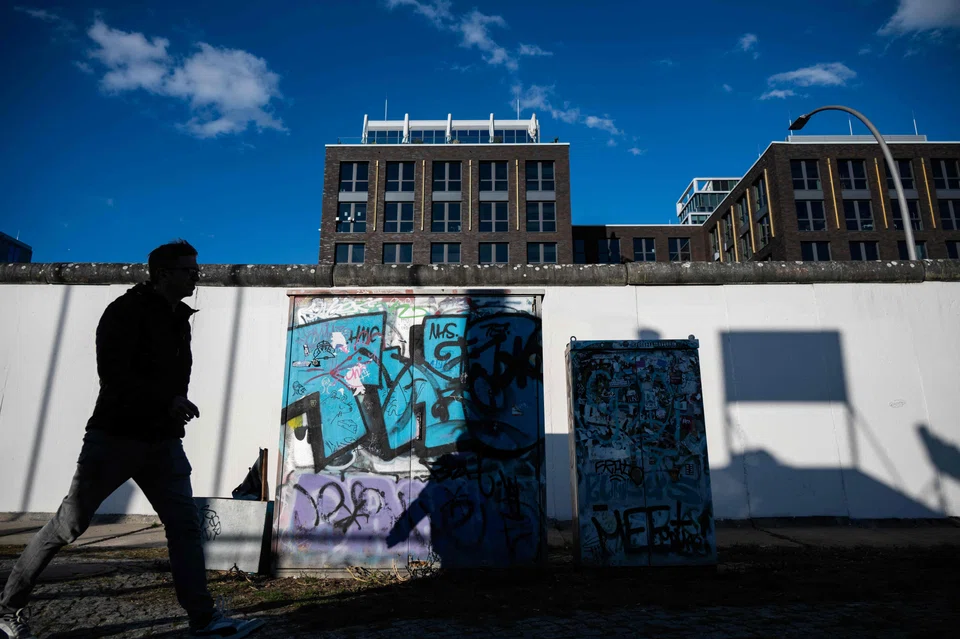
THIS Saturday’s (Nov 9) 35th anniversary of the fall of the Berlin Wall might, ordinarily, be expected to be a cause for joy in Germany. However, celebration of the milestone will, for many, be much subdued, given the nation’s deep economic and political funk.
Despite the original promise of 1989, which hastened the end of Soviet Communism and led to the reunification of Germany, the nation has recently been given the moniker of “sick man of Europe”.
To be sure, Germany has long had the largest economy in the region, and is the most powerful nation in the European Union, yet its multiple current challenges range from a flatlining economy to a government that may collapse in the coming weeks, ahead of national elections in 2025.
The country has been in ferment now for many years, and this has been exacerbated by the Covid pandemic and the energy shock, following Russia’s invasion of Ukraine.
Economically, latest data shows that Germany very narrowly escaped a recession in the third quarter, but is still struggling after shrinking last year, with the International Monetary Fund forecasting zero growth in 2024.
The challenges are exemplified by Volkswagen, which has seen a sharp fall in profits, and may close several entire factories for the first time in its almost 90-year history in Germany. Operating profit for the nine months to the end of September 2024 fell more than a fifth on the previous year to just under 13 billion euros (S$18.6 billion) because of, among other factors, weaker demand in China.
Volkswagen’s problems underline a wider malaise in the automotive industry, which is Germany’s single-largest industrial sector employing almost 800,000 people and accounts for 5 per cent of gross domestic product. With economic confidence weak, there has also been the biggest reduction in employment for around a half decade, according to a S&P Global and Hamburg Commercial Bank index.
According to the Federation of German Industries, a trade group for business groups, one-fifth of Germany’s industrial output may be at risk between now and 2030. This is not just due to weaker international demand for German goods (exports account for nearly half of the nation’s GDP, higher than many other major economies), but also high energy costs.
One worrying sign of declining economic confidence may be German birth rates, which have gone into decline after rising before the pandemic. Between 2011 and 2016, fertility rates rose from 1.38 to 1.59 children per woman. However, rates have fallen in recent years, to only 1.35 children per woman in 2023.
To rub salt into the wounds, the nation’s troubled public finances could soon be made much worse by a Federal Constitutional Court decision, which might reduce by up to 75 billion euros of tax income. The court case concerns the legality of the so-called solidarity surcharge introduced to tackle the burden of German reunification.
In play is reportedly around 66 billion euros collected since 2020, and another roughly nine billion euros in interest. If the court rules against the government, it will blow a huge hole in the public finances.
This economic uncertainty is fracturing, further, the nation’s polity, too. This is shown most markedly with the fragility of the three-way governing coalition of the left-of-centre Social Democrats (SPD), Greens and the liberal Free Democratic Party (FDP).
The internal splits in the government are shown by the lack of consensus on trying to fix the economy. A document recently leaked from the finance ministry, led by the FDP’s Christian Lindner, laid out a plan for tax cuts and fiscal discipline. This contrasts with the multibillion-euro investment programme put forward by Economy Minister Robert Habeck, a member of the Green Party.
According to a survey last week by German public broadcaster ARD, approval for the coalition has fallen to 14 per cent, a five-percentage-point drop since early October. Some 85 per cent of the respondents expressed dissatisfaction with the government’s performance.
The poll also found that more than 50 per cent of respondents favour snap polls before the scheduled September 2025 election. The three coalition parties are polling less combined than the opposition, right-of-centre Christian Democratic Union (CDU)/Christian Social Union (CSU). Moreover, Olaf Scholz is the least popular chancellor in recorded history.
Underlying this governmental instability is a deeper issue: There is a breaking down of the traditional duopoly of power of the SPD and the CDU/CSU, which have been the twin pillars of German politics since the end of World War II.
With the SPD now very unpopular, and the CDU/CSU’s bearings still uncertain in the period since Angela Merkel’s long chancellorship from 2005 to 2021, Germany appears to be moving from a de facto two-party to a multiparty system. This is shown by the rising number of smaller parties which once functioned as subsidiaries of either the SPD or the CDU/CSU.
One of the drivers of this unravelling is that the nation’s post-war consensus is falling away in multiple areas. This includes history, geopolitics, the economy (such as attitudes toward the auto industry) and ethics (including views towards refugees), and is reflected in the fracturing of the political landscape.
For much of the last 35 years since the fall of the Berlin Wall, many Germans have been generally content with their post-Cold War lot, seeing themselves generally as beneficiaries of globalisation. However, this may be changing, as shown by the rise of smaller parties with, for instance, the far-right Alternative for Deutschland (AfD) currently second in the polls.
The AfD is the first far-right group to have Bundestag seats for some six decades. Moreover, it also won earlier this year, in Thuringia, its first state-wide election.
The AfD campaigns extensively on immigration, an issue which has grown significantly in salience in recent years. In part, this is because of the integration of more than one million Ukrainian refugees since Russia’s invasion in 2022, plus the wave of around a million migrants largely from the Middle East in 2015 and 2016, which Merkel allowed to settle into the country in a decision strongly criticised by the AfD.
The nation’s political fracturing may now mean that politics is generally more unstable and less predictable, with significant challenges each election cycle to establish a governing coalition. So, there may be more rotating coalitions with attendant problems, including potential paralysis and the prospect of the chancellorship becoming weaker in patchwork governments.
Taken together, this underlines the historical crossroads the nation may now be at. The danger is a potentially significantly weaker Germany, and wider EU, at a time of growing global geopolitical flux and economic uncertainty.
The writer is an associate at LSE IDEAS at the London School of Economics
TRENDING NOW

Britain’s mansion tax shows the difficulty of targeting wealth

Once staunchly pro-China, Malaysian Chinese businesses are now distancing themselves from Beijing

The only common thing in S-E Asia is that we all eat rice: Cisco’s Asean president
Singapore data centre operator DayOne opts for US IPO at likely US$20 billion valuation

