

GIC is charting a new course, but should it throw caution to the wind?
It is changing its playbook to match a new reality as the global world order shows structural shifts

[SINGAPORE] Scrolling through media headlines as Singapore’s sovereign wealth fund GIC released its results for FY2025/2026 on Friday (Jul 24), it might be easy to focus on the numbers and miss the actual news.
For the fiscal year ended Mar 31, 2026, GIC reported an annualised rolling 20-year real rate of return – after adjusting for inflation – of 3.4 per cent. This is a 0.4 percentage point decline from the 3.8 per cent recorded in the previous year, and the lowest in six years since FY2019/2020.
Meanwhile, on a nominal basis before adjusting for inflation, its five-year annualised return of 3.6 per cent was GIC’s worst such result since FY2012/2013 – more than a decade ago.
Indeed, it is natural for the fund to face scrutiny over its recent scorecard.
But beyond the headline-grabbing figures, the key takeaway should have been this: as the global financial climate shifts, Singapore’s sovereign wealth fund is changing its playbook to match the new reality.
In a media briefing, the leadership team issued words of caution about the global outlook.
“The outlook is one of elevated uncertainty,” one executive said. “The foundational structure of the world economy, world politics, world technology has changed – and has not settled.”
Given the changing world order, GIC announced Friday that it will operate under a refreshed investment framework from this financial year starting April 2026, with a new “strategic portfolio” to replace previous systems that relied on more rigid asset classifications and reference portfolios.
The sovereign wealth fund is grouping its massive pool of capital – which Global SWF estimates to be around US$936 billion under management – into three broad categories based on core economic drivers.
However, as global markets face severe turbulence, observers have to ask a difficult question. Is this a meaningful evolution in strategy? Or is the sovereign wealth fund simply rearranging the deck chairs on a ship caught in a storm?
Return to the good old days?
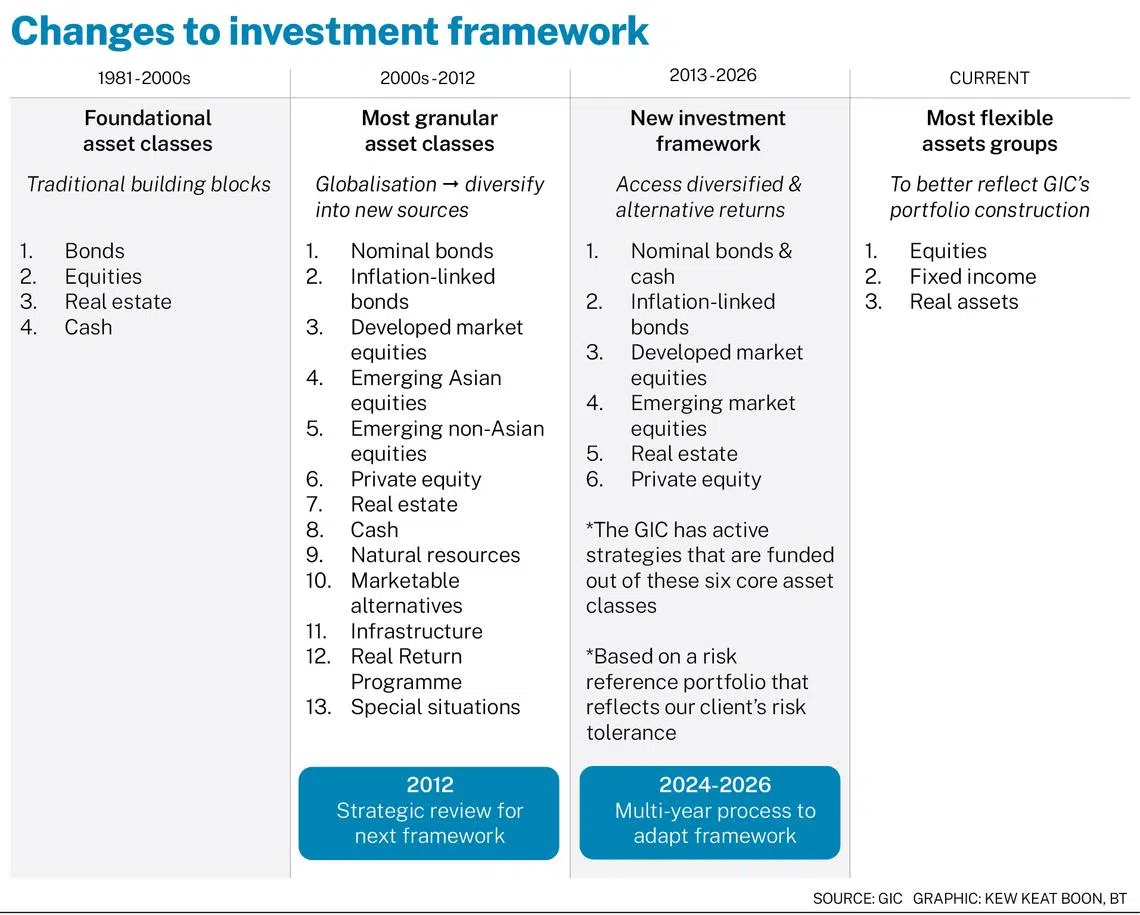
On the face of it, the new framework actually looks like a step backwards – remarkably similar to GIC’s original foundation from 1981 to the 2000s.
Back then, the fund relied on four basic building blocks: bonds, equities, real estate and cash.
As globalisation took hold, the structure became highly complex, and the portfolio was chopped into more specific, granular asset classes.
Now, we are back to just three broad groups.
A critic could reasonably argue that GIC is reverting to an outdated 1980s structure – merely moving capital between differently labelled buckets without altering the fundamental nature of the underlying investments.
However, the internal mechanics of the new approach suggest something much deeper. While it mirrors the 1980s setup visually, its underlying engine is completely different.
Back in the era of shoulder pads and early computers, those four foundational asset classes – bonds, equities, real estate and cash – were static, isolated silos.
In fact, the 1980s structure was defined by its limitations. You bought a government bond simply because it was a bond.
Today, the simplicity of the three new groups could be deceptive.
This new framework categorises investments by their economic function, erasing the walls between public and private markets: equities will chase growth; fixed income will generate steady cash; and real assets will serve as a shield against inflation.
Shopping for returns
And how different would the new structure be compared to its immediate predecessor, which was the prevalent investment framework from 2013 to 2026? Or to the one before that, which splintered the portfolio into 13 specific asset classes?
One way to look at it would be as a trip to the supermarket.
Under the previous framework, a fund manager would be armed with a rigid shopping list and strict instructions to buy exactly two bags of Asian equities and one box of European bonds.
If the Asian equities on the shelf were rotten or overpriced, the manager still had to buy them to fill the assigned quota. This meant capital could end up trapped in mediocre assets to satisfy an internal rule.
The new structure discards that list.
Now, the manager enters the supermarket with three broad goals. They need items for immediate energy, which means growth; items for daily sustenance (or steady income); and items with a very long shelf life to protect against winter (or inflation resilience).
The manager carries three large shopping baskets designed for these specific purposes.
If the traditional South-east Asian equities look unappetising, the manager can quickly pivot and fill their growth basket with a direct stake in a logistics hub in Melbourne or private credit in Europe instead.
In essence, the fund is prioritising the economic value of an asset over its traditional label.
We can see this agility in action through GIC’s new alternative bets, for example.
The sovereign wealth fund said it plans to deploy an extra US$30 billion into hedge funds over the next three years. It is already an established player in this space, having tripled its hedge fund investments over the past decade.
The logic behind this move is diversification.
Currently, a sizeable portion of global investments is closely tied to the artificial intelligence boom, which creates a heavily concentrated risk factor. Hedge funds provide an active strategy that diversifies away from this single concentrated risk.
Navigating choppy waters
GIC’s new investment framework comes amid a growing worry that it might be lagging behind its global sovereign wealth peers.
The Norwegian Government Pension Fund Global, for example, delivered a massive 15.1 per cent return in 2025.
Norway’s sovereign wealth fund captured these outsized gains by allocating a heavy 71.3 per cent of its assets directly to publicly listed equities, with technology and financial stocks driving their massive surplus.
Norway accepts erratic swings in yearly performance to capture these huge gains during bull markets. GIC, however, runs a fundamentally different mandate.
Singapore prioritises the preservation of purchasing power over aggressive growth, and GIC builds a highly defensive portfolio to ensure the reserves remain safe during a crisis.
While this caution is a core part of the fund’s identity, watching a peer like Norway pull in such enormous yields forces a serious debate over whether the cost of this defensive posture is too high.
GIC’s new investment framework must prove it can close that gap without taking on reckless risk.
The fund accepts that the era of easy market gains has ended. The world is dealing with profound macroeconomic headwinds, geopolitical tensions are rewiring global trade routes, and supply chains are breaking down and rebuilding at a massive financial cost.
Most importantly, inflation remains a persistent threat.
GIC expects these structural challenges to last for many years, and is bracing for a harsh environment defined by higher costs, heavier debt and lower overall returns.
Ultimately, the success of GIC’s new strategic portfolio framework will be judged by its ability to navigate these challenges.
The fund is dismantling its rigid asset classifications in favour of three flexible shopping baskets. However, tearing down the walls between asset classes removes a traditional safety net.
Without rigid quotas, the temptation to chase outsized returns – like those seen in Norway – might conflict with GIC’s core mandate to protect the reserves.
Indeed, instead of simply rearranging the deck chairs, GIC is fundamentally redesigning the ship.
The coming years will prove whether this new vessel can actually outrun the global economic storm, or if it has simply taken on a different kind of risk entirely.
TRENDING NOW

Britain’s mansion tax shows the difficulty of targeting wealth

Once staunchly pro-China, Malaysian Chinese businesses are now distancing themselves from Beijing

The only common thing in S-E Asia is that we all eat rice: Cisco’s Asean president

Singapore data centre operator DayOne opts for US IPO at likely US$20 billion valuation

