Global context for 2024 US race is different to 1968
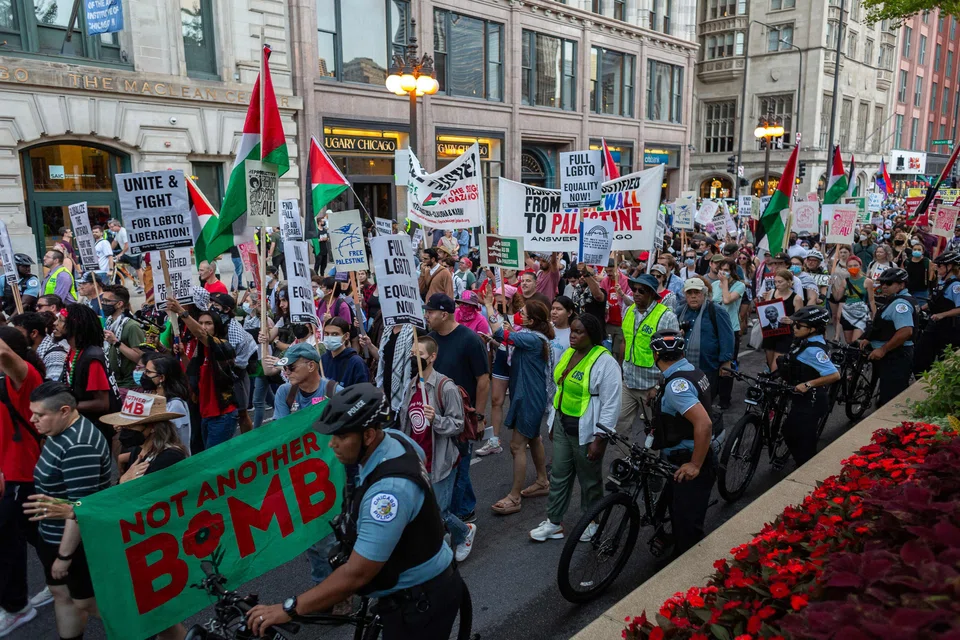
AS THE Democratic presidential convention gets into full swing in Chicago, sweeping comparisons are being drawn with the event in 1968 held in the same city during the Vietnam conflict. However, while there are some similarities, the foreign policy context between then and now is significantly different.
The 1968 election, which pitted Republican Richard Nixon against Democrat Hubert Humphrey, came during a distinctive, roughly quarter of a century political era from 1948 to 1972 during the early Cold War era. During this time, foreign policy was usually the single most salient issue in US elections, as it was in 1968 with the Vietnam war.
The year 1968 saw an unusually turbulent period framed by that Vietnam conflict with then president Lyndon Johnson’s decision not to run for re-election (paralleled this year by President Joe Biden’s decision not to seek a second term); the assassination of Martin Luther King on Apr 4; and the killing of Robert Kennedy on Jun 5.
This was capped off in August 1968 with the riots at the Democratic convention in Chicago, of which there will be an echo this week with high profile, impassioned pro-Palestinian protests against Israel’s military operation in Gaza.
Since the 1970s, however, economic issues have tended to be the US electorate’s highest priority. Most recently, in the 2020 presidential race for instance, during the first year of the pandemic, the US economy was spun into recession after more than a decade of growth, one of the longest expansions in US history.
This downturn saw a very significant decline in employment and production, across much of the economy, as the pandemic struck. The unusually high, rapid increases in unemployment were revealed by US employers cutting around 22 million jobs in March and April 2020 alone, as virus-related restrictions forced many businesses to collapse.
This is not to dismiss the importance of American foreign policy in the 2024 US campaign, even though the US is not formally engaged in any war today, unlike 1968.
Take the example of an Associated Press-University of Chicago National Opinion Research Centre (AP-NORC) survey, which saw 40 per cent of voters cite foreign policy as a key issue in the 2024 election. That is about twice as many who mentioned international topics in the AP-NORC poll conducted around a year earlier.
The big troubles in the Middle East since last October’s Hamas attacks in Israel, and the subsequent offensive in Gaza, have spiked US voter concerns about geopolitics. This alongside concerns about the Ukraine war, plus the possibility of wider challenges, including China’s posture towards Taiwan.
Immigration is also a rising US voter concern. Overall, the AP-NORC poll found that concerns about this issue, especially relating to the Mexican border, climbed to 35 per cent from 27 per cent last year.
While foreign policy is still not as salient for voters in 2024, as it was generally during the early years of the Cold War from 1948 to 1972, there are a significant number of reasons why international affairs will remain prominent in coming months before Election Day.
For one, there remain very high escalation risks in the Middle East, with the region at its most febrile point in years. The international impact is not just geopolitical but also economic, with the possibility of a new oil shock comparable to that in the mid-1970s, which saw the price of oil quadruple in less than a year.
In Ukraine, meanwhile, Kyiv has launched in August a spectacular new offensive inside Russia, gaining more than an estimated 2590 square kilometres of territory, at time of writing. After months of Moscow making gains in Ukraine, this has at least temporarily changed the narrative of the war there.
Meanwhile, significant numbers of US voters are concerned about potential for a crisis in Asia-Pacific, too, possibly over Taiwan. This could create a third major source of international conflict for the US and its Western allies, with resources increasingly stretched.
Yet, even if foreign policy issues were to grow significantly further in salience in 2024, possibly through heightened tensions in Asia-Pacific, there is nonetheless still a major key difference between now and the first 25 years of the Cold War. That is, the earlier period was characterised by a relative policy consensus and widespread bipartisan cooperation on foreign affairs.
Today, however, this policy domain is significantly more divisive. To be sure, the early Cold War consensus can be overstated. Nonetheless, a significant degree of bipartisan agreement on foreign affairs, and wider political decorum, did exist, at least until it broke apart in the late 1960s under the strain of the Vietnam debacle and the demise of the notion of monolithic communism in light of the Sino-Soviet split, which saw Nixon’s visit to Mao Zedong in Beijing.
No clear foreign policy consensus has emerged in recent years, and if anything, the gaps are widening.
Even before Donald Trump took up presidential office in 2017, many Republicans and Democrats differed significantly on how they view the power and standing of the US internationally; on the degree to which the country should be unilateralist; in their attitudes towards the campaign on terrorism and the methods by which they are being fought; and on what the priorities of foreign policy should be.
These divisions have grown, further, since Trump’s presidency, with 2024 seeing significantly divergent US grand strategies. That is, Trump’s “America First”, versus the more internationalist vision of the Biden-Harris administration, which is much more similar to the foreign policies of both Republican and Democratic predecessors in the post-war era.
The increasing polarisation of foreign policy also reduces the scope for the longstanding “rally around the flag” at times of geopolitical tension. This is illustrated by how some Republicans are now laying the blame for current geopolitical tensions on the Biden-Harris administration.
US Representative Mario Diaz Balart, for instance, has slammed what he calls “the results of a feckless (Biden-Harris) US foreign policy of appeasement”. He has called the world “a much more dangerous place today than before... after Afghanistan, Ukraine, and negotiations towards an Iran deal, I shudder at the thought of more incompetence, weakness and appeasement from the current administration”.
Especially if the conflicts in Ukraine and the Middle East continue into late 2024, it is therefore increasingly plausible that the salience of international issues could remain high on Nov 5, Election Day. Moreover, partisan splits on foreign policy will reinforce the already sky-high political polarisation in America, potentially increasing global interest in the race to boot.
The writer is an associate at LSE IDEAS at the London School of Economics