

Global economy’s looming geopolitical risks
GEOPOLITICS was not widely seen as a key trigger for last week’s market turmoil. However, multiple political fissures may yet erupt, bringing about greater economic disequilibrium in their wake.
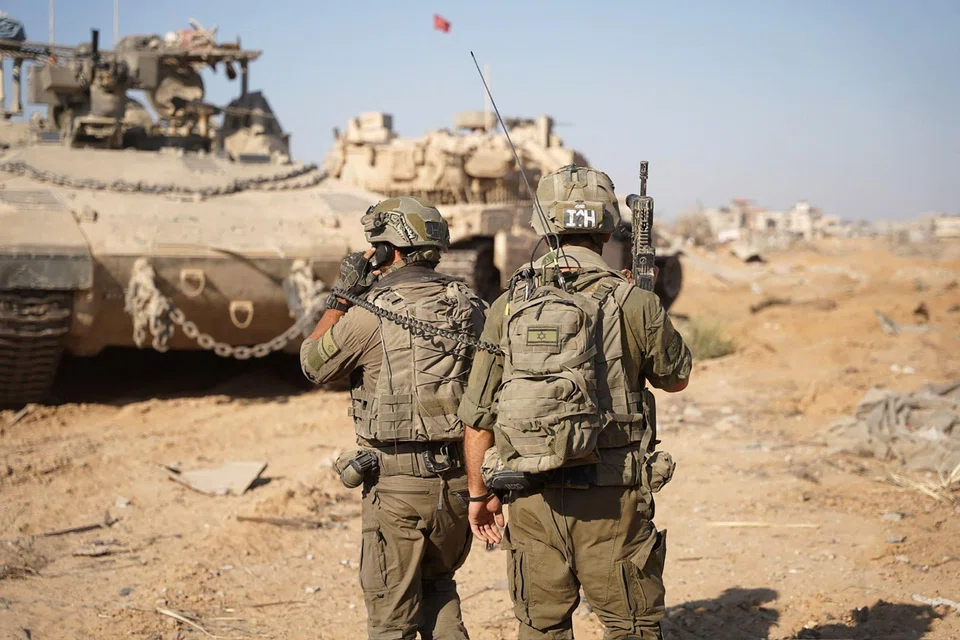
Take the example of the Middle East, where the downside risks that the Gaza conflict could erupt into a full-scale war between Israel and Iran may be underpriced in markets. The immediate context is Iran’s pondering of its response to the recent killings of a top Hamas leader in Tehran and a senior Hezbollah commander in Beirut.
US National Security Council spokesman John Kirby said on Monday (Aug 12) that Iran could carry out retaliatory military measures on Israel as early as this week. He said “we have to be prepared for what could be a significant set of attacks” – a view shared by Israeli and other Western intelligence agencies, too.
Iran, which attacked Israel in April with some 300 missiles and drones, is expected to carry out a much bigger strike. For instance, Jonathan Conricus, senior fellow at the Foundation for Defense of Democracies, asserted that what is coming may be several times bigger.
On Monday, US President Joe Biden and key European leaders, including UK Prime Minister Keir Starmer, French President Emmanuel Macron and German Chancellor Olaf Scholz, released a joint statement urging restraint.
As the US Navy sends more vessels to the region, building up military assets there, doubts over the possibility of securing an Israel-Hamas ceasefire grow. There is also the looming possibility of a wider regional war.
With Iran’s religious leadership under heavy pressure internally to respond with substantial force, assumptions that have long been made about Tehran’s military posture may be more fragile than in the past.
One of these is that Iran prefers to fight wars via proxies. The regime may now be positioning itself for a potential confrontation with Israel and its Western allies in which it will not rely solely on its proxy fighters – such as Hezbollah, Hamas, the Islamic Jihad or the Houthis – to carry out its strategic aims.
As Iran contemplates its next step, a key risk for all sides is miscalculation. This is in a region where geopolitics has been upended since last October, when Hamas infiltrated Gaza to perpetrate a major terror attack in Israel’s worst intelligence failure in decades.
Despite recent rises in crude oil prices, there is still no extensive discussion on the possibility of an oil shock in the style of 1973-74, during which a barrel of oil nearly quadrupled in value in less than a year. That event saw an embargo by Arab oil-producing nations in response to US support for Israel during the Yom Kippur War.
The downside risks in the Middle East are only one part of a cocktail of potential global fissures. The macro context is that for several decades, there has been a long cycle of globalisation and geopolitical stability, but a new, riskier era appears to have begun.
So much so that there is increased speculation of a broader “polycrisis” with a growing number of overlapping challenges. In the assessment of many, we are living in an era of successive, interconnected disruptions in which a permanent sense of crisis is a new normal.
This has implications not just for politics, but also financial markets. While some stock exchanges around the world have recovered their losses since last week’s turmoil, further volatility could still be on the horizon.
The multiple global fractures right now include health risks in the post-pandemic landscape, technological challenges such as last month’s global IT meltdown, climate crises, and economic inequality. On the security front, there is the ongoing Ukraine war, the continuing threat from international terrorism, plus North Korea’s acquisition of nuclear weapons.
While some financial market participants appear not to have geopolitical risks top of mind right now, such international political turbulence has been a recurrent feature for several years now. Several market commentators have been asserting since around 2016 that geopolitical risks are at a post-Cold War high.
Of course, 2016 was the year when anti-establishment populism and anti-globalisation may have reached their apotheosis. This was seen in the election of Donald Trump as US president, and the United Kingdom’s vote to leave the European Union.
What was so striking about both these events was that two countries previously known for their political stability – and role as traditional rule-makers of the international order – made the world more uncertain.
In this landscape, there may be no easy answers to meeting the current crises. But it is sometimes forgotten that there are some successes.
One example is the 2015 global climate change agreement in Paris. While the deal was far from perfect, it nonetheless represented a welcome shot in the arm for attempts to tackle global warming. And crucially, a new post-Kyoto treaty framework was put in place.
Moreover, the review framework means that countries can toughen their responses to climate change, especially if the political and public will to tackle the problem intensifies. So, Paris is potentially a very important stepping stone, and what is now needed are well-informed lawmakers from across the political spectrum to help ensure effective implementation and government accountability.
With the 2024 presidential election in full swing, there is much focus on the United States, which was one of the key parties of the Paris agreement. However, it may be China – which is a bystander in several current crises – which has a significant bearing on whether the polycrisis of today gets better or worse.
This is because Beijing’s rise to power has the potential to be a growing source of tension with Washington and the wider West. Or perhaps it could lead to a more fruitful partnership.
Growing bilateral rivalry, rather than an increasingly cooperative relationship, is the most likely scenario for future relations. However, there remains an outside possibility that a different future is possible, in which there is more cooperation around softer issues such as climate change, and less tension on harder issues including security.
The direction of that bilateral relationship is therefore perhaps the single most important uncertainty in the later 2020s. While greater collaboration is widely dismissed, the possibility of a more cooperative relationship may yet offer a prospect of a different global future.
The writer is an associate at LSE IDEAS at the London School of Economics
TRENDING NOW

Once staunchly pro-China, Malaysian Chinese businesses are now distancing themselves from Beijing

Stocks to watch: HPL, Aims Apac Reit, Zico, Advanced Systems Automation, ComfortDelGro

‘How many will survive?’: Bubble fears arise as China’s humanoid robotics face reality check

Smaller board lots can’t fix a market run by three banks

