

Global populists rally to France’s Le Pen
She has been found guilty of embezzling EU funds and barred from standing for public office for five years
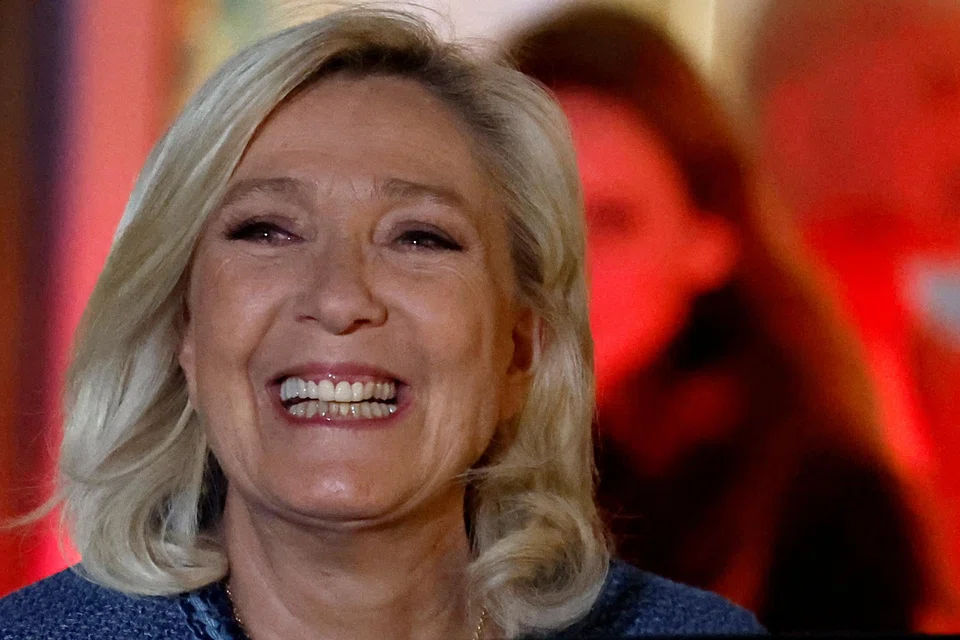
US PRESIDENT Donald Trump’s tariffs dominate the global economic headlines this week. Yet, political debate in Europe, and internationally, is as focused on Monday’s (Mar 31) hugely consequential French court ruling that may prevent Trump-favourite and poll-frontrunner Marine Le Pen from running for the nation’s presidency in 2027.
Monday’s decision, which found her guilty of embezzling EU funds and barred her from standing for public office for five years, could badly destabilise French politics and the second-largest economy in the European Union again. This after 2024 saw the nation go through no less than four prime ministers.
It is possible, for instance, that Le Pen’s National Rally (RN) may now try to bring down the government of Prime Minister Francois Bayrou. His centrist MoDem party was – in 2024 – also ruled by courts to have been involved in misusing European Parliament funds to pay for party work in France, but Bayrou was not personally implicated.
A second way in which Monday’s judicial decision will undermine French political stability is that the RN will now seek to make Le Pen into a far-right political martyr. Her protege, 29-year-old Jordan Bardella, RN’s president who may well now stand for the presidency in 2027, blasted the judges by saying “it is not only Marine Le Pen who is being unjustly condemned, it is French democracy that is being executed”.
As much as the French judicial decision is legally sound, it has given global populists and authoritarians the political ground to rally around Le Pen, including Hungary’s Prime Minister Viktor Orban, Italy’s Deputy Prime Minister Matteo Salvini, and the so-called Dutch Trump, Geert Wilders whose far-right party has become the largest in the Netherlands’ House of Representatives. Even the Kremlin, hilariously, has voiced alarm about France’s falling democratic standards.
Tesla CEO Elon Musk, who leads Trump’s Department of Government Efficiency initiative has, meanwhile, compared Monday’s judicial ruling to the US president’s legal troubles before he won last November’s election. Said Musk: “This will backfire, like the legal attacks against President Trump. When the radical left can’t win via democratic vote, they abuse the legal system to jail their opponents.”
Musk’s sentiment also echoes the warnings of US Vice-President JD Vance, who asserted in February that the biggest threat to Europe is not from China or Russia but “from within”, including what they claim is a decline in free speech. While Vance and Musk are wrong, as on much else, events since then have given them bragging points.
The French judicial decision follows a similar case in Romania recently. That saw the Romanian constitutional court bar rightist Calin Georgescu, who won the nation’s first round presidential election last November, from standing in the second round after credible allegations of Russian interference.
While both the French and Romanian authorities acted diligently, it remains a truism that populists are best defeated at the polls. Of course, even then, as in the November 2020 US presidential election, populists like Trump will often cry foul when they lose. But the ballot box is nonetheless the best way of countering insurgent right-wing politicians.
One of the key outstanding questions in the next three and a half years is how much Trump’s presidency will fuel the global growth of populism in Europe and beyond. A defining feature of the 21st century – so far – has been the growth of populism which has not just sent political, but also economic shockwaves across much of the world, as Trump’s trade tariff policy shows in 2025.
At the beginning of the 21st century, only a handful of key states with populations over 20 million –including Italy, Argentina and Venezuela – had populist leaders. This was an era that saw, for instance, the controversial billionaire businessman Silvio Berlusconi as a maverick prime minister from 2001-2006 in Italy, presaging the rise of Trump. Moreover, Hugo Chavez was Venezuelan president from 1999-2013, aligning himself with the regimes of Fidel and then Raul Castro in Cuba.
This then relatively small populist club expanded significantly after the onset of the 2008-09 international financial crisis, which led to Trump’s first presidential win in 2016. This latest wave of populism has cast a bigger footprint than ever before, from Asia-Pacific to the Americas, including India’s Prime Minister Narendra Modi.
Yet, the populist wave of the last two and a half decades may not yet have peaked. In this context, what is particularly striking is how much Europe has become perhaps the single most important centre of global populism, taking the mantle from South America.
As much as this vision is the wrong one for Europe, far-right populists are increasingly winning power across the region, in both West and East. Moreover, Italian Prime Minister Giorgia Meloni is, by some assessments, the most powerful politician in the continent. That is, at least until probable new German chancellor Friedrich Merz is sworn into office.
The influence that Trump has over European populists is shown by perhaps his biggest admirer in the continent, Orban. During Hungary’s six-month presidency of the EU in the second half of 2024, he made the official slogan into one loaded with Trumpist lexicon: “Make Europe Great Again” (MEGA). This included a unilaterally planned visit last July to see Russian President Vladimir Putin, which dismayed European partners.
During his long premiership since 2010, Orban’s team has not only got closer to Trump, but also the political ecosystem surrounding him. This includes conservative US thinkers widely seen as the team behind the controversial Project 2025.
This initiative includes bolstering the White House’s power, and displacing many thousands of career civil servants. It is similar to the authoritarian model that Orban has adopted, which preserves some elements of democracy, but seeks to politicise key institutions.
Few outside of Europe fully understand how much Orban’s long period as Hungarian prime minister, since 2010, has seen his country slide to the bottom – among the 27 EU members – in the annual Transparency International corruption index. So much so that Brussels has withheld billions of euros of EU funding earmarked for Hungary because of concerns over the rule of law.
In this context, the remaining core of centre-right and centre-left European leaders must do much more to push back at this misguided, far-right populist MEGA vision. Europe’s moderate politicians need to show they can work together better to deliver political and economic progress across the bloc to thwart the damaging political tide which Trump and Orban represent.
The writer is an associate at LSE IDEAS at the London School of Economics
TRENDING NOW

ComfortDelGro appoints two new independent directors

Once staunchly pro-China, Malaysian Chinese businesses are now distancing themselves from Beijing

NoonTalk needs continued financial support from CEO Dasmond Koh, auditors warn

DP Architects sets the benchmark for sustainability disclosure and design

