Global water crisis needs accelerated action on all fronts
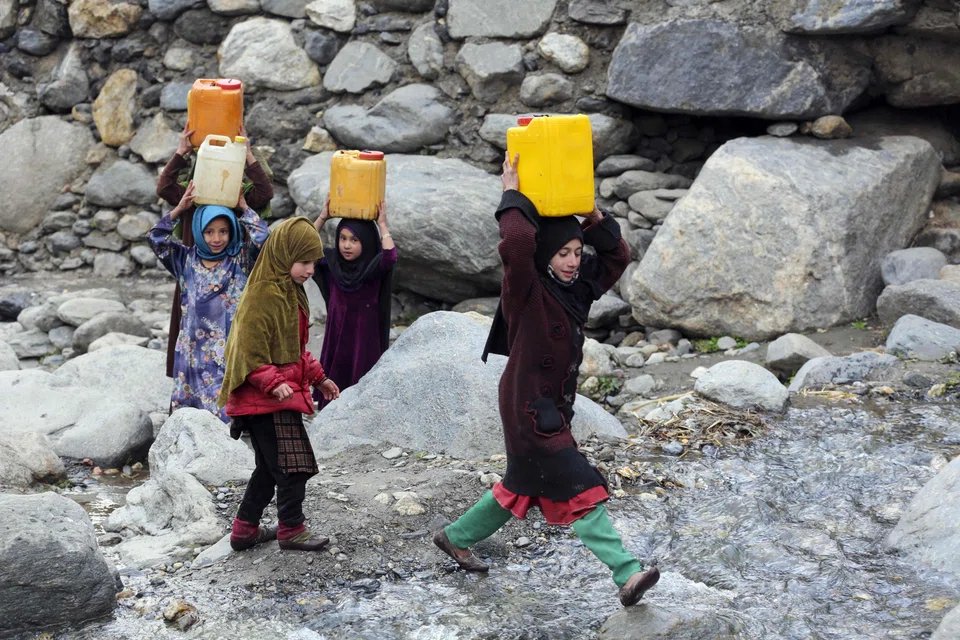
    • Girls carry drinking water canisters after filling from a stream in the Dara-i-Nur district of Afghanistan's Nangarhar province. Globally, billions of people still lack safe water, sanitation, and handwashing facilities, while climate change continues to amplify water-related extremes around the world.
    • Girls carry drinking water canisters after filling from a stream in the Dara-i-Nur district of Afghanistan's Nangarhar province. Globally, billions of people still lack safe water, sanitation, and handwashing facilities, while climate change continues to amplify water-related extremes around the world. PHOTO: AFP
    Published Tue, Mar 21, 2023 · 05:50 AM

    CLIMATE change is now well established as one of the most pressing issues of our time, with the most evident impact felt through our relationship with water.

    Rising temperatures and changing weather patterns continue to disrupt our water cycle around the world, impacting societies, ecosystems, and economies through unpredictable water availability and quality. In response, the world committed to Sustainable Development Goal (SDG) 6 back in 2015 as part of the 2030 Agenda – with the aim of providing safely managed water and sanitation for all.

    Unfortunately, less than a decade later, we are already alarmingly off track. Globally, billions of people still lack safe water, sanitation, and handwashing facilities, while climate change continues to amplify water-related extremes around the world.


    Beyond its direct impacts, climate change reveals underlying vulnerabilities stemming from poor water governance, giving rise to calls for more sustainable management of water. Closer to home, the wider South-east Asian region’s water security demonstrates this by being at risk from a range of interconnected pressures including population growth, urbanisation, and increasing water pollution.

    The theme for this year’s World Water Day – which falls on Wednesday (Mar 22) – is “Accelerating Change”, reflecting the critical need for climate action to match or even exceed the pace of climate change if it is to make true progress.

    How do we increase the pace of transition? This remains top-of-mind for me and the other attendees at this week’s UN 2023 Water Conference – the first event of its kind in nearly 50 years – where key decision-makers from all fronts will come together to create an agenda that “gives our world’s lifeblood the commitment it deserves”, as noted by UN Secretary-General Antonio Guterres.

    What’s encouraging is that each stakeholder will bring their own unique perspectives and strengths to this crucial forum on the future of our water. What I hope we come away with is a bold, whole-of-society approach that significantly accelerates action across government, businesses, and the public.

    Setting a strong water agenda

    Governments have taken a lead with policies that provide impetus for the sustainability transition. But while the water management community understands the issues and agrees on the solutions, the challenge is to ensure decision-makers in other sectors that rely on water, or impact water management, understand and come on board too.

    Taking a page from our wider climate action efforts, the Paris Agreement has been a landmark initiative in the multilateral climate change process. For the first time, a binding agreement brings all the world’s nations to support a common strategy to cut greenhouse gas emissions. It is now the leading framework for key discussions and dialogues. Meanwhile, at a corporate level, the Science Based Targets Initiative (SBTi) mobilises the private sector to take urgent climate action by providing guidance for businesses to set ambitious emissions-reduction targets.

    But globally, consensus on water is proving more elusive, despite it being an important element of climate policy formulation. Ultimately, we need to take a similar approach to climate by building a stronger consensus on frameworks, goals, and guidelines for water, with nuances to reflect local conditions and resources.

    I’m optimistic about the Water Action Agenda, which will be a main outcome of the conference. With a collection of all water-related voluntary commitments, the agenda is set to accelerate progress in the second half of the Water Action Decade and guide both governments and businesses to better manage water and tackle water and water-related challenges.

    Corporate action needed

    To make a sustained impact on tackling the water crisis, it is key for the private sector to “walk the talk” and embed water stewardship in their businesses, by leveraging innovation and collaboration to achieve collective change.

    With water as a key ingredient in the operations of all businesses, companies can take the lead in sustainable water management. One approach is advancing water reuse and recycling, which ensures wastewater is effectively treated to a quality that makes it possible to feed back into our water cycles.

    Water treatment solutions now enable companies to reuse their wastewater, reduce costs, and do their part to ensure that natural water sources are not unnecessarily exploited.

    A leader in this area is Danish multinational brewer Carlsberg, which aims to halve its water use by 2030. In its production facility in Fredericia, Denmark, Carlsberg has developed a Total Water Management treatment plant with consultants, universities, and technology providers such as Grundfos. The on-site facility treats used process water from mainly cleaning purposes and purifies it to drinking water quality, sending 90 per cent of it back to the brewery to be reused as process water.

    Empowering people with knowledge

    The public also has a big role to play in accelerating change. Over the past decade, governments, businesses, non-governmental organisations (NGOs) and the scientific community have driven home the message about climate change and highlighted the importance of strength in numbers, and that it is crucial we mobilise the public on climate action.

    However, more work needs to be done to raise awareness about the particular challenges of water management and climate change. Aided by data and knowledge shared by the aforementioned key stakeholders, the public can take more informed and effective individual action.

    In Singapore, this is happening through the roll-out of smart water meters, which provides real-time water consumption information and better understanding of demand patterns, enabling people to be more water-conscious and encouraging water-wise behaviours. With each drop of water saved, we can make a bigger difference.

    While the SDGs drawn up in 2015 have yet to be fully realised, it’s crucial that we don’t lose momentum. Effective water management is a key component of each SDG and is critical for its success, from better health and well-being to reducing inequalities.

    World Water Day reminds us that by channelling the efforts of government, business, and individuals towards addressing the water crisis, we can together bring about the change we want to see, and by accelerating action on the ongoing water crisis we can collectively close the gaps on our other global challenges.