As goes the Sogo department store, so goes Japan
SHOPPING might be the most capitalist of all activities. Little wonder, then, that where we shop reflects capitalism back to us, capturing the zeitgeist of an era or a country: Think Walmart’s ascension as a metaphor for the unbridled consumption of post-Cold War US.
Nowhere is this truer than Japan’s department stores – once a staple of travel-guide tropes about elevator girls, white-gloved assistants and incomparable service.
Indeed, their history traces capitalism’s trajectory in the country, right from when Echigoya, a predecessor of today’s Mitsukoshi that traces its roots back to 1673, became the first place to sell goods at fixed prices instead of haggling.
The hyakkaten, as they’re known, later absorbed Western practices such as point-of-sale displays and double-entry accounting, as stores were inspired in the early 1900s by the likes of Wanamaker’s or Harrods.
These places were where people went to encounter state-of-the-art technology, such as elevators. By the height of the economic bubble in the late 1980s, they were symbols of the country’s might, an essential destination for the newly wealthy. But when the bubble burst, no industry was harder hit.
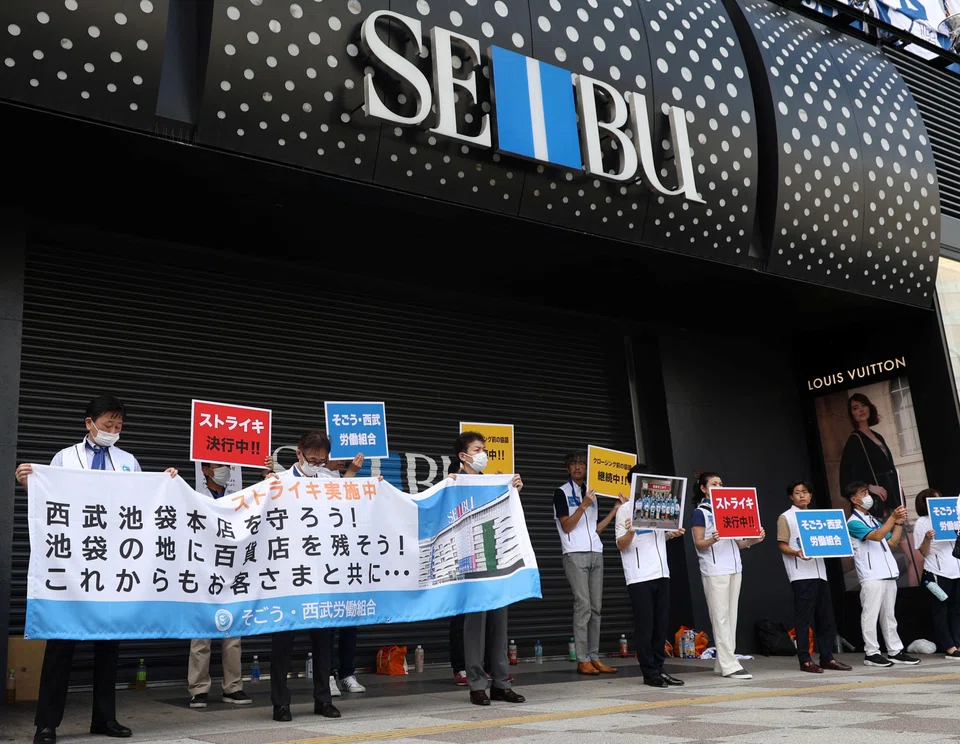
More recently, Sogo & Seibu made headlines after workers went on a historic strike last month to protest its sale to US fund Fortress Investment Group.
Japanese workers striking is, in and of itself, unusual. Perhaps it’s a barometer for a country with a shrinking workforce, one where labour finds itself with an increasingly louder voice.
But the sale also encapsulates the changes afoot in Japanese business. The once-cherished national asset, whose fate was debated in parliament not so long ago and entwined with the fortunes of premiers, is now being sold with relatively little outcry to what the press might have once termed a “vulture fund”.
Furthermore, the pressure to sell came from another foreign investor, activist ValueAct Capital Management, which forced the board of owner Seven & i Holdings to let its treasured but troubled asset go.

For a country often accused of not changing, that’s a remarkable turnaround. But it’s far from the only time Sogo & Seibu has been at the inflection point of how business renews itself.
The Sogo Company’s bankruptcy in 2000 was one of the biggest stories during Prime Minister Yoshiro Mori’s frenetic reign.
Like so many companies in the 1980s, Sogo had taken on debt that it expected to be backed by its overvalued assets. When its balance sheet was exposed, Mori initially pledged to use taxpayer money to salvage the chain. But he backtracked amid increasing opposition to rescues of “zombie” companies.
Sogo filed for bankruptcy with liabilities of US$17 billion, the second-biggest corporate failure in the country’s history at the time. The fallout prevented the then-governor of the Bank of Japan, Masaru Hayami, from raising interest rates off zero that month.
Allowing Sogo’s failure was a watershed moment. The Mori government had “made the smartest financial decision of its brief political life”, said BusinessWeek at the time.
The era of bailing out failing firms was (mostly) over, paving the way for tougher measures. Instead of the government, rival Seibu Department Stores stepped up to support Sogo’s revival.
It wasn’t long, though, before Seibu had debt troubles of its own. The solution, arranged by bankers and creditors, was a merger of the two struggling companies.
Other peers followed: Isetan and Mitsukoshi formed the conglomerate that today bears their names; Matsuzakaya and Daimaru formed J Front Retailing; Osaka railway operators Hankyu and Hanshin, which pioneered placing department stores in train hubs, merged along with their retail units, becoming H2O Retailing.
That company, in turn, planned to join with Takashimaya but failed to reach an agreement. That, too, echoes the business environment then, when combinations that made sense on paper – such as beer-makers Kirin and Suntory, or industrial conglomerates Mitsubishi Heavy Industries and Hitachi – were discussed but ultimately fell through.
Japan’s department stores have stabilised since, with Seven & i buying Sogo & Seibu in 2006, but the industry’s long-delayed restructuring put them on a weaker footing. The debt was partly due to opening across Asia at the wrong time – and, because of their busted balance sheets, they gave away those assets too quickly.
The Sogo in Hong Kong is iconic even today, but it’s owned and operated by tycoon Thomas Lau, after the parent company sold its international assets during restructuring. Focusing on domestic operations to the detriment of opportunities overseas was a common error of Japanese businesses in the 2000s, from mobile phones to television panels.
Today, concerns lie not only over the jobs in Sogo & Seibu’s remaining domestic outlets but also the fate of the department store experience.
At the flagship Ikebukuro location, electronics retailer Yodobashi intends to occupy much of the floorspace. The spectre of an electronics retailer’s blinding lights and constant jingles occupying the hyakkaten has even led Norbert Leuret, the local head of LVMH Moet Hennessy Louis Vuitton, to voice his opposition.
But discount electronics outlets, or Pan Pacific International Holdings’ Don Quijote discount chain, are more synonymous with Japan now – a reflection maybe of how the country is transforming into a cheap shopping destination rather than a premium one.
Young domestic customers are far more likely to buy online from the likes of Chinese clothing giant Shein; apparel sales at department stores plunged to just 1.1 trillion yen (S$10 billion) in 2020 from 3.9 trillion yen in 1990. That’s one reason the number of department stores located outside the 10 biggest cities has dropped by 30 per cent in the past decade.
But one curiosity is that some of the largest stores are doing better than anticipated: Isetan Mitsukoshi Holdings’ flagship Shinjuku Isetan posted its best-ever annual sales last fiscal year, surpassing a 1991 peak; Osaka’s Hankyu Umeda had a record 12 months, too. Tourists had only just returned post-Covid for a portion of that time, and there were hardly any big-spending Chinese visitors.
That success, then, might be a reflection of where wealth has shifted firmly to the biggest urban hubs.
And as more of Japan eschews the “job-for-life” model and moves towards rewarding performance, this two-track economy is likely to accelerate. As the nation changes, so too will the hyakkaten. It’s not closing time yet. BLOOMBERG
Decoding Asia newsletter: your guide to navigating Asia in a new global order. Sign up here to get Decoding Asia newsletter. Delivered to your inbox. Free.
Share with us your feedback on BT's products and services