The great delusion behind Twitter

We need a thoughtful alternative that doesn’t exist yet
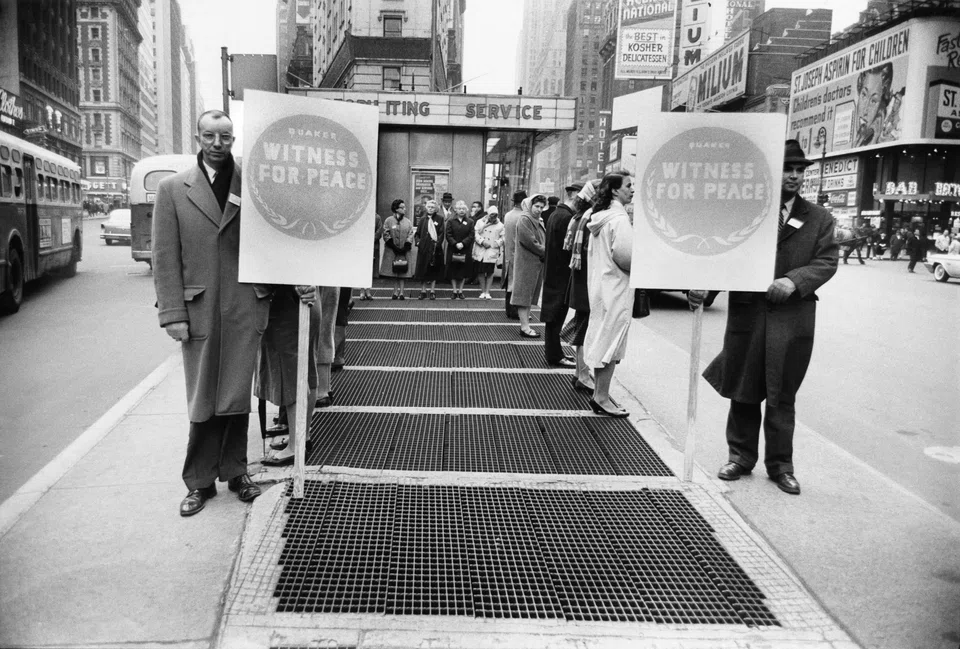
    • Quakers at a prayer vigil in front of the armed forces recruitment booth in Times Square, New York City, in 1961.
    • Having put us in an active, fretful mental state, Twitter then encourages us to fire off declarative statements on the most divisive possible issues, always with one eye to how quickly they will rack up likes and retweets and thus viral power.
    • Quakers at a prayer vigil in front of the armed forces recruitment booth in Times Square, New York City, in 1961. PHOTO: NYTIMES
    • Having put us in an active, fretful mental state, Twitter then encourages us to fire off declarative statements on the most divisive possible issues, always with one eye to how quickly they will rack up likes and retweets and thus viral power. PHOTO: AFP
    Published Mon, Dec 12, 2022 · 12:04 PM

    FOR what feels like ages, we have been told that Twitter is, or needs to be, the world’s town square. That was Dick Costolo’s line in 2013, when he was Twitter’s chief executive officer (“We think of it as the global town square”), and Jack Dorsey, one of Twitter’s founders, used it, too, in 2018 (“People use Twitter as a digital public square”).

    Now the line comes from the “chief twit”, Elon Musk (“The reason I acquired Twitter is because it is important to the future of civilisation to have a common digital town square”).

    This metaphor is wrong on three levels.

    First, there is not, cannot be and should not be a “global town square”. The world needs many town squares, not one. Public spaces are rooted in the communities and contexts in which they exist. This is true, too, for Twitter, which is less a singular entity than a digital multiverse. What Twitter is for activists in Zimbabwe is not what it is for gamers in Britain.

    Second, town squares are public spaces, governed in some way by the public. That is what makes them a town square rather than a square in a town. They are not the playthings of whimsical billionaires. They do not exist, as Twitter did for so long, to provide returns to shareholders. (And as wild as Musk’s reign has already been, remember that he tried to back out of this deal, and Twitter’s leadership, knowing he neither wanted the service nor would treat it or its employees with care, forced it through to ensure that executives and shareholders got their payout.) A town square controlled by one man is not a town square. It is a storefront, an art project, or possibly a game preserve.

    Third, what matters for a polity is not the mere existence of a town square, but the condition the townspeople are in when they arrive. Town squares can host debates. They can host craft fairs. They can host brawls. They can host lynchings. Civilisation does not depend on a place to gather. It depends on what happens when people gather.

    So much genius and trickery and money have gone into a mistaken metaphor. The competition to create and own the digital square may be good business, but it has led to terrible politics. Think of the hopeful imaginings that accompanied the early days of social media: We would know one another across time and space; we would share with one another across cultures and generations; we would inform one another across borders and factions.

    Billions of people use these services. Their scale is truly civilisational. And what have they wrought? Is the world more democratic? Is gross domestic product growth higher? Is innovation faster? Do we seem wiser? Do we seem kinder? Are we happier? Shouldn’t something, anything, have gotten noticeably better in the short decades since these services fought their way into our lives?

    I think there is a reason that so little has gotten better and so much has gotten worse. It is this: The cost of so much connection and information has been the deterioration of our capacity for attention and reflection. And it is the quality of our attention and reflection that matters most.

    In a recent paper, Benjamin Farrer, a political scientist at Knox College in Illinois, argues that we have mistaken the key resource upon which democracy, and perhaps civilisation, depends. That resource is attention. But not your attention or my attention. Our attention. Attention, in this sense, is a collective resource; it is the depth of thought and consideration a society can bring to bear on its most pressing problems. And as with so many collective resources, from fresh air to clean water, it can be polluted or exhausted.

    One telling study recruited participants across 17 countries and six continents and measured skin conductivity – a signal of emotional response – when participants saw positive, negative and neutral news. Negative news was, consistently, the most engaging. If you have ever wondered why the news is so focused on tragedy and conflict or why social media furnishes more outrage than inspiration, that is the reason. Negativity captures our attention better than positivity or neutrality.

    Permit me a weird turn here. I became interested this year in how Quakers deliberate. As a movement, Quakers have been far ahead of the moral curve time and again – early to abolitionism, to equality between the sexes, to prison reform, to pressuring governments to help save Jews from the Holocaust. That is not to say Quakers have gotten nothing wrong, but what has led them to get so much right?

    The answer suggested by Rex Ambler’s lovely book The Quaker Way is silence. In a typical Quaker meeting, Ambler writes, community members “sit in silence together for an hour or so, standing up to speak only if they are led to do so, and then only to share some insight which they sense will be of value to others”. If they must decide an issue collectively, “they will wait in silence together, again, to discern what has to be done”.

    There is much that debate can offer, but much that it can obscure. “To get a clear sense of what is happening in our lives, we Quakers try to go deeper,” he writes. “We have to let go our active and fretful minds in order to do this. We go quiet and let a deeper, more sensitive awareness arise.”

    I find this powerful in part because I see it in myself. I know how I respond in the heat of an argument, when my whole being is tensed to react. And I know how I process hard questions or difficult emotions after quiet reflection, when there is time for my spirit to settle. I know which is my better self.

    Democracy is not and will not be one long Quaker meeting. But there is wisdom here worth mulling. We do not make our best decisions, as individuals or as a collective, when our minds are most active and fretful. And yet “active and fretful” is about as precise a description as I can imagine of the Twitter mind. And having put us in an active, fretful mental state, Twitter then encourages us to fire off declarative statements on the most divisive possible issues, always with one eye to how quickly they will rack up likes and retweets and thus viral power. It’s insane.

    And it will get so much worse from here. OpenAI recently released ChatGPT, an artificial intelligence system that can be given requests in plain language (“Write me an argument for the benefits of single-payer healthcare, in the style of a Taylor Swift song”) and spit out remarkably passable results.

    What ChatGPT can do is a marvel. We are at the dawn of a new technological era. But it is easy to see how it could turn dark – and quickly. Artificial intelligence systems such as this make the production and manipulation of text (and code and images and eventually audio and video) functionally costless. They will be deployed to produce whatever makes us most likely to click. But these systems do not and cannot know what they are producing. The cost of creating and optimising content that grabs our attention is plummeting, but the cost of producing valuable and truthful work is not.

    These are technologies that lend themselves to cacophony, not community. I fear a world in which the business models behind them run on our attention or profit off our anger. But other worlds and other models are possible.

    A few weeks back, I spoke to Audrey Tang, Taiwan’s minister of digital affairs. I asked her what it would mean for social media to be run democratically, given the mistrust many Americans have – and for good reason – of the state. (Imagine if the Trump administration had owned Twitter.) “Does the social sector mean anything in the American context?” she asked me.

    By the social sector, Tang meant what we sometimes call civil society – the layer of associations and organisations between the government and the market. In Taiwan, key parts of digital infrastructure are managed at this level. The PTT Bulletin Board System, which she described as Taiwan’s Reddit, if Reddit were far more central to social and political life, is still owned by the student group that started it. It was part of how Taiwan responded so early and so effectively to the coronavirus. “It has no shareholders,” Tang said. “No advertisers. It is entirely within the academic network. It’s entirely open source. It’s entirely community governed. People can freely join it. It’s a public digital space.”

    It sounded like utopia to me, before I remembered that a key part of our digital infrastructure is run similarly. Wikipedia remains one of the most-visited sites on the web, and it is owned and managed by the non-profit Wikimedia Foundation. It shows. Wikipedia has never tried to become more than it is. It never pivoted to video or remade itself around an algorithmic feed in order to harvest more of our attention. It is a commons, but one that is governed so that we may use it rather than so that it may use us. It gives so much more than it takes. It thrives, quietly and gently, as a reminder that a very different Internet, governed in a very different way, intended for a very different purpose, is possible.

    There are those who believe the social web is reaching its terminal point. I hope they’re right. Platform after platform was designed to make it easier and more addictive for us to share content with one another so the corporations behind them could sell ever more of our attention and data. In different ways, most of these platforms are now in decline.

    What if the next turn of the media dial was measured not by how much attention we gave to a platform, but by how much it gave to us? I am not sure what such a service would look like. But I am hungry for it, and I suspect a lot of other people are, too. NYTIMES

    This is an abridged version of the New York Times piece “The great delusion behind Twitter”.