HOCK LOCK SIEW

Having raced past rivals to become the world’s top EV seller, BYD’s challenge is to stay ahead

Tay Peck Gek
Tay Peck Gek

Published Tue, Feb 6, 2024 · 05:00 AM
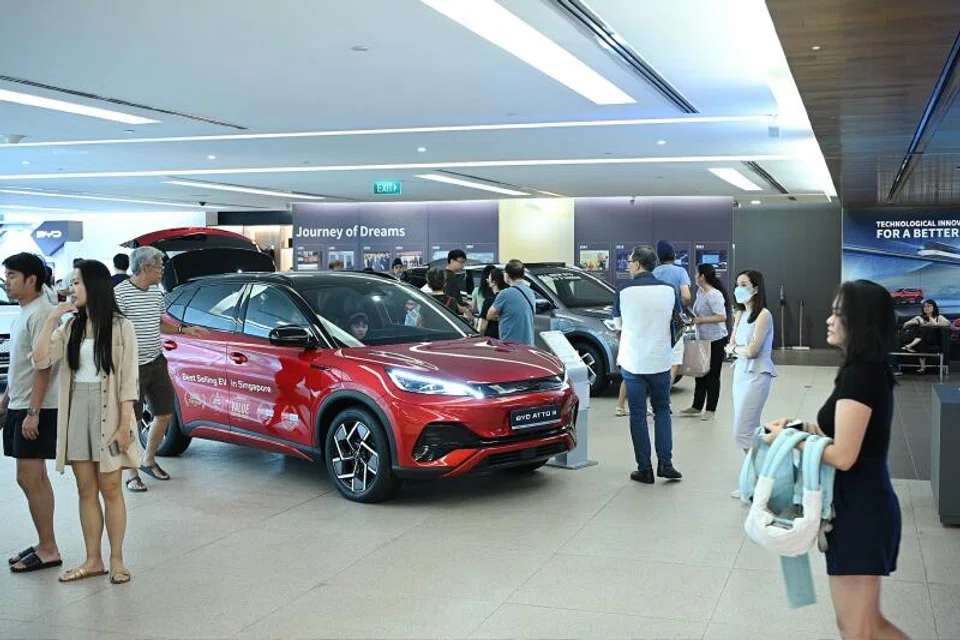
    • Chinese automobile maker BYD pipped US counterpart Tesla to be the top electric vehicle seller in Singapore in 2023.
    • Chinese automobile maker BYD pipped US counterpart Tesla to be the top electric vehicle seller in Singapore in 2023. PHOTO: ST FILE

    INVESTORS in BYD might be feeling like the Chinese automobile maker is at a crossroads. And perhaps rightly so.

    BYD – short for Build Your Dreams – last week posted guidance for its 2023 net profit amid a flurry of industry news about slowing demand for electric vehicles (EVs).

    The company estimated that its full-year earnings would come in at between 29 billion yuan (S$5.4 billion) and 31 billion yuan, which works out to an improvement of 74.4 per cent and 86.5 per cent year on year.

    While its bottom line improvement in 2023 is no small feat, it is dwarfed by the 446 per cent surge it recorded in 2022, which raised its net profit to 16.6 billion yuan.

    Instead of driving the stock price higher, the estimate caused the counter, which is listed in Hong Kong and mainland China, to slide by 4 per cent on Jan 30, the day after the profit guidance announcement.

    BYD shares on the Hong Kong Stock Exchange have shed 16.3 per cent over the month of January, and have lost 33.1 per cent for the one-year period up to Feb 1. Market watchers expect the stock is likely to continue to face short-term volatility.

    However, Nomura analysts believe BYD will be the long-term winner of the EV industry in the China market as less-competitive players exit. It is one of the handful of profitable EV makers globally as the rest struggle to break even, given the huge capital investment and a crowded industry.

    Last year, BYD delivered three million green cars to overtake Tesla to be the world’s top EV seller.

    The Chinese marque reportedly boosted deliveries with a two-pronged approach to meet its annual delivery target – dangling monetary incentives of 666 yuan per car for achieving sales targets in its home turf, and slashing prices of its cars.

    Globally, the carmaker has a geographical footprint in over 70 countries, with exports having skyrocketed 334.2 per cent to 242,765 units in 2023.  

    In Thailand, its market share has spiked from 1.5 per cent in 2022 to 35.4 per cent in 2023 with 30,567 EVs sold. In just one year, BYD has leapfrogged two Great Wall Motors brands – Haval and Ora – as well as Chinese-owned, British marque MG to be the market leader in the kingdom.

    In Malaysia, where it had no presence in 2022, BYD sold about 3,000 EVs – propelling its market share to 50.9 per cent in 2023.

    It also emerged as the top-selling EV in Singapore last year, overtaking arch rival Tesla as the former’s market share increased to 25.1 per cent of total EV registrations.

    Clearly, BYD’s first-mover and cost advantages are reaping their benefits in international markets, especially at a time when some countries have dropped subsidies for EV purchases.

    Nonetheless, the Shenzhen-based company is facing potential protectionism in making further inroads in the West, ranging from European Union regulators to the world’s most valuable automobile maker Tesla’s chief executive Elon Musk.

    Musk recently paid Chinese automobile makers high compliments for being “most competitive” and “extremely good”. Nevertheless, he also said the Chinese rivals could “demolish” other EV makers if they are not constrained by trade barriers.

    Besides protectionism, “significant” national security concerns from the United States have recently surfaced concerning Chinese EVs collecting a huge amount of information about the driver, the location of the vehicle, as well as its surroundings.

    Like its peers, BYD is experiencing a competitive landscape. Key players have reported sluggish demand and compressed margins amid never-ending price wars.

    General Motors in an earnings call last week acknowledged that demand for EVs is rising at a slower pace, leading the maker to cut production targets. Ford has also lowered its EV output in response to weak demand.

    Sweden’s Polestar Automotive, meanwhile, will cut around 450 jobs globally or about 15 per cent of its workforce, amid “challenging market conditions” and missed delivery targets.

    Separately, rental company Hertz plans to replace a third of its US EV fleet with petrol-powered cars, with the U-turn caused by weak demand and high repair costs for the environmentally friendly vehicles.

    BYD may be in pole position in the global EV race right now. But investors should not be lulled into thinking that it is on autonomous driving mode from here on.