The hidden link between rice and climate change
These tiny grains come with giant carbon footprints. Calls are growing to make rice more sustainable

SOFT, fluffy grains of rice mask a bitter reality: the staple crop is a major contributor to climate change.
Rice cultivation accounts for 1.5 per cent of greenhouse gas emissions – almost on par with the aviation industry, by some estimates. It is responsible for about 10 per cent of global emissions of methane, which traps more heat than carbon dioxide. Rice also uses 34 per cent to 43 per cent of global irrigation water, based on a 2021 paper.
The reason for such a heavy toll is that rice is grown in flooded paddy fields. This not only uses gallons of water, but also allows methane-releasing bacteria to thrive on decomposing rice straw residue.
Yet, the environmental impact of rice has been largely neglected, says Wyn Ellis, executive director of the Sustainable Rice Platform (SRP), a not-for-profit association. In contrast, high-value crops such as cocoa and coffee, and high-visibility ones including palm oil, have attracted huge attention from civil society and activists.
“Sustainability (and) voluntary standards have existed for those crops for 25, 30 years. Not so for rice. There just hasn’t been the consumer activism or the interest… that there has been for high-profile crops,” he says.
This is a significant problem for South-east Asia’s population of over 675 million. The region harvests nearly a third of the world’s rice supply, but also consumes a large portion of it. Rice is inseparable from livelihoods and economic growth, and pushing for change is a delicate affair.
And there is yet another complication: Rice is not just a perpetrator of climate change, but increasingly a victim of it too. Extreme weather has made harvest cycles harder to predict, creating new supply-chain challenges.
“When you have climate change, it’s not just about the warming environment. When you have weather and rain pattern changes, you may have drought and flooding and that leads to associated plant stress, and to pests and diseases,” says Peter Chia, chief executive of Singapore’s Temasek Life Sciences Laboratory (TLL), which studies the crop.
Rising sea levels and saltwater intrusion can also render agricultural land unsuitable for rice cultivation, says Rakesh Agarwal, partner for advisory at KPMG Singapore.
Shifting geopolitics has thrown in new uncertainties. Earlier this year, rice prices hit a 15-year high. This was prompted by an abrupt export ban by India, which was trying to lower its own domestic rice prices. Meanwhile, the return of the El Nino dry weather pattern this year has also hit major rice producers.
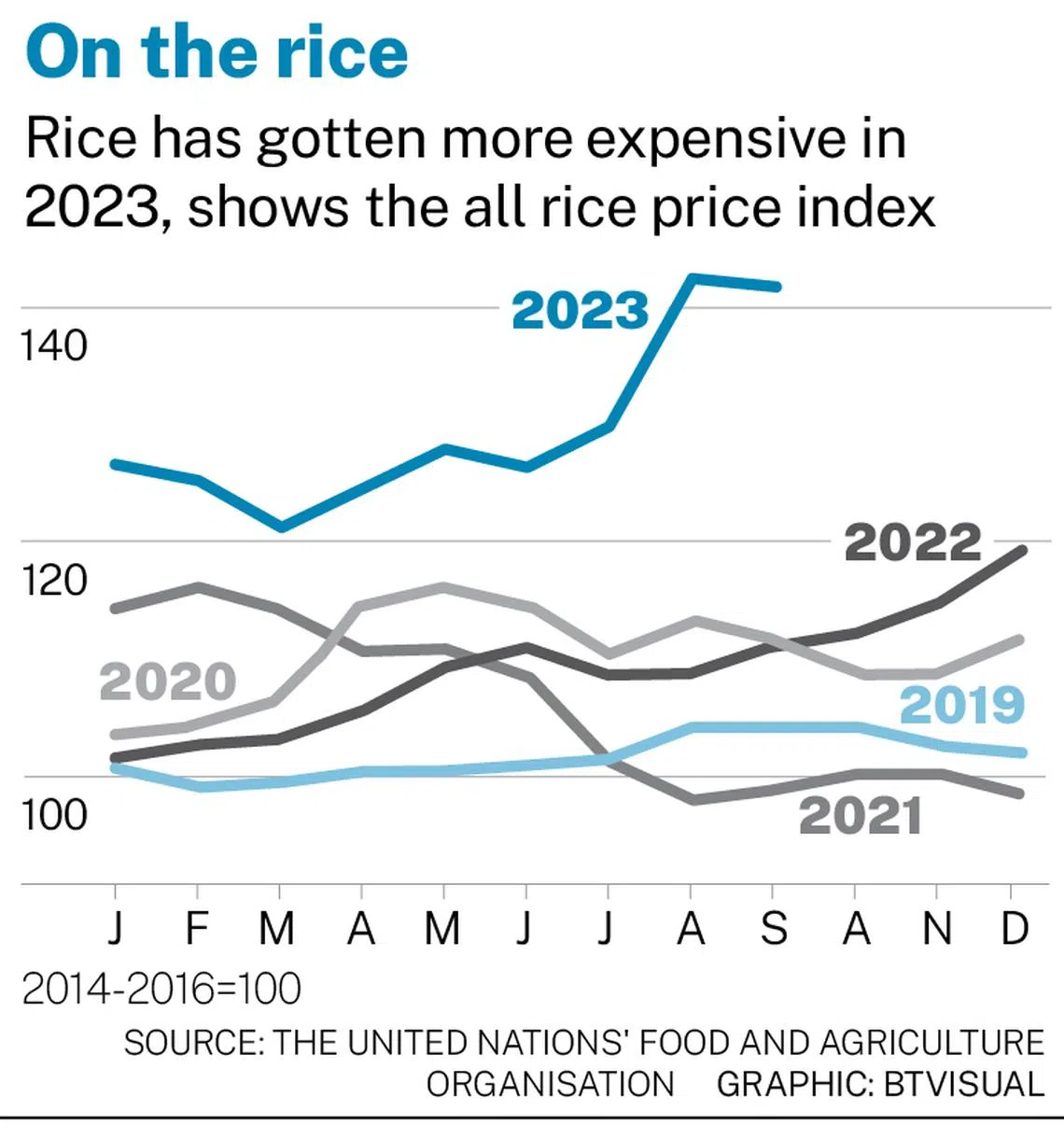
“Prices could surge further if other countries follow suit in implementing export restrictions, with importing countries looking to stockpile rice for domestic food security,” says Agarwal.
Decarbonising rice is a daunting task. But efforts are growing to untangle the problem and secure the future of rice – with a mix of science, farmer engagement and green finance.
Science-based solutions
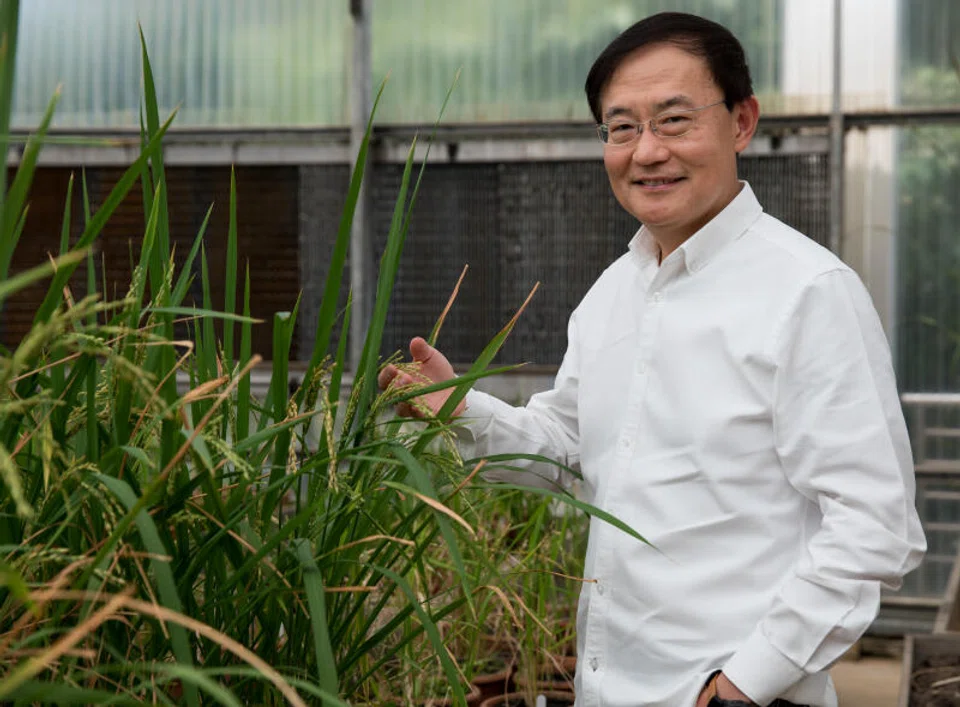
At a small greenhouse in Kent Ridge, rows of rice plants with vibrant green leaves sit in glass boxes. Some of TLL’s researchers demonstrate how they collect samples from the boxes using syringes, to measure the methane levels emitted.
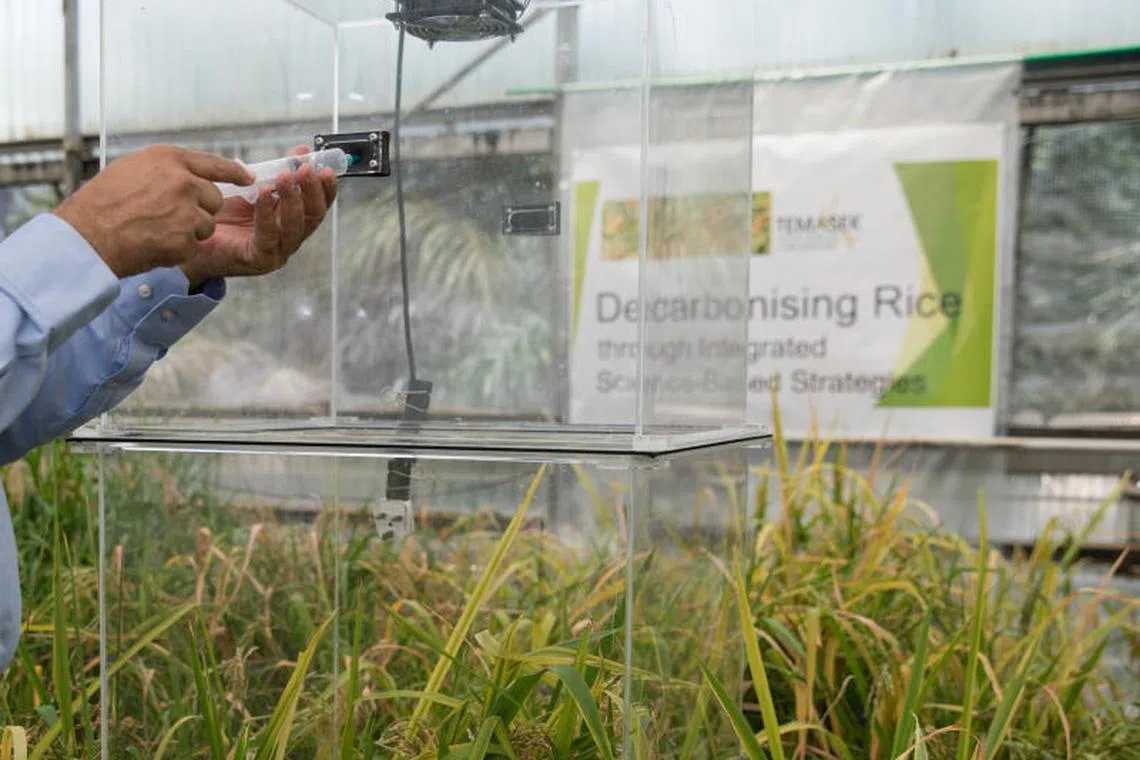
Last year, TLL started a project to decarbonise rice, through science-based strategies. This comprises three aspects: improving water management, enhancing the soil microbiome and developing climate-resilient rice varieties.
The first component involves researching alternative irrigation and cultivation strategies that can cut methane emissions and water usage. Rice does not actually require water-logged soil, but humans have long grown it in such conditions. The reason for this is simple: to prevent weed growth.
“Rice can grow under flooded conditions; the weeds cannot. So when you flood the fields, it’s actually a very effective, simple way of weeding,” explains Chia.
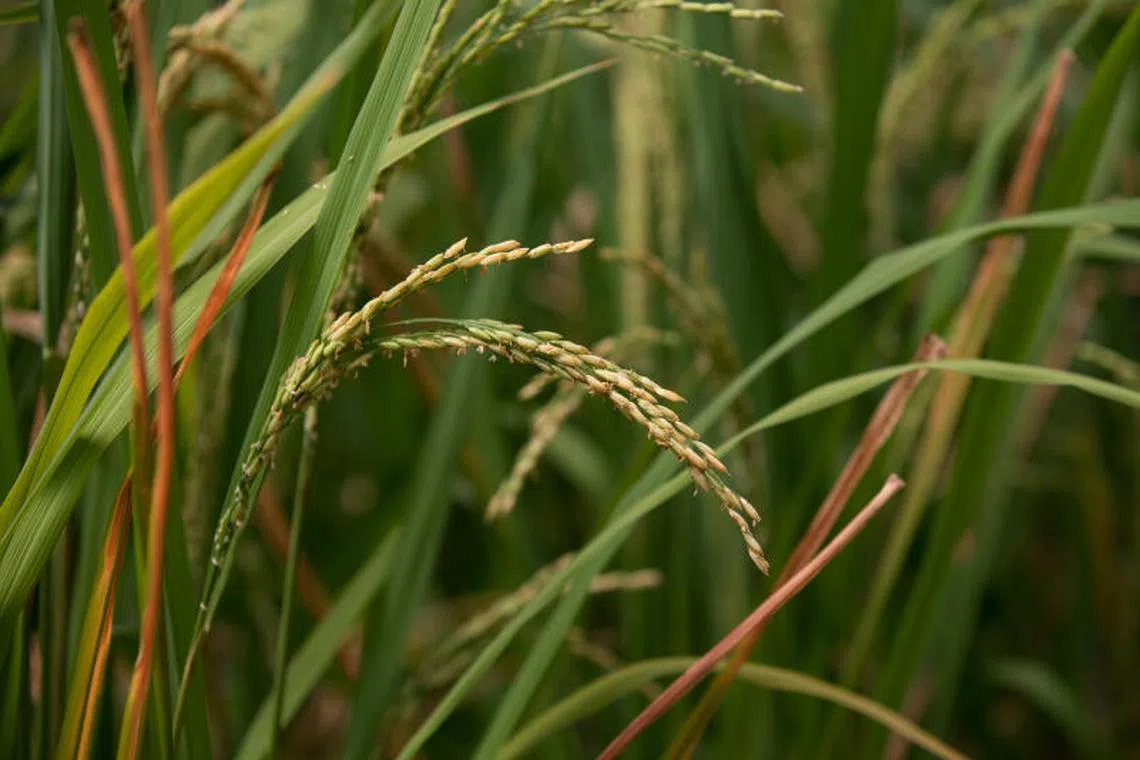
TLL has been studying alternative strategies such as drip irrigation, where pipes deliver precise amounts of water and fertiliser to rice roots, and alternate wetting and drying, which means that rice fields are only intermittently – not constantly – flooded.
Separately, the lab is developing a fertiliser mixture that can improve rice yields, while reducing methane emissions.
Beyond that, TLL has developed rice varieties with desirable traits imbued. In 2016, it commercialised Temasek Rice, an aromatic rice variety high in dietary fibre, with the ability to tolerate both submergence and droughts. The plant is also shorter in height, enabling it to resist strong winds.
Temasek Rice traces back to TLL’s years of research on rice varieties.
“What we did was to look at what nature has provided, a whole library of rice lines. We searched through the library and picked out what we thought were good traits that were lost, because since the 1960s, there has been a big push towards productivity,” says Chia.
In a recent TLL study, conducted in a greenhouse, Temasek Rice was found to emit a lower amount of methane compared with other rice varieties. TLL is now working with farmer groups and rice growers to cultivate Temasek Rice in the Indonesian island of Java, as well as in Laos. The lab will conduct more studies on multiple rice varieties in larger-scale trials, to identify those with lower methane emissions which farmers can adopt.
“What we want to do right now is to scale this across various geographies, so that we can collect the data. We want to make this a science-based approach – collect and publish the data so that people can use that as reference,” Chia says.
He emphasises that TLL is not trying to prescribe any one rice variety or cultivation method, but to provide a good assessment of the various choices that farmers have. Ultimately, sustainable rice cultivation also has to make economic sense for farmers.
Working with farmers
This is where ground efforts to work with farmers become critical. One player in this space is Rize, a Singapore-based startup that works with farmers in Indonesia and Vietnam on sustainable farming practices.
Growing rice in flooded paddy fields is an “age-old” practice and change is always hard, Rize’s chief executive Dhruv Sawhney acknowledges. “It’s literally making this change one field, one farmer at a time,” he says.
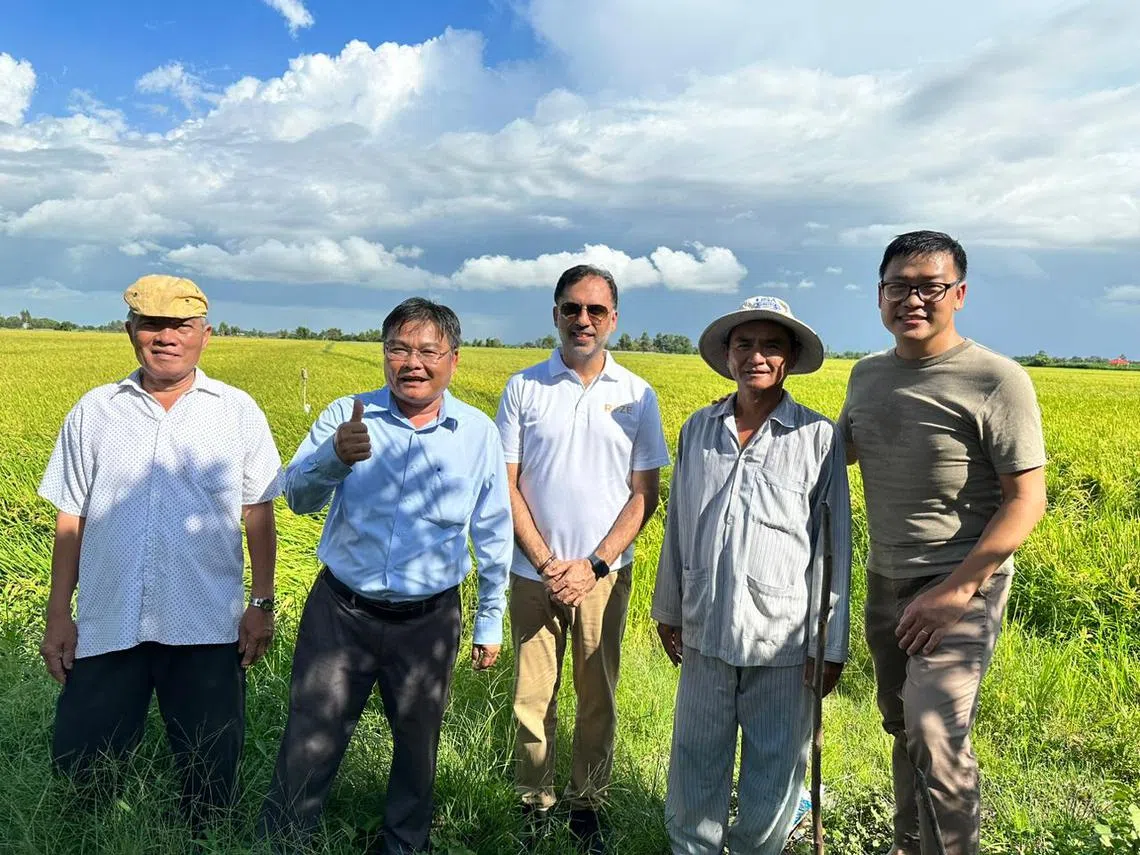
Rize was formed in October last year as a joint venture between Temasek, its subsidiary GenZero and venture investors Wavemaker Impact and Breakthrough Energy Ventures, which is founded by Microsoft billionaire Bill Gates.
The startup provides farmers with advisory services on how to adopt more sustainable methods, such as alternate wetting and drying. Sawhney notes that the practice not only saves water, but can actually improve yields.
“When we introduce water stress, the roots grow stronger during those periods, and as a result, there is better plant growth in the subsequent days,” he says.
To further incentivise farmers to adopt sustainable practices, Rize also provides input financing: supplying seeds, fertilisers and other resources.
“We are trying to, by aggregating all the demand, gain some leverage and offer better pricing to farmers at 0 per cent interest, because there’s an opportunity for us to source from distributors and brands,” he says.
And on a broader scale, the startup is linking up farmers who grow rice sustainably with millers and food processors. Rize is currently working with some industry players, although Sawhney declined to disclose their names.
“We’re able to aggregate a lot of consistently grown rice with the same protocol, in a sustainable way. We can then bring that to the millers and the food processors directly. That’s a very big advantage,” he says.
Green capital
With the need for scientific research and ground-up efforts, decarbonising rice can be an expensive venture. But industry players see plenty of room for the growing pool of sustainability-focused investors to come in.
The SRP, for instance, is currently working on a global rice fund. “We are starting with three countries – in Bangladesh, Cambodia and Vietnam – to establish blended finance facilities in these countries, which we hope will meet financing gaps in the rice sector,” says Ellis.
Carbon credits could also be on the cards. TLL, for instance, is evaluating the possibility of generating carbon credits through methane emission reduction in rice plantations.
While securing funds is important, getting corporates on board will be just as crucial. Some companies in the rice value chain are stepping up efforts.
For instance, agribusiness Olam Agri has partnered with organisations such as the SRP and International Rice Research Institute to train more than 50,000 smallholder rice farmers in climate-smart agriculture.
The company plans to train another 50,000 farmers in the next three years, says Paul Nicholson, vice-president of rice research and sustainability at Olam Agri. Farmers are taught alternate wetting and drying, as well as drip irrigation, among other techniques.
“Another critical area we invest in is data collection in the fields to prioritise the right interventions. In rice farming in India and Thailand, we are capturing methane emissions directly at field level to better understand local emission factors and the impact of water management techniques,” he adds.
Olam Agri has also partnered the Thai Rice Nationally Appropriate Mitigation Action project in Thailand to promote low-emission rice production, and is a founding partner of the Carbon Offsetting Rice Emissions project in India
Wilmar International, which engages in rice milling and the production of consumer pack rice, says it recognises that climate change poses risks to its business.
“For instance, in the event of a drought, not only would rice yields be affected, cost of operations would also increase as measures such as trucking water or piping water from a further source would be necessary,” a spokesperson says.
The company is making efforts to do its part. For instance, Wilmar’s rice-milling Chinese unit, Yihai Kerry Arawana, is tapping rice husk, a waste product, to generate electricity and steam. It also uses rice husk ash to produce silica and activated carbon.
All players along the rice value chain, including policymakers, will need to chip in for the sector to eventually decarbonise. There will be many moving parts, but hopefully enough momentum to push for greener rice.
Charles Hart, a commodities analyst at Fitch Solutions, puts it this way: “There isn’t a golden bullet that can fix all this. It’s a bit like keeping all the plates spinning at the same time.”