

Higher carbon taxes may be needed for Singapore to meet its 2035 climate targets
To achieve an aggressive reduction in its emissions, a carbon tax rate above S$80 would likely be required

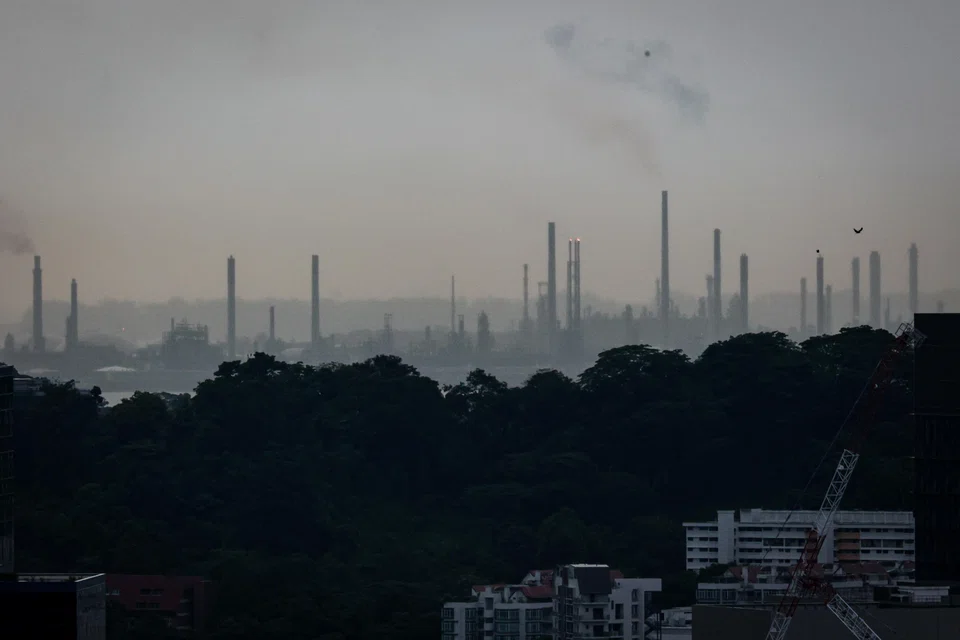
SINGAPORE has laid out the next phase of its journey in cutting down its national greenhouse emissions.
It aims to reduce emissions to between 45 million and 50 million tonnes of carbon dioxide equivalent by 2035, as part of a new set of climate targets submitted to the United Nations on Feb 10.
According to the National Climate Change Secretariat (NCCS), the lower bound of 45 million tonnes keeps Singapore on a linear path to its eventual 2050 target of net-zero carbon emissions.
This would mean cutting down its emissions by 15 million tonnes (or 25 per cent) over five years from its 2030 target of 60 million tonnes – an updated figure from Singapore’s first set of climate targets.
That is ambitious by any measure. The situation is compounded by the fact that Singapore, being a tiny city-state, lacks renewable energy resources.
Compare this with plans to reduce emissions by 4.4 million tonnes (or 6.8 per cent) across two years from 2028 – when emissions are expected to peak at 64.4 million tonnes – to 2030.
These climate targets – known as nationally-determined contributions (NDCs) – form the backbone of the Paris Agreement, an international treaty countries committed to back in 2015 to limit global warming to 1.5 degrees Celsius above pre-industrial levels.
Countries that have signed the treaty are obligated to submit NDCs every five years to demonstrate increasingly ambitious commitments to climate action, which would gradually bring them on a pathway to hit net-zero emissions by 2050.
Besides laying out climate targets, NDCs also include the measures countries are planning to take to mitigate and adapt to the climate crisis that are unique to their own national circumstances and capabilities.
Singapore is one of the very few countries out of over 190 signatories to have submitted their second set of climate targets on time.
This is the first time it has announced its intention to reduce its national emissions -– a commendable move in a wider geopolitical environment where the urgency to address the climate crisis has taken a backseat with the election of climate sceptic Donald Trump as president of the United States.
However, details on how the country will get to its 2035 target remains scant. Which part of the national carbon budget would the 15 million tonnes of emissions reduction come from, and what are the policies that would be implemented?
In its submission to the United Nations, the government itself acknowledged that achieving its 2035 targets would be a challenge, and that “more stringent regulations, pricing and market policies to incentivise and enable all sectors of the economy to decarbonise” will be required.
Could this signal higher carbon taxes on the horizon post-2030?
Singapore’s carbon tax rate is currently set at S$25 per tonne, after it was increased from S$5 per tonne from Jan 1 last year. It will be raised to S$45 per tonne in 2026 and 2027, with plans for the rate to hit between S$50 and S$80 by 2030.
The government announced these progressive hikes in 2022 to get companies to start pricing in the environmental costs of their business operations.
But no carbon pricing indications beyond 2030 have been made thus far.
For Singapore to achieve such an aggressive reduction in its emissions, a carbon tax rate above S$80 would likely be required.
The use of carbon offsets, as well as the continued exploration of various low-carbon technologies – which have been previously mentioned – will be other mechanisms to help achieve these targets.
The topic of carbon tax was not raised during this year’s Budget statement, which was delivered by Finance Minister Lawrence Wong, who is also prime minister, on Tuesday (Feb 18).
That being said, the government is showing commitment to these targets even before more details are released.
In his Budget speech, PM Wong announced the doubling of the Future Energy Fund to S$10 billion. The fund was first set up at last year’s Budget with an initial capital injection of S$5 billion to support infrastructure investments for the energy transition towards a net-zero future.
Given that clean energy solutions are nascent and may involve high upfront costs and significant risks, the government noted in its NDC submission that the Future Energy Fund could help mitigate such risks by providing catalytic funding to improve the commercial viability of such infrastructure investments.
These infrastructure investments may also include nuclear power deployment, given the challenges of scaling up clean hydrogen production in a commercially viable manner, PM Wong acknowledged.
The government also made it very clear that the fund will focus on supporting capital expenditure, and will not be used to subsidise fuel costs and recurrent expenditures.
More details on Singapore’s climate strategy between 2031 and 2035 are expected to come. NCCS said on Feb 10 that Senior Minister and Coordinating Minister for National Security Teo Chee Hean, who also chairs the Inter-Ministerial Committee on Climate Change, will be discussing the country’s climate action approach and its 2035 targets during the Budget debates for the ministries.
TRENDING NOW

Once staunchly pro-China, Malaysian Chinese businesses are now distancing themselves from Beijing

Britain’s mansion tax shows the difficulty of targeting wealth

Three hats, one goal: How Ng Kian Swan runs sustainability at NUHS
COE review: The gap between luxury and mass-market cars isn’t the only one worth bridging

