Higher costs, lower returns: Why are Singaporeans still betting on real estate?
Returns are often lower than equities, but policy and psychology keep property at the centre of wealth


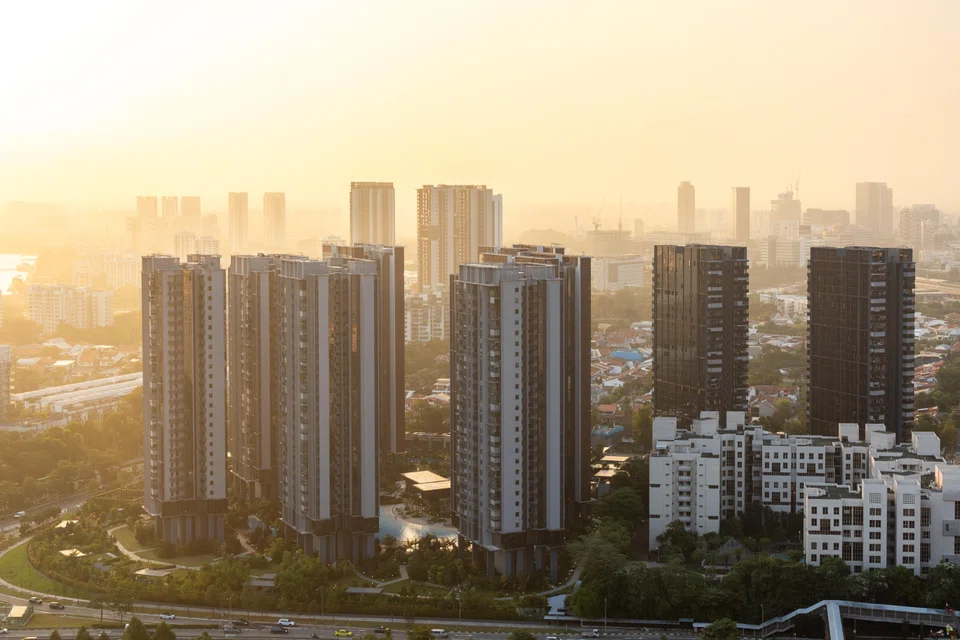


[SINGAPORE] At dinner tables and across generations, one piece of financial advice tends to resurface: buy property if you can.
Setting aside Build-To-Order flats that are sold at a market discount – thus implying resale gains – the assumption is that real estate, more broadly, is a reliable means of wealth accumulation, with prices always rising.
There is even the perception – nurtured by past booms – that massive gains are possible.
Singapore’s property market has indeed proven resilient, not least over the last decade. Even as the Covid-19 pandemic upended most markets, both private and public housing prices held firm, with property indices even recording their fastest annual growth in over a decade in 2021.
Investors, however, should not count on replicating the windfalls of earlier decades.
Observers say that residential property in Singapore is not the runaway winner that many assume, with other assets such as equities often outpacing it over the longer term.
What keeps property at the top of people’s minds is not just performance, but a mix of government policy, cultural norms and behavioural biases that have shaped how Singaporeans think about wealth.
Better performers
In recent times, global equities – not property – have delivered the strongest performances among asset classes, according to local banks.
In the past decade, the S&P 500 and MSCI World had total annualised returns of around 15 per cent and 13.7 per cent, respectively.
The Straits Times Index returned about 11 per cent; S-Reits roughly 6 per cent; and global corporate bonds around 3 per cent. Cash-like instruments such as Singapore Savings Bonds averaged around 2 per cent.
In comparison, Singapore’s private residential market delivered annualised returns of about 4 per cent.
“So interestingly, the idea that ‘property always wins’ doesn’t necessarily hold true,” says OCBC head of wealth advisory Chez Anbu.
Data from local wealth platform Endowus shows a similar trend: globally diversified equity portfolios consistently outperform income-focused and cash alternatives over the long term.
Chief investment officer Hugh Chung notes that in the past decade, global equities have had higher returns than their multi-decade average of around 7 to 8 per cent. Yet, even that average outpaces the returns of real estate and fixed-income investments.
Varied returns
Furthermore, returns may vary within the property sector itself.
Over various rolling 10-year periods, the annualised price growth of non-landed properties averaged between 1.8 and 4.2 per cent, according to data consolidated for The Business Times by property consultancy Cushman & Wakefield.
Price growth was consistently strongest in the suburbs or Outside Central Region (OCR), followed by the city fringe or Rest of Central Region (RCR). Prime Core Central Region properties saw the weakest gains.
Returns have improved in more recent rolling periods, with 2016 to 2025 seeing the highest annualised growth rates.
Over a five-year rolling period, the average returns for non-landed homes ranged between -1.1 and 6.3 per cent.
Tricia Song, CBRE head of research for Southeast Asia, explains that private home prices were previously on a “slow dive”, falling 11.6 per cent from Q3 2013 to Q2 2017.
Within the last decade, the greatest gains happened between 2020 and 2023, she says. “Hence total returns on an annualised basis could beat some other asset classes in the past few years, but only provided you optimised your entry and exit points… Some properties made more, some made less, and some even made losses.”
As for rents, gross rental yield for private homes ranges from 1 to 2.5 per cent for freehold, landed and luxury apartments, and 3 to 5 per cent for leasehold, older, less-connected or freehold boutique properties, says Song.
Yields have also diverged with uneven price appreciation across the CCR, RCR and OCR, says Cushman & Wakefield research head Wong Xian Yang.
In the luxury market, gross yields have long stayed low, with a 10-year average of 2.3 per cent as at Q4 2025.
These assets are treated more as a “safe store of wealth” than income-generating investments, says Savills Singapore research and consultancy executive director Alan Cheong.
Headline yields may also overstate true gains.
Unlike other investments, real estate comes with entry, holding and exit costs, says Cheong. Rental returns may also be eroded by interest and maintenance expenses, as well as property taxes.
Combined, these costs typically cut gross yield by about 1.5 to 2.5 percentage points, estimates Chia Siew Chuin, JLL head of residential research, research and consultancy.
“A property advertising a 4 per cent gross yield will likely only deliver a 1.5 to 2.5 per cent net yield in hand. In many cases where financing is high, the annual cash flow can be neutral or even negative.”
Other investments such as equities also comes with costs, including commissions or brokerage fees, as well as platform, trading and custody charges. But these are typically lower, in percentage terms, than the taxes, duties and ongoing costs of owning property.
Property investors must also account for periods of vacancy, as properties continue to incur property taxes and maintenance charges, says Cheong. Transaction costs such as stamp duties, legal fees and agent commissions can further eat into returns.
UOB group head of deposit and wealth management Gidon Kessel concludes that major asset classes have “consistently outperformed” residential property over the past decade, especially once returns are annualised and adjusted for costs.
For Singaporeans who tap their Central Provident Fund (CPF) Ordinary Account to fund property purchases, there is another hidden cost, notes Endowus’ Chung.
Should they sell their property, homeowners must return both principal and accrued interest to their CPF accounts at 2.5 per cent per annum, compounded over the period. “That comes directly out of your sale proceeds, often in amounts that surprise people,” says Chung.
Enduring love affair
Nonetheless, investing in property still holds a powerful appeal for many in Singapore.
Derek Tan, DBS Group Research head of regional property research, traces the country’s “enduring love affair with property” to the 1980s, when it was fuelled by the government’s narrative of homeownership and supportive policies.
This includes continual efforts in upgrading housing estates and broader urban development that “unlocks” land value, creating the potential for residential properties to “evolve beyond mere shelter to become a valuable asset that can store wealth and appreciate” over time, says Professor Qian Wenlan, director of National University of Singapore’s (NUS) Institute of Real Estate and Urban Studies (Ireus).
Tan says: “With Singapore’s strong economic growth through the years, many Singaporeans saw the value of their homes and property investments appreciate by multiple folds over time, which made property a major contributor to household net wealth.”
As at end-2025, residential property assets accounted for 42 per cent of average household wealth.
From a practical perspective, property does have advantages.
It can provide “effective inflation hedging”, as property price growth often outpaces inflation, notes Professor Sing Tien Foo, provost’s chair professor of real estate at NUS Business School.
Leverage is another draw, as owners can control a “high-value asset” with a relatively small initial cash outlay, says JLL’s Chia. “This… significantly magnifies the potential returns on capital, a feature not readily available for most other asset classes.”
The physical nature of property also offers a “safety net”, she says. “Even if its market value falls, it still provides a roof over one’s head or can be rented out to generate income.”
OCBC’s Anbu agrees that beyond investment returns, property’s appeal lies in its tangibility. “People touch, live and raise a family in it. That physical connection is very different from watching an investment portfolio fluctuate on a screen every day.”
Professor Yohanes Eko Riyanto, chair of Nanyang Technological University’s School of Social Sciences and professor of economics, considers this an example of ambiguity aversion: people gravitate towards risks they feel they can understand.
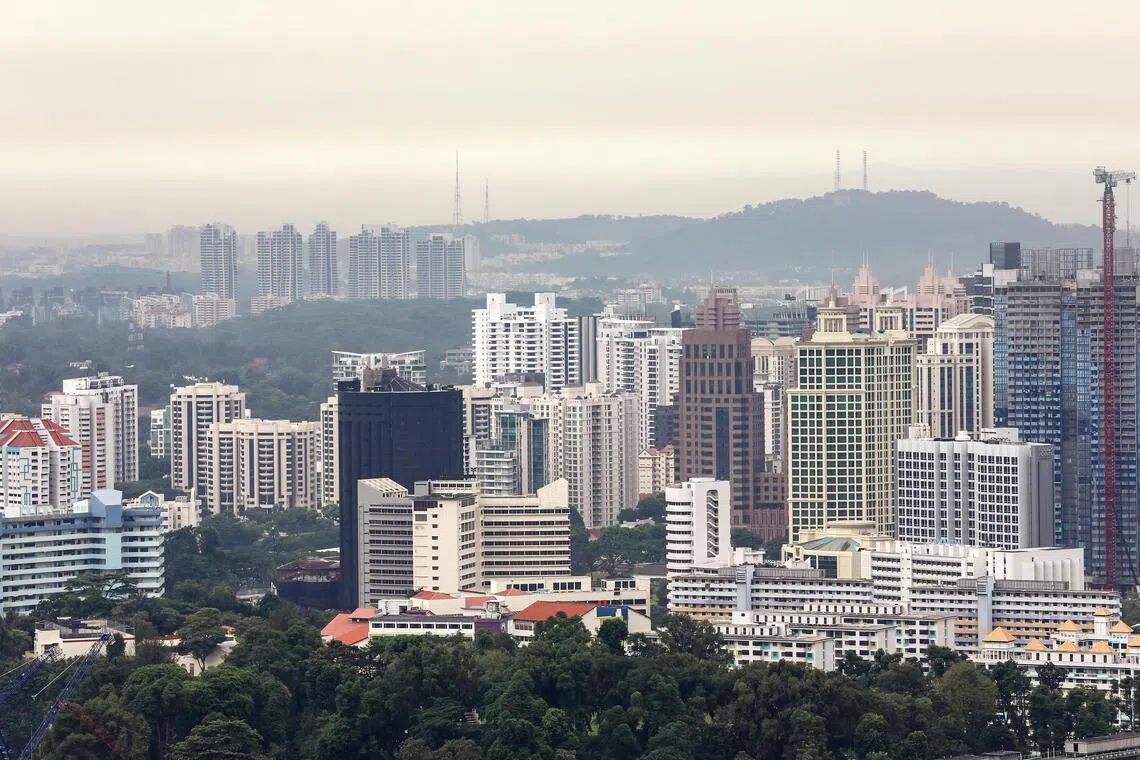
But he notes that survivorship bias may shape the narrative of property as a winner.
“Households that bought early and did well tend to share their experience,” Prof Riyanto says. “In contrast, households that lost money – for example, those who had to sell during the 1997 Asian financial crisis or the 2008 downturn – usually keep quiet.”
“Over time, we hear more about wins than losses, and property starts to be perceived as a safer investment option.”
Once households commit a large share of their wealth to property, it can be psychologically hard to question the decision, he adds.
Owners look for “reassuring signals” such as record transactions, million-dollar flats and en bloc stories, and pay less attention to weaker rental yields, tighter policies or periods of flat prices – a classic case of confirmation bias, reinforced by the sunk-cost effect.
This belief that property is the “safest path” is also socially transmitted, he adds: passed from parents to children, reinforced by agents and media coverage, and validated by what people observe, such as older homeowners who seem wealthy.
Endowus’ Chung notes that because property is not priced in real time, owners are “shielded from the emotional roller coaster of daily market moves typical of stocks and funds”.
There is also a strong social element underpinning demand.
Housing type and location are seen as key markers of social status, says Prof Riyanto. “The move from HDB to condo to landed housing is widely understood as a social ladder. So a property purchase is not only a financial decision (but) also an identity statement and a social signal.”
More than just prices
The most direct consequence of Singapore’s property-as-investment mindset is on prices, says JLL’s Chia. “When a nation treats housing as its primary investment, demand is no longer just for shelter but also wealth accumulating… (creating) a powerful, persistent upward force on prices.”
Such demand has kept the property market “remarkably resilient” amid broader volatility, says Prof Qian.
In Ireus’ latest quarterly survey, sentiment among real estate players here remained positive in Q4 2025, buoyed by robust demand even at premium price points.
In March, for instance, several new launches saw take-up rates of 90 per cent or higher in their launch weekend, even at prices ranging from nearly S$1,900 per square foot (psf) for an executive condominium to over S$3,200 psf for prime projects.
The focus on property’s wealth-accumulation role has implications for inequality and intergenerational mobility, NUS Emeritus Professor of Sociology and Anthropology Chua Beng Huat says.
“The days of accumulating wealth through housing is over for all wage earners, except for very high income earners,” says Prof Chua.
Instead, wealth accumulation is increasingly driven by intergenerational transfers, with younger households often relying on parental support to access property, he adds.
Families with fewer housing assets naturally have less capacity to do this, says Prof Riyanto. “Over time, a property-centric model can widen wealth gaps.”
“Here lies a contradiction: Singaporeans want affordable housing, understood as a shelter, while seeing it as an investment product.”
Dr Tan Ern Ser, NUS Institute of Policy Studies adjunct principal research fellow and academic adviser
The dual role of housing as a home and investment creates a broader policy dilemma, he points out. “Existing owners benefit from rising prices, but they harm first-time buyers. Policies that improve affordability by lowering prices can also reduce paper wealth for current owners.”
Dr Tan Ern Ser, adjunct principal research fellow and academic adviser at NUS Institute of Policy Studies, says: “Here lies a contradiction: Singaporeans want affordable housing, understood as a shelter, while seeing it as an investment product.”
As in any free market, speculation can emerge, notes Prof Qian. Left unchecked, the housing market could shift from one dominated by owner-occupation to one driven more by financial speculation.
JLL’s Chia adds that with much of Singaporeans’ housing wealth tied to 99-year leasehold properties, there are risks for retirement planning. Homeowners’ expectations of perpetual appreciation may not be met, as a property may shed value as its remaining lease shrinks.
For investors, there is also portfolio risk, says Chung. Many homeowners have the bulk of their net worth tied to a single illiquid asset that cannot be partially sold or quickly exited.
Awareness of this concentration risk may be rising. Says OCBC’s Anbu: “More Singaporeans now understand the importance of portfolio diversification and the amount of investment education today challenges the old default of ‘just buying another property’.”
The “aspiring middle class” may still see housing as an investment, says Dr Tan. “But some Singaporeans would come to realise that a decent-sized (rather than larger home)...is not a bad deal, especially if they could be somewhat more investment-savvy and accumulate wealth towards the longer term.”