

Home sick home: Formaldehyde danger pushes furniture industry to clean up act
Regulators and furniture makers are stepping up after a spate of health issues

WHEN Cherie Tan’s pet dog was diagnosed with cancer just a few months after she had moved into a new apartment, she did not suspect that the furniture could be the cause.
The marketing director and her husband also experienced frequent bouts of less severe illnesses, but brushed them off as the result of exhaustion.
After news broke in July about the danger of the volatile organic compound formaldehyde in homes, however, she began to suspect that her home might have caused some of these issues. In her research, she discovered that the compound can lead to both minor illnesses and severe diseases such as cancer.
She therefore turned to a formaldehyde treatment company to test the air quality in her home.
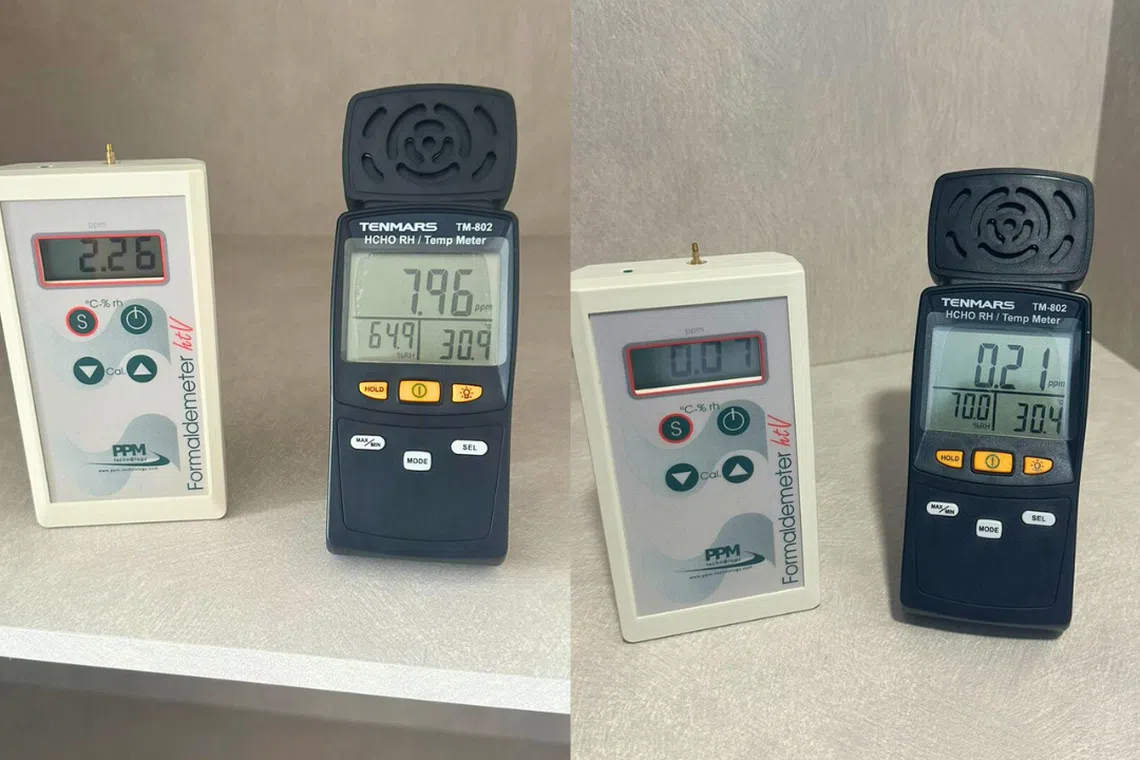
The result? In some areas of her apartment, there were readings of 2.35 parts per million (ppm) of air. Most formaldehyde treatment companies say a reading below 0.1 ppm is considered safe.
At the time of the testing, Tan and her partner had been staying in the home for about nine months. Formaldehyde gas usually dissipates over time if the area is properly ventilated or exposed to the sun.
“The levels were a lot higher near the cabinetry… That’s where my dog liked to sleep the most,” she says. While there is no way to prove that formaldehyde was the root cause of the cancer, she points out that her pet had a clean bill of health prior to the move.
Formaldehyde recently came under scrutiny when media reports noted that homeowners have started seeking help to remove it from their houses, either from the walls or furnishings.
The increased awareness of its dangers has since led to more queries at treatment companies, interior design firms and furniture manufacturers, resulting in a boom in business.
But more significantly, this is galvanising furniture makers to review processes and regulators to take steps for change.
More interest
Formaldehyde, a colourless chemical, is used in building materials such as particleboard, plywood, and other pressed-wood products. It is often found in the adhesive glue used to create such products, and is also used as a preservative in certain paints.
The presence of formaldehyde in the air often results in people feeling a stinging sensation in their eyes and nose, resulting in them tearing up.
Formaldehyde removal service provider Home Guards has noticed a “drastic spike” in inquiries in recent months. Co-founder Eugene Lim notes that the company worked on fewer than 10 cases a month “up until the news”.
“Now, we are servicing about 80 to 100 cases a month. We are likely to see a further increase – especially towards the year-end, when most homeowners are completing their renovations before Chinese New Year,” he says.
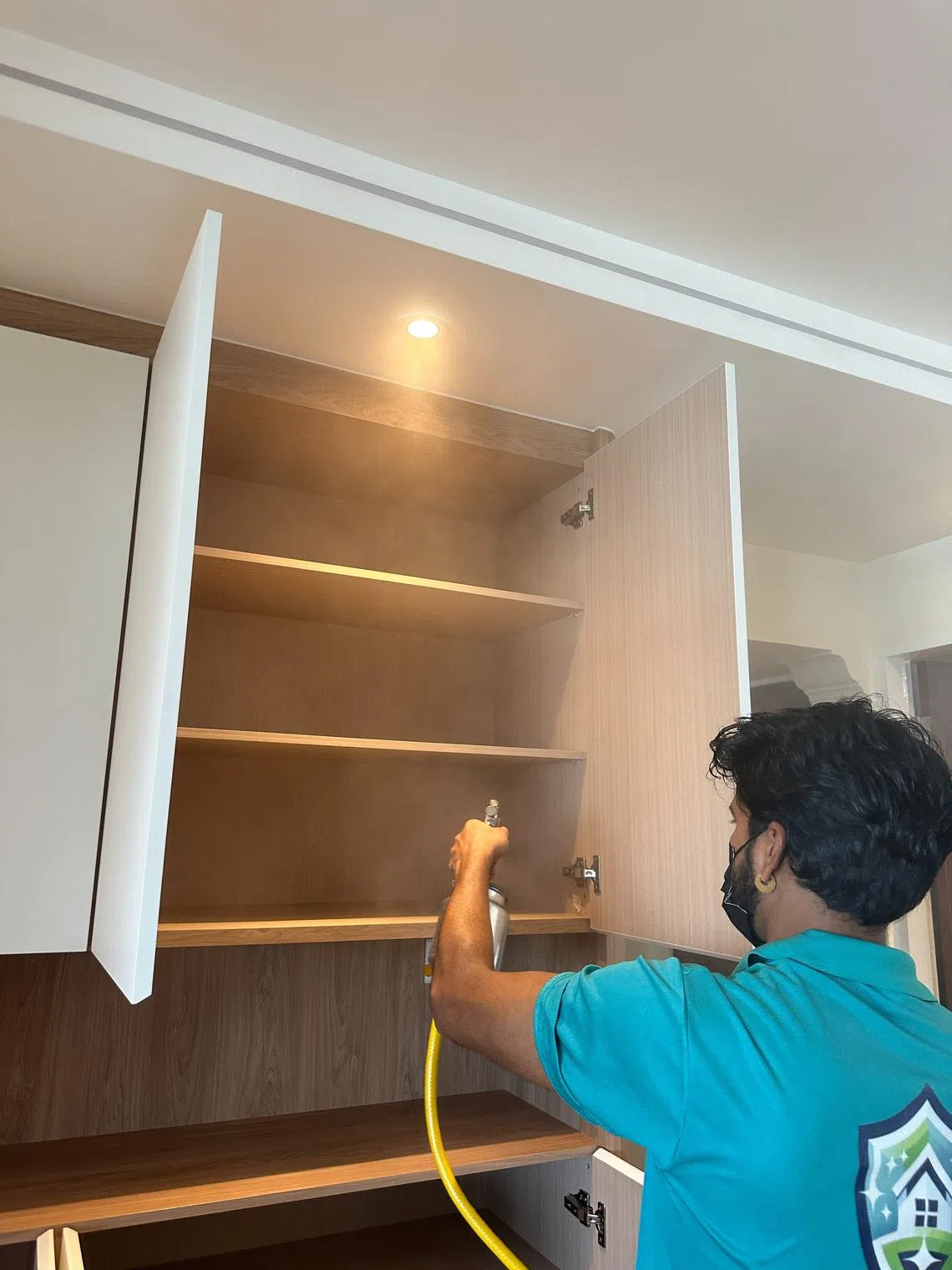
These companies first test for the level of formaldehyde in various parts of the home before informing customers where the treatment should be done. In Home Guards’ case, it applies a coating that constantly breaks down formaldehyde that is being emitted from the furniture.
“The application works in two ways – it breaks down the initial bulk of formaldehyde emitted, then acts as a guard or filter, breaking down whatever else is emitted from the furniture,” Lim says.
He notes that the inquiries come not just from homeowners but interior designers and carpenters as well.
“The problem (for carpenters and interior designers)... is that they are unable to guarantee the whole process of manufacturing has low formaldehyde,” he says.
“For example, even if they supply the plywood to an outsourced company, they don’t know if the company uses certain adhesives (to craft), such as plywood glue, which is very high in volatile organic compounds.”
He notes that Home Guards is in discussions with four to five interior designers about incorporating its services into their packages.
Furnishing company Mokuzai Carpentry has also seen more formaldehyde-related inquiries from customers. Director Alaric Ng says that several customers have started asking for ways to reduce levels of it in their homes and he has therefore started speaking to treatment companies such as Home Guards about their services.
This is because opting for low-formaldehyde materials during the renovation process may be more costly than getting a removal service to come in after the renovation.
For example, carpentry works for a new five-bedroom Build-To-Order flat can cost up to S$40,000 on average using normal materials. If environmentally friendly timber plywood, which uses low- or zero-formaldehyde glue, is used, this cost may go up by 20 per cent, says Ng.
“I would rather advise customers to engage (formaldehyde removal services), which are more affordable, than have them engage me to do their carpentry with eco-glue, which still contains formaldehyde,” he adds.
However, another interior design company, The Interior Lab, has not seen a significant increase in such inquiries, with only two in 10 customers expressing concern about volatile organic compounds.
Senior design consultant Mabel Hong says the company’s designers proactively address the topic before homeowners raise the issue, working with them to explore viable options.
Furniture brands step up
Furniture companies, too, are noting more interest from customers.
Jamie Lim, chief executive of home-grown teak furniture brand Scanteak, says that while her staff has been trained to answer queries on formaldehyde levels in the company’s furniture, the issue did not come up in Singapore until recently.
“Based on my experience, the number of queries in Singapore from furniture seekers rose from zero to 20 to 30 per cent (now)… But last time, if we talked about this here, nobody knew,” she says.
Scanteak, which works only with sustainable teak plantations, ensures its products have low levels of formaldehyde by adhering to the standards issued by other countries. Its furniture is available in Taiwan and was previously sold in Japan, and both markets stipulate that furniture should not exceed a certain level of formaldehyde emissions.
For example, in the European Commission’s latest publication on the topic, it stated that from Aug 6, 2026, consumer products cannot emit formaldehyde of a concentration higher than 0.06 milligram per cubic metre (mg per cu m) for furniture and wood-based articles, and 0.08 mg per cu m for items other than furniture and wood-based articles. This translates to about 0.05 ppm and 0.07 ppm of air, respectively.
These countries had standards that Singapore consumers and manufacturers were not even aware of, says Lim. “This all started when we internationalised around 2015 to 2016, then we panicked because we didn’t know such a thing existed,” she says, referring to the issue of formaldehyde emissions.
She found that getting an E1 classification – which means formaldehyde emissions do not exceed 0.125 mg per cu m – for Scanteak’s furniture would mean a 15 to 20 per cent increase in production costs.
Despite this, the brand elected to standardise its materials and search for compliant suppliers, as Lim and her brother – both second-generation leaders of Scanteak – realised the dangers of having their then-young children near formaldehyde-emitting products.

The brand was “in it for the long haul”, says Lim. “We did our maths, and we did a conscience check in our hearts… and decided to do this.”
Similarly, furniture brand Commune decided from the beginning to ensure its boards of plywood were E1-compliant. Chief executive Joshua Koh says it is more costly, but “safer and better for the environment”.
Active removal
Noting the increased interest in formaldehyde prevention among homeowners, some brands have designed their products to aid the process of breaking down the compound in the environment. Electronics giant Dyson, for example, says its air purifiers can detect and destroy formaldehyde “permanently”.
Lead electronics engineer Lee Dai Jin says: “Dyson’s air purifiers are able to determine the removal rate for formaldehyde, recorded at up to 100 mg per cu m each hour.”
Wall coverings maker Pepperwall, meanwhile, has a series of acoustic panels – sound-absorbing boards – that are designed to remove formaldehyde and other volatile organic compounds from enclosed spaces. They were developed in partnership with hygiene company Speco, using nanotechnology that will degrade these compounds.
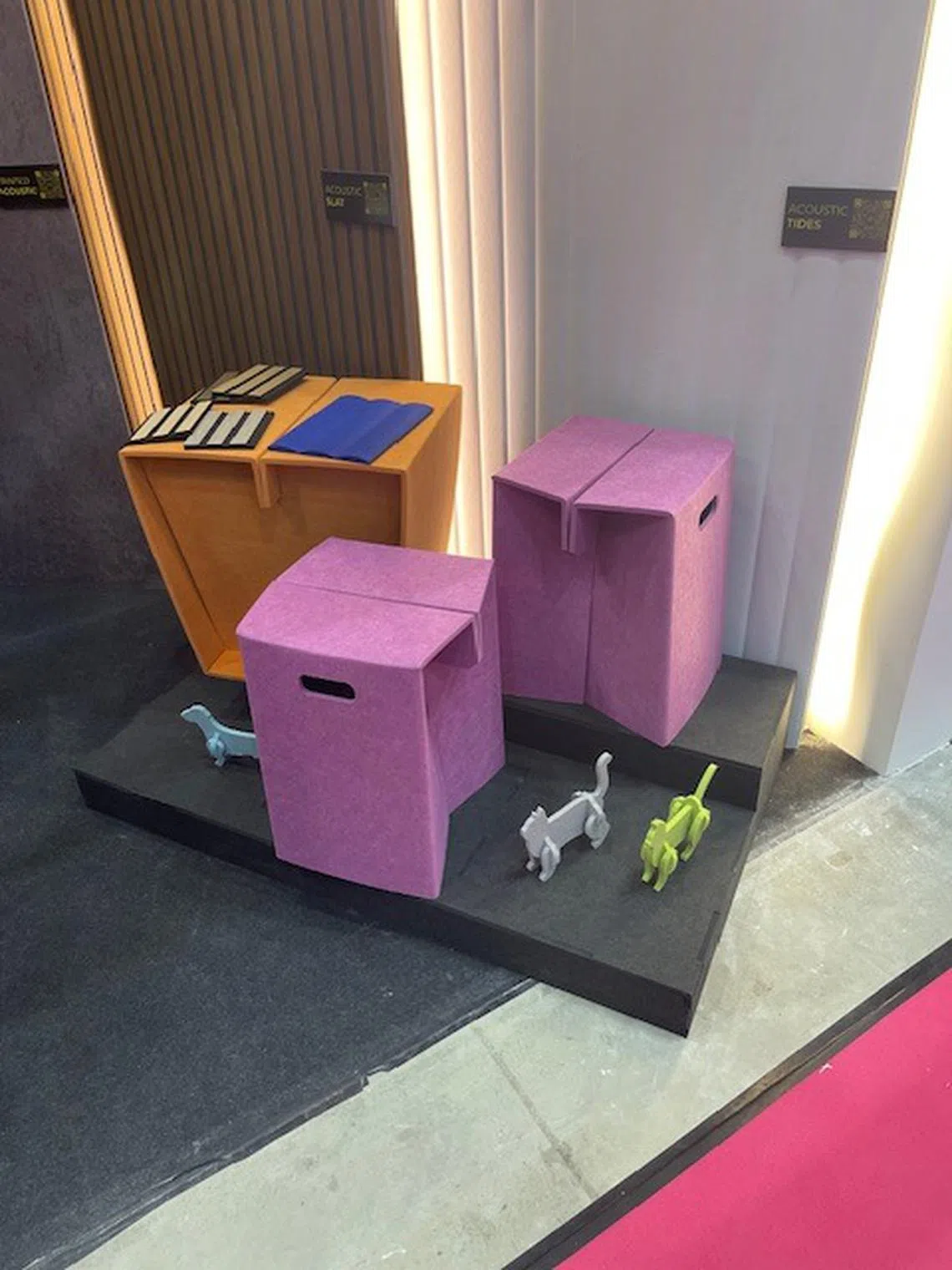
Pepperwall’s manager Nigel Yap says: “In a nutshell, these acoustic panels can become something like a wide-scale air purifier.” They can also be used to make small furniture, such as chairs, which can be packed flat when not in use.
That said, the National Environment Agency (NEA) in September said there is “limited data” on whether air purifiers are effective in removing formaldehyde from the air.
Professor Tai Lee Siang, deputy president and chief innovation and enterprise officer at the Singapore University of Technology and Design (SUTD), notes that as furniture companies look into low-formaldehyde materials, “cost increase may be anticipated as costlier alternatives may impact price of furniture”.
“However, the impact on health and well-being is critical enough to warrant a more rapid and effective measure to reduce formaldehyde usage.”
Nascent regulation in Singapore
Despite the increased interest from consumers, Singapore does not yet have official standards for formaldehyde levels in a home. But it is making some steps towards removing it from homes.
In March this year, NEA said that from Jan 1, 2026, paints used for the interior surfaces of buildings must not contain formaldehyde, as part of efforts to safeguard public health.
A set of industry guidelines and recommendations to improve indoor air quality was also published in 2023 by the Alliance for Action on Sustainable Spaces, jointly formed by the Singapore Business Federation, Singapore Furniture Industries Council (SFIC), and Singapore Green Building Council. The guidelines contain recommended formaldehyde emission limits for products and indoor furnishings.
Baey Yam Keng, senior parliamentary secretary for the Ministry of Sustainability and the Environment, said in August that NEA is actively studying the issue of composite wood products and adhesives that may emit formaldehyde. This will include a review of international best practices, guidelines and regulatory requirements.
SFIC, a representative body of more than 360 furniture and related companies in Singapore, told The Business Times that the industry has been looking into solutions to lower the amount of volatile organic compounds in its offerings. It has a list of member companies that have pledged to supply or adopt low- or no-formaldehyde products.
“The industry has the duty to look into the products and solutions available in the marketplace to see whether the products are fit for purpose, and do not have all these compounds,” says SFIC president Phua Boon Huat.
“What we are trying to do is set the industry standard to constitute what type of furniture is sustainable.”

At the same time, the council is aware that the regular consumer may not understand what these industry standards mean and why companies should be measured by them, he says.
To help consumers better understand how they are used in Singapore, SFIC is intending to launch a sustainability furniture mark at its Sustainability Summit, to be held at the end of October.
This mark will indicate to consumers which companies have met certain standards – in the first year, the mark will be given to member companies whose products have met the European E1 low-formaldehyde standard, which SFIC is adopting for this initiative.
Ahead of its official launch, 12 companies which are also members of SFIC have been recognised, including Commune and Pepperwall, Phua says.
Moving the needle
Educating consumers about these industry standards cannot be a one-time effort of bestowing a mark. Phua notes that SFIC will regularly communicate the importance of these standards, and aims for them to eventually be adopted industrywide.
SUTD’s Prof Tai, who is also the university’s head of the architecture and sustainable design pillar, says there needs to be a balance between a regulatory framework and advocacy to ensure furniture in Singapore contains zero or low levels of formaldehyde.
“Regulatory intervention is sometimes perceived as heavy-handed… Concurrently, industry bodies such as SFIC can begin to champion the (cause) for more aggressive adoption by furniture makers and advocate stronger demand from consumers,” he says.
Those in the industry hope that there will be further regulation coming soon to address health and safety issues in the furniture sector. The Interior Lab’s Hong says: “We hope Singapore can elevate standards across the entire sector, addressing not just formaldehyde issues but overall quality control as well.”
Homeowner Tan notes that since a treatment company attended to her cabinetry, the stinging sensation and smell she encountered when she removed clothes from her cupboards are now gone. Several of her friends are also considering formaldehyde testing after she posted about her experience on social media.
“The treatment was only done one or two months back, but I haven’t fallen sick since,” she says.






